




01. Edit your form online
Type text, add images, blackout confidential details, add comments, highlights and more.

Type text, add images, blackout confidential details, add comments, highlights and more.

Draw your signature, type it, upload its image, or use your mobile device as a signature pad.

Send it via email, link, or fax. You can also download it, export it or print it out.
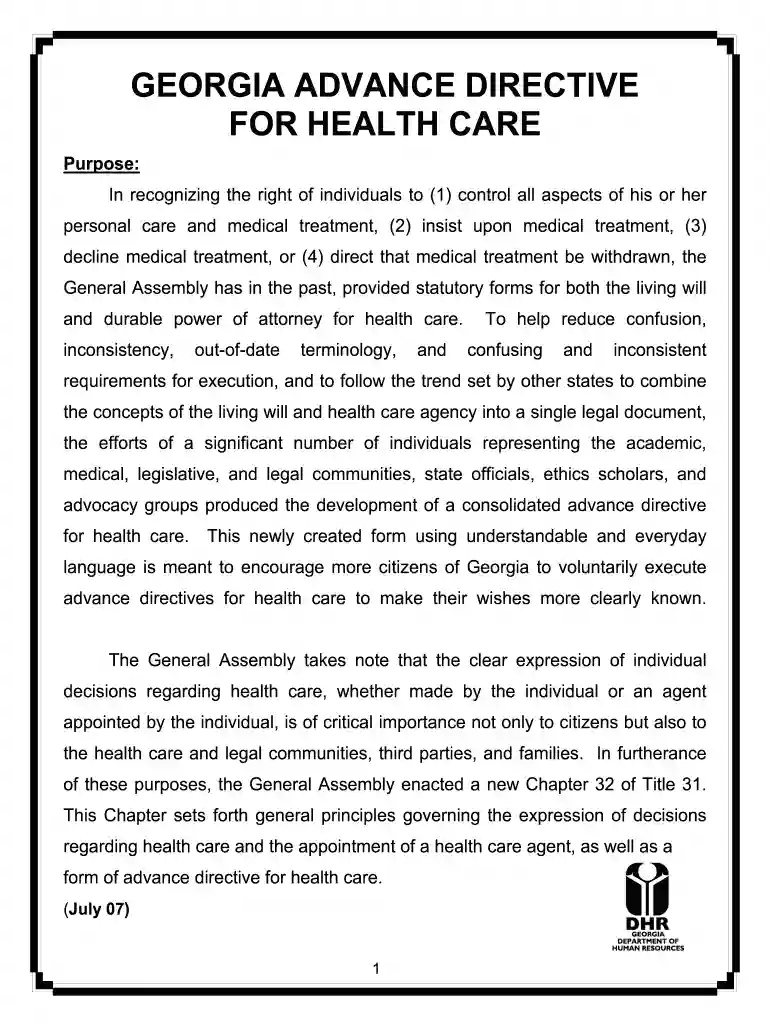
The Georgia Advance Directive for Healthcare is a legal document that empowers individuals to outline their medical treatment preferences and appoint a healthcare agent to make decisions on their behalf if they are unable to communicate their wishes. This directive consolidates previous living wills and durable powers of attorney into one streamlined form, providing a comprehensive tool for conveying healthcare decisions in situations such as terminal illness or permanent unconsciousness.
Obtaining the Georgia Advance Directive for Healthcare form is straightforward. It can be downloaded from healthcare provider websites, legal service platforms, or state government pages. The form is also available in PDF format, allowing for easy printing and completion by individuals. Importing the form into document management platforms, such as DocHub, allows for digital completion and secure storage.
The form comprises several key components:
The document emphasizes the importance of clearly communicating treatment preferences to ensure they align with the individual’s values and beliefs.
Digital platforms can facilitate the completion process by providing editable fields and electronic signature capabilities.
The directive carries legal weight and must be respected by healthcare providers in Georgia. It is governed by state law and must be executed in compliance with specified witnessing requirements. By appointing a healthcare agent and specifying treatment preferences, individuals ensure their medical decisions are adhered to, reducing the potential for disputes between family members and providers.
Scenario 1: An older adult is diagnosed with early-stage Alzheimer's. They use the directive to appoint a trusted family member as a healthcare agent and specify no use of artificial respiration in the event of terminal illness.
Scenario 2: A young adult with no immediate health issues prepares a directive to ensure their vegan lifestyle influences their treatment options, such as specifying vegan nutritional support.
These examples illustrate the directive’s versatility in reflecting a wide range of personal values and medical preferences.
Understanding these terms is crucial for accurately completing and interpreting the directive.
Georgia law dictates specific rules for executing an advance directive, such as the requirement for two adult witnesses who are not related by blood or marriage and who do not stand to benefit from the individual’s death. These requirements ensure the document’s integrity and reduce the potential for undue influence.
Having this directive ensures that individuals retain some control over their medical and personal care decisions when they might otherwise be unable to express their preferences.
We've got more versions of the georgia advance directive for healthcare pdf 2007 form form. Select the right georgia advance directive for healthcare pdf 2007 form version from the list and start editing it straight away!
At DocHub, your data security is our priority. We follow HIPAA, SOC2, GDPR, and other standards, so you can work on your documents with confidence.
Nov 19, 2024 ensuring that the patients advance directive is documented and implemented; securing a private room for the patient when possible; Med Care
The Georgia Advance Directive For Health Care is a legal document that you complete. It tells your doctor and your healthcare providers your writtenRead more
This newly created form using understandable and everyday language is meant to encourage more citizens of Georgia to voluntarily execute advance directives forRead more


