




01. Edit your st 124 online
Type text, add images, blackout confidential details, add comments, highlights and more.

Type text, add images, blackout confidential details, add comments, highlights and more.

Draw your signature, type it, upload its image, or use your mobile device as a signature pad.

Send st 124 form via email, link, or fax. You can also download it, export it or print it out.
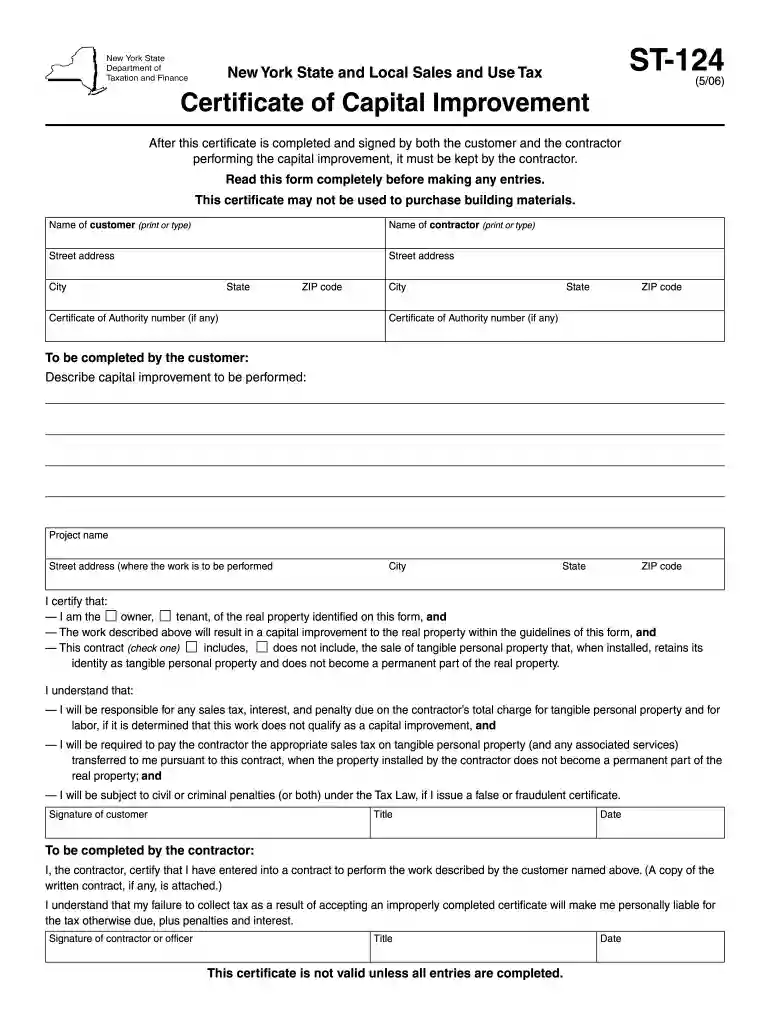
The NYS Form ST-124, known as the Certificate of Capital Improvement, is crucial in certifying construction work as capital improvements exempt from New York State sales tax. It defines the roles and obligations of the customer and contractor. The form clearly distinguishes capital improvements, which qualify for tax exemption, from general repairs or maintenance, which do not. It is vital for contractors to understand that the form cannot be used to purchase building materials tax-free. This distinction is essential to ensure compliance and avoid potential legal issues.
Acquiring the NYS Form ST-124 is a straightforward process. Individuals can download it directly from the New York State Department of Taxation and Finance's official website. Alternatively, physical copies are available at local tax offices across the state. To ensure you have the latest version of the form, always check the document's revision date on the website. For those preferring digital access, using document management platforms like DocHub can simplify the process by allowing easy import, editing, and sharing.
Completing the NYS Form ST-124 requires careful attention to detail. Follow these steps for accurate submission:
The NYS Form ST-124 includes several critical elements:
Each component must be filled accurately to meet legal standards and ensure the tax exemption applies.
Legally, the NYS Form ST-124 serves as proof that a particular construction project qualifies as a capital improvement, exempting it from sales tax. Both contractors and property owners must maintain a copy for their records, as the form may be requested by tax authorities. Improper use of the form, such as using it to evade sales tax for non-qualifying work, can result in penalties. Thus, both parties must ensure that all statements made on the form align with state guidelines.
New York State imposes specific rules concerning the use of Form ST-124. The state’s Department of Taxation and Finance outlines particular qualifications for classifying work as a capital improvement. For instance, the work must substantially add to the value or prolong the useful life of the property. Additionally, the improvement should become a permanent part of the real property. Contractors and property owners must adhere to these rules to ensure compliance and valid exemption from sales tax.
The form is typically used in a variety of scenarios:
Each scenario demonstrates the form's flexibility in covering diverse types of property improvements.
Failing to properly complete or misuse the NYS Form ST-124 can lead to penalties, including liability for unpaid sales tax. Contractors may face fines or legal actions if the form is used to falsely claim tax exemptions. To avoid these harsh consequences, it is crucial that both contractors and property owners thoroughly understand and comply with the guidelines for completing and maintaining the form. Regular audits by the Department of Taxation and Finance further underscore the importance of adherence to all legal requirements.
We've got more versions of the st 124 form. Select the right st 124 version from the list and start editing it straight away!
At DocHub, your data security is our priority. We follow HIPAA, SOC2, GDPR, and other standards, so you can work on your documents with confidence.
Jul 1, 2026 ST-124 (Fill-in), Instructions on form, Certificate of Capital Improvement. ST-125, Instructions on form, Farmers and Commercial Horse BoardingRead more
by LA JEGEN III Cited by 2 The administrative hearing was conducted on March 24, 2006 determination on June 12, 2006.


