
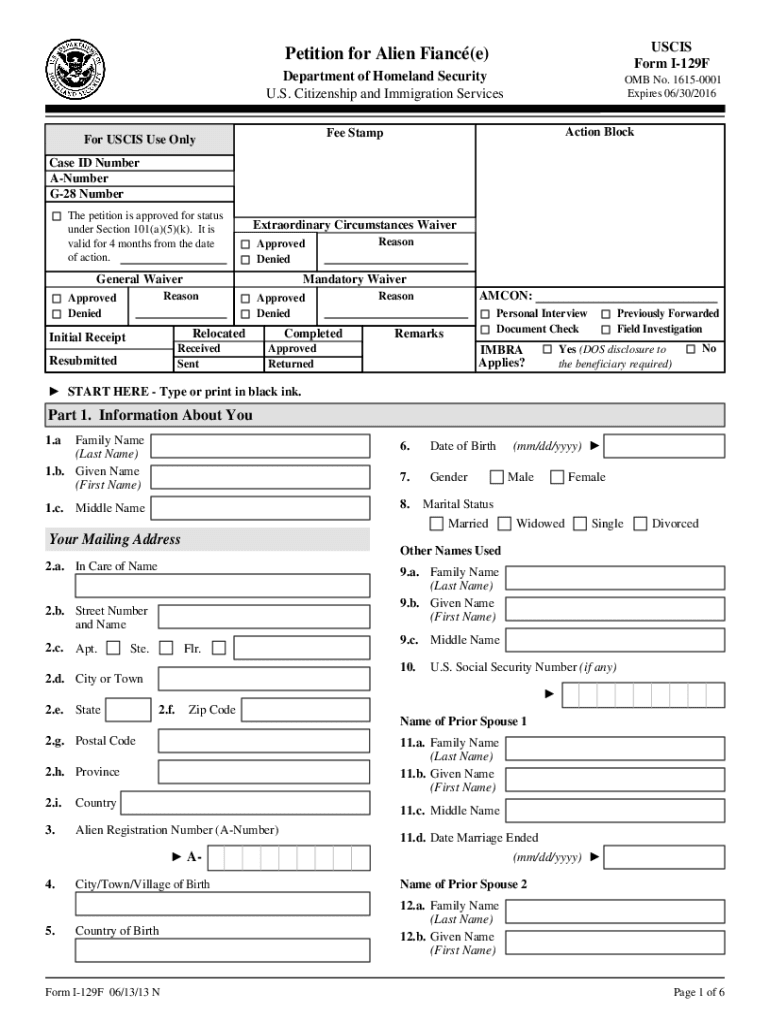







Definition and Meaning
Form I-129F, also known as the "Petition for Alien Fiancé(e)," is a document used by U.S. citizens to bring their foreign fiancé(e)s to the United States so they can get married. This form is submitted to the U.S. Citizenship and Immigration Services (USCIS). It collects essential information about the U.S. citizen petitioner and the foreign fiancé(e), including personal data such as names, contact information, and details of their relationship. The form establishes the intent of both parties to marry within 90 days of the fiancé(e)’s arrival in the U.S., and provides legal grounds for this immigration process. The I-129F is an essential step for couples aiming to build a life together in the United States, serving as the foundation for obtaining a K-1 visa.
How to Use the I-129F Form
To use Form I-129F effectively, the petitioner should ensure all necessary sections are completed with accurate information. Key sections include the background of the petitioner, details about the foreign fiancé(e), and the relationship history. The form also requires the inclusion of supporting documents that prove the legitimacy of the relationship, such as photographs, correspondences, and travel itineraries. After completing the form, the petitioner should review it thoroughly to ensure that no sections are left incomplete, as USCIS will reject incomplete or incorrect applications.
Preparation Tips
- Gather all supporting documents early, including proof of citizenship, evidence of a genuine relationship, and passport-style photos.
- Confirm that all details match official documents, such as birth certificates and passports.
- Carefully read the USCIS instructions that accompany the I-129F form to avoid errors during completion.
Steps to Complete the I-129F Form
- Gather Required Information: Collect all necessary personal and relationship details.
- Complete Personal Information: Fill out the petitioner's and fiancé(e)'s biographical information.
- Provide Relationship Details: Explain how the couple met, and attach evidence supporting the relationship.
- Submit Supporting Documents: Attach additional required documents such as proof of U.S. citizenship and passport photos.
- Review the Form: Double-check accuracy before submission to avoid rejections.
- Sign the Form: Ensure that both the petitioner and any preparer sign the document where required.
- Submit the Application: Send the form to the appropriate USCIS address, paying attention to submission guidelines for mail or online filing.
Common Mistakes to Avoid
- Failing to provide comprehensive details about the relationship.
- Submitting photocopies without notarization when originals are needed.
- Overlooking the requirement for photographs or signatures.
Important Terms Related to the I-129F
- Fiancé(e) Visa (K-1 Visa): The visa granted to the foreign fiancé(e) after the approval of the I-129F, allowing them to enter the U.S. and marry the U.S. citizen petitioner.
- USCIS: U.S. Citizenship and Immigration Services, the agency responsible for processing the I-129F.
- Intent to Marry: A certification within the form stating that the couple intends to marry within 90 days of entry into the U.S.
Eligibility Criteria for the I-129F Form
To qualify for filing the I-129F, the U.S. citizen petitioner must meet specific eligibility criteria, including proof of citizenship and a bona fide intention to marry the foreign fiancé(e) within 90 days of their arrival. Furthermore, both parties should be legally free to marry, having terminated any previous marriages. It is also required that the couple has met in person at least once within two years prior to filing, unless such a meeting would result in extreme hardship or violate cultural norms of the fiancé(e)'s country.

Exceptions to the In-Person Meeting Requirement
- Cultural or social customs that prohibit pre-marriage meetings.
- Documented cases of extreme hardship preventing travel.
Required Documents for the I-129F Submission
Submitting Form I-129F requires several supporting documents to verify and authenticate the petition. These include:
- Proof of U.S. citizenship: Birth certificate, passport, or naturalization certificate.
- Passport-style photos of both the petitioner and the foreign fiancé(e).
- Evidence of the relationship’s legitimacy: Photos, correspondence, and travel records.
- Proof of termination of any prior marriages, such as divorce decrees or death certificates.
Application Process and Approval Time
After submission, USCIS reviews the I-129F form for completeness and accuracy. The typical processing time can vary but generally ranges from five to nine months. During this period, USCIS may issue a Request for Evidence (RFE) if additional information is needed. Post-approval, the petition moves to the U.S. Department of State for visa processing, where the foreign fiancé(e) will attend an interview at their local U.S. consulate.
Factors Influencing Processing Times
- Completeness and accuracy of the initial form.
- The caseload of the particular USCIS center handling the petition.
- Delays in gathering additional information following an RFE.
Legal Use of the I-129F Form
The I-129F form provides a legal pathway for U.S. citizens to sponsor their foreign fiancé(e) for immigration. It is strictly intended for couples who genuinely intend to marry within 90 days of the fiancé(e)'s entry into the U.S. Submissions should reflect accurate and honest information to avoid legal repercussions, including denial of the petition or future applications, or even deportation. False information can lead to severe penalties under U.S. immigration laws, demonstrating the form’s serious legal implications.




