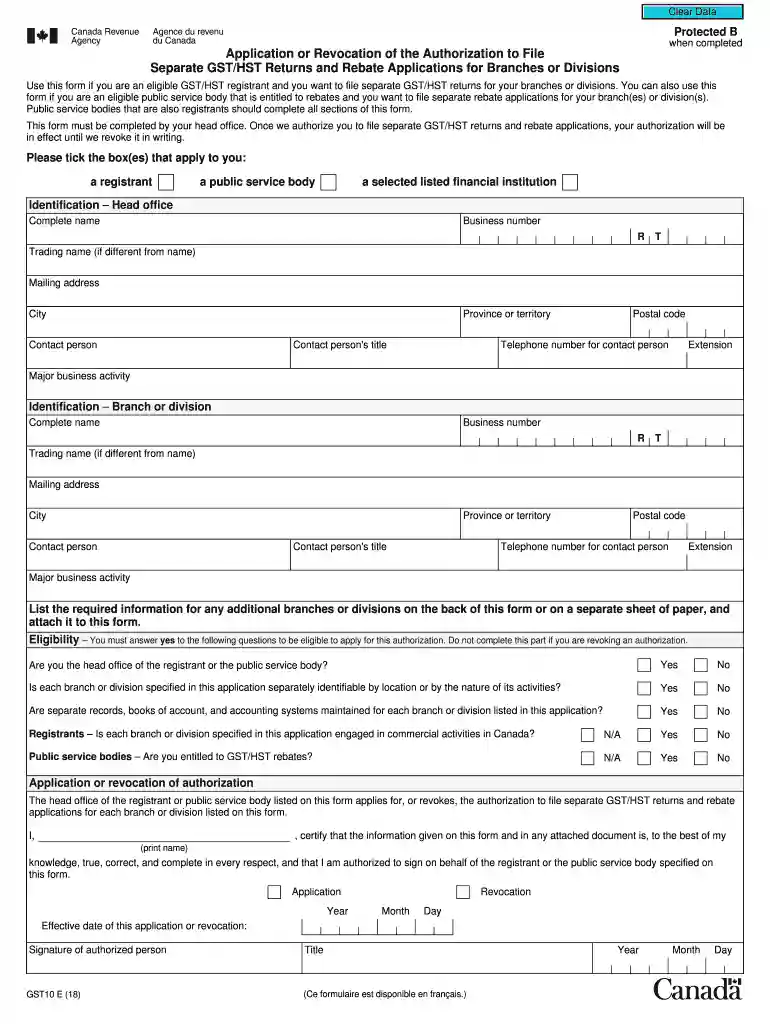
Application or Revocation of the Authorization to File Separate 2026

Get Form
gst10 Preview on Page 1

Here's how it works

01. Edit your gst10 online
Type text, add images, blackout confidential details, add comments, highlights and more.

02. Sign it in a few clicks
Draw your signature, type it, upload its image, or use your mobile device as a signature pad.

03. Share your form with others
Send gst10 form via email, link, or fax. You can also download it, export it or print it out.

Definition and Purpose of the Application or Revocation of the Authorization to File Separate

The "Application or Revocation of the Authorization to File Separate" is a formal document primarily used by organizations, such as businesses and public service bodies, to either apply for or cancel the authorization to file separate returns or rebate applications for distinct branches or divisions. This form is essential for entities that want to streamline their filing processes by segmenting their operations for tax purposes. Typically, the head office must complete this form, providing crucial identification data and details about each branch or division. The authorization continues until formally revoked in writing, ensuring there are no interruptions in the filing process.

How to Use the Application or Revocation of the Authorization to File Separate

Filing this form involves a few critical steps to ensure appropriate processing. First, the head office must gather identification and detailed information about each branch or division that will file separately. Entities should complete all required sections accurately to avoid processing delays. Once filled, the form must be submitted to the relevant agency or tax authority as per their guidelines. Organizations may opt to use this form to manage their tax filings more efficiently, reducing the risk of errors or non-compliance associated with unified filing across diverse operations.

Steps to Complete the Application or Revocation of the Authorization to File Separate

  1. Gather Necessary Information:

    • Collect details about the main office and each branch or division.
    • Verify eligibility criteria for separate filings.
  2. Fill Out the Form:

    • Accurately input identification information.
    • Include specific details about each branch or division.
  3. Review Entries:

    • Ensure all sections are complete and accurate.
    • Correct any inconsistencies or errors.
  4. Submit the Form:

    • Determine the preferred submission method (online, mail, in-person).
    • Follow specific submission guidelines from the relevant authority.
  5. Confirm Submission:

    • Obtain confirmation receipt or tracking for submitted forms.
    • Monitor for acknowledgement from the agency or tax authority.

Eligibility Criteria for Filing Separate Returns

Eligibility to file separately using this application is typically determined by the nature of the business and organizational structure. Businesses must meet specific criteria, which may include:

  • Being a registered entity with distinct branches or divisions.
  • Operating multiple locations that function independently.
  • Meeting regional tax codes or guidelines for separation of operations.

These criteria ensure that only suitably structured organizations can apply for or maintain separate filing statuses. It is advisable to consult with a tax professional to navigate these requirements accurately.


decoration image ratings of Dochub

Key Elements of the Application or Revocation of the Authorization to File Separate

This document contains several critical components that require accurate completion:

  • Identification Information: Company name, address, and other unique identifiers.
  • Branch/Division Details: Information specific to each entity that will file separately.
  • Revoke Clause: Section allowing entities to retract previously given authorization.

Each of these elements must be filled out precisely to avoid non-compliance issues. Detailed reviews of these sections ensure the document effectively captures the organizational layout and tax obligations.

Legal Use and Compliance Requirements

The authorized use of this form aligns with domestic tax laws, specifically enabling entities to manage tax obligations effectively through separate filings. Compliance involves:

  • Ensuring proper authorization and accurate representation of entity details.
  • Adhering to submission deadlines and regional tax guidelines.
  • Revoking authorizations formally when necessary to remain compliant.

Businesses must be aware of the legal ramifications of misusing this form, including potential fines or legal actions for fraudulent claims.

Penalties for Non-Compliance

Failing to properly file or complete the Application or Revocation of the Authorization to File Separate can lead to severe penalties:

  • Financial Penalties: Potential fines and interest on unpaid taxes due to incorrect filings.
  • Legal Repercussions: Legal action may be taken against the entity or responsible individuals.
  • Administrative Consequences: Revocation of authorization, leading to mandatory unified filings.

Ensuring correct and timely completion of these forms is paramount to maintaining a streamlined, compliant tax process.

Who Typically Uses the Application or Revocation of the Authorization to File Separate

Various business entities utilize this form across different sectors. These include:

  • Corporations: With multiple subsidiaries needing individual returns.
  • Non-Profits: Managing assets and activities distinctly across various initiatives.
  • Public Service Bodies: Facilitating transparent financial operations across diverse public sectors.

Understanding the advantages and regulatory requirements specific to each organizational type can guide the effective use of this document for tax management purposes.

decoration image

See more Application or Revocation of the Authorization to File Separate versions

We've got more versions of the Application or Revocation of the Authorization to File Separate form. Select the right Application or Revocation of the Authorization to File Separate version from the list and start editing it straight away!
Versions Form popularity Fillable & printable
2022 4.6 Satisfied (33 Votes)
2012 4.5 Satisfied (66 Votes)
be ready to get more

Complete this form in 5 minutes or less

Get form

Got questions?

We have answers to the most popular questions from our customers. If you can't find an answer to your question, please contact us.
Contact us
All persons carrying on a business in Canada are required to register for and collect/remit GST/HST unless they are deemed to be small suppliers.
The GST62 form, officially known as the Goods and Services Tax (GST)/Harmonized Sales Tax (HST) Return (Non-Personalized), is an important document for Canadian businesses and self-employed individuals required to file their GST/HST returns.
Objective of GST For instance, the primary objectives of the GST service tax include: Elimination of the cascading tax effect: Under the GST bill, taxes are levied only on the net value-added portion, which eliminates the tax-on-tax regime and, in turn, lowers the cost of goods.
GST - Goods and Services Tax.
Composition Scheme Forms Form NumberForm Name GST CMP-02 Intimation to pay tax under the composition scheme GST CMP-03 Intimation of stock and payment of tax GST CMP-04 Application for opting out of the composition scheme GST CMP-05 Notice of denial of the option to pay tax under Section 10 of the CGST Act4 more rows May 26, 2025

Security and compliance

At DocHub, your data security is our priority. We follow HIPAA, SOC2, GDPR, and other standards, so you can work on your documents with confidence.

Learn more
ccpa2
pci-dss
gdpr-compliance
hipaa
soc-compliance