




01. Edit your florida tasa online
Type text, add images, blackout confidential details, add comments, highlights and more.

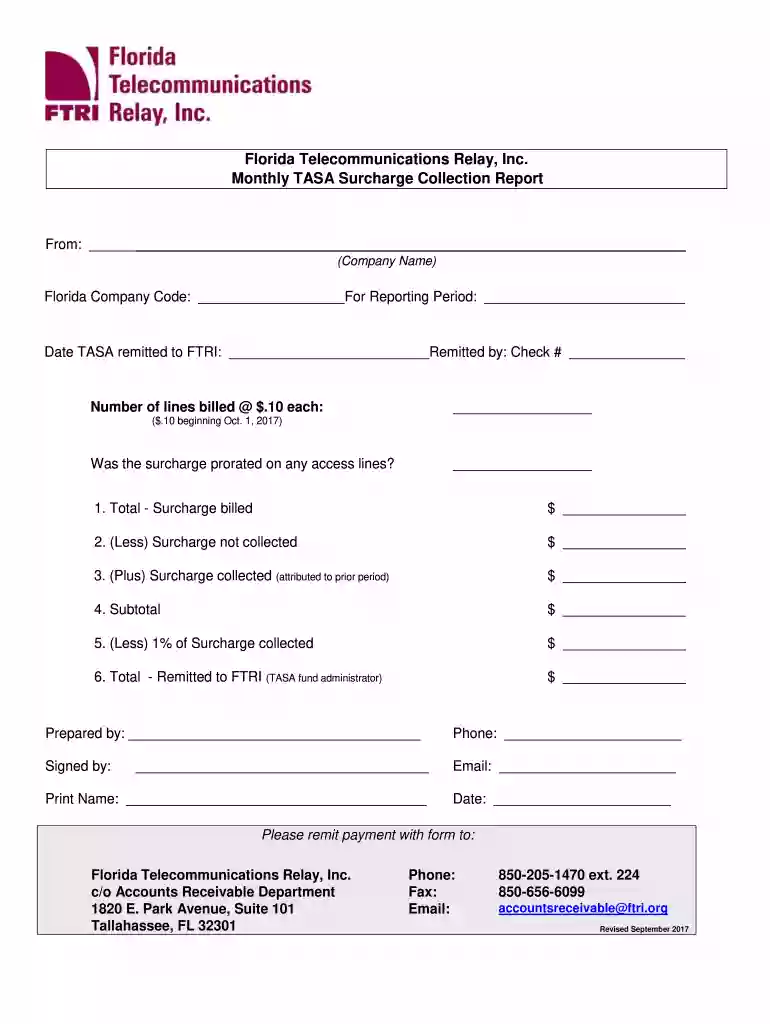
Type text, add images, blackout confidential details, add comments, highlights and more.

Draw your signature, type it, upload its image, or use your mobile device as a signature pad.

Send florida tasa via email, link, or fax. You can also download it, export it or print it out.
The "FL TASA," or Florida Telecommunications Access System Act, is a framework designed to manage the surcharge collection specifically for supporting telecommunications relay services in Florida. This surcharge facilitates assistance for individuals with hearing or speech disabilities by funding specialized communication services. Understanding the original legislation and the specific financial obligations it creates is integral for businesses involved in telecommunications within Florida.
Using the FL TASA form requires careful attention to detail to ensure compliance with state regulations. The form is structured to streamline surcharge reporting and remittance.
Understanding the terminology associated with the FL TASA is critical for proper form completion and compliance.
Fulfilling the requirements of the FL TASA form involves a systematic approach to ensure all financial data is correctly represented.
Knowing the legal frameworks governing the FL TASA is crucial for maintaining compliance and avoiding penalties.
The FL TASA is governed by rules specific to the state of Florida, which may differ from other states' practices.
Examples help illustrate how businesses might apply the FL TASA to manage billing and surcharge obligations.
Understanding potential penalties encourages adherence to FL TASA requirements.
Completing the FL TASA form requires gathering specific documentation to substantiate reported financial data.
Different types of businesses and scenarios require specific considerations when completing the FL TASA form.


We've got more versions of the florida tasa form. Select the right florida tasa version from the list and start editing it straight away!
At DocHub, your data security is our priority. We follow HIPAA, SOC2, GDPR, and other standards, so you can work on your documents with confidence.
Tasas de graduacin, empleo y retencin de la MAU notificadas al CIE (20242025). Resultados transparentes en programas de grado y posgrado.
Jun 23, 2025 The bill revises the Telecommunications Access System Act of 1991 (TASA) to reflect modern advances in communications technology by expandingRead more


