




01. Edit your mckinney venti homeless assistance act online
Type text, add images, blackout confidential details, add comments, highlights and more.

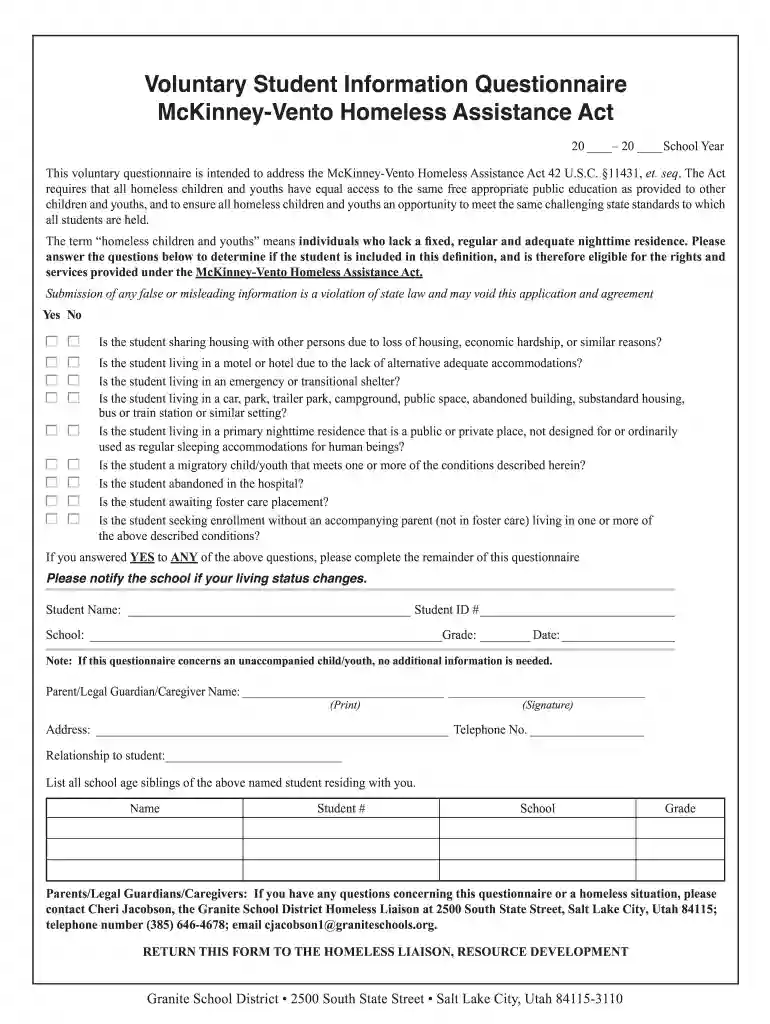
Type text, add images, blackout confidential details, add comments, highlights and more.

Draw your signature, type it, upload its image, or use your mobile device as a signature pad.

Send it via email, link, or fax. You can also download it, export it or print it out.
The McKinney-Vento Homeless Assistance Act is a federal law in the United States designed to ensure that homeless children and youths have equal access to public education. It addresses the challenges that these individuals face in enrolling, attending, and succeeding in school despite their living circumstances. The Act mandates that schools must remove barriers to enrollment and retention, offering resources and support to provide a stable educational experience. It underscores the commitment to educational equality, recognizing education as a fundamental right independent of a student's housing status.
Understanding the terminology used in the Act is crucial for accurately interpreting its provisions. Key terms include:
These terms help clarify eligibility criteria and the responsibilities of schools under the Act.
Completing the voluntary questionnaire is a vital step in identifying students who qualify for assistance. Here is a step-by-step guide:
To be eligible for the benefits under the McKinney-Vento Act, students must meet specific conditions:
This eligibility aims to ensure that educational rights are protected regardless of living conditions.


The McKinney-Vento Act is legally binding, and compliance is required to uphold students' rights to education. Schools must:
Non-compliance can lead to repercussions, including financial penalties or loss of federal funding. Schools must be diligent in their adherence to these legal requirements to ensure educational access and equity for all students.
While the Act allows for immediate enrollment without typical documentation, eventually, certain documents might be required to continue services and support, including:
Document accessibility should not hinder a student's enrollment or access to resources, serving as a guideline rather than a blockade.
Several scenarios illustrate the Act's application:
These examples demonstrate the Act’s practical role in supporting educational continuity.
While the McKinney-Vento Act provides federal guidelines, each state may have additional rules and resources:
Understanding state-specific rules helps in effectively leveraging the Act to secure necessary resources and support for students.
The application process under the McKinney-Vento Act is designed to be as seamless as possible to facilitate immediate support:
Timeliness is prioritized to ensure educational stability regardless of living conditions.
We've got more versions of the mckinney venti homeless assistance act form. Select the right mckinney venti homeless assistance act version from the list and start editing it straight away!
| Versions | Form popularity | Fillable & printable |
|---|---|---|
| 2018 | 4.8 Satisfied (86 Votes) |
At DocHub, your data security is our priority. We follow HIPAA, SOC2, GDPR, and other standards, so you can work on your documents with confidence.
Nov 20, 2025 This program works to ensure the enrollment, attendance and the opportunity to succeed in school for homeless children and youth. This programRead more
The McKinney-Vento Homeless Assistance Act authorizes the federal Education for Homeless Children and Youth (EHCY) Program and is the primary piece of federal


