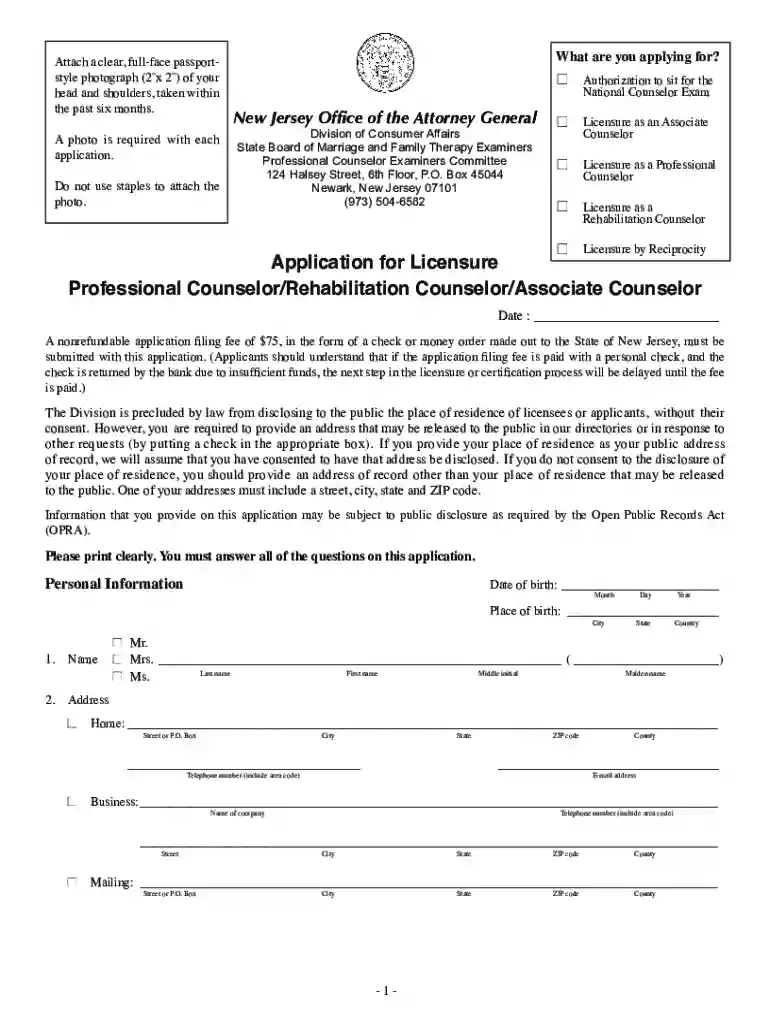
Definition & Purpose of the New Jersey Licensure Form
The New Jersey licensure form serves as an essential document for individuals seeking professional licensure as a Counselor in New Jersey, including roles such as Professional Counselor, Associate Counselor, or Rehabilitation Counselor. The form is designed to collect necessary personal, educational, and professional information to verify the qualifications and eligibility of applicants. It functions as a comprehensive application requiring the submission of various documents, such as passport-style photographs, educational credentials, and legal disclosures related to child support and criminal histories.
Key Elements of the Form
- Personal Information: Applicants must provide basic details such as name, address, and contact information.
- Educational Background: Details about academic qualifications, including degrees obtained and institutions attended, are mandatory.
- Supervised Experience: Candidates need to provide evidence of prior supervised professional experience, outlining their roles and responsibilities.
- Legal Disclosures: The form also requires information about any child support obligations or criminal history, ensuring that all applicants meet legal standards.
Steps to Complete the New Jersey Licensure Form
Completing the New Jersey licensure form involves several critical steps to ensure all requirements are fulfilled correctly:
-
Gather Required Documents:
- Collect personal identification documents, such as a government-issued ID and passport-style photographs.
- Secure academic transcripts and certificates as proof of educational qualifications.
- Obtain documentation that provides a verifiable record of supervised counseling experience.
-
Complete the Application:
- Fill out personal details with accuracy to avoid processing delays.
- Provide complete educational background information, listing all relevant degrees and certifications.
- Answer all legal disclosure sections truthfully, as misrepresentation could lead to application denial.
-
Submit Supporting Documentation:
- Attach photocopies of all required documents, ensuring they are clear and legible.
- Additional documents might be needed for specific cases — check the application guidelines for any additional requirements.
-
Application Fee:
- Pay the requisite application fee, as specified in the instructions. Payment methods and amounts may vary, so it's important to consult the official guidelines.
Completing Supervised Experience Details
Submitting detailed evidence of your supervised experience is crucial for this application. Ensure that:
- Supervisors’ credentials are verified and accompany your work experience reports.
- Accurate descriptions of duties, responsibilities, and hours worked are provided.
- Employers or supervisors confirm the experience with signatures or official documentation.
Who Typically Uses the New Jersey Licensure Form
This form is primarily used by professionals seeking licensure to practice as counselors within the state. Typical applicants include:

- Professional Counselors: Individuals who have completed postgraduate credentials and are aiming to offer counseling services independently.
- Associate Counselors: New graduates or those with a master’s degree looking to practice under supervision.
- Rehabilitation Counselors: Specialists focused on assisting individuals with disabilities in achieving their personal and professional goals.
Important Terms and Legal Use
Understanding the legal terminology and stipulations associated with the New Jersey licensure form is vital:
Key Terms
- LICSW: Licensed Independent Clinical Social Worker, a designation requiring adherence to strict professional and ethical guidelines.
- CEUs: Continuing Education Units, which might be necessary for maintaining licensure status.
Legal Considerations
- Compliance with the ESIGN Act ensures that electronic applications are legally binding.
- Mandatory disclosures need to be completed with transparency, as inaccuracies could result in penalties or licensure denial.
State-Specific Rules for the New Jersey Licensure Form
Certain regulatory aspects are unique to New Jersey, which applicants should be aware of:
- Residency Criteria: Some particular provisions and requirements apply to out-of-state applicants seeking licensure in New Jersey.
- State-specific Disclosures: Additional information regarding state taxes, child support obligations, or criminal records might be needed as per state law.
- Cultural Competence Requirement: The state mandates that applicants demonstrate knowledge and sensitivity toward cultural diversity as part of the licensure criteria.
Application Process & Approval Time
The journey from application submission to approval typically follows these stages:
- Pre-Application Preparation: Assemble documentation, ensure it meets the criteria, and understand all form instructions.
- Submission: Engage in a comprehensive review before official submission via permitted channels, which might include mail or online portal.
- Review Period: The processing time may vary, usually taking several weeks, during which verifications are conducted.
- Notification of Approval or Rejection: Applicants are informed of the outcome, and, if approved, they may follow any additional steps for certificate issuance.
Approval Timeline Considerations
- Processing times can vary depending on the completeness of the application and the volume of submissions.
- Incomplete or inaccurate applications could result in delays, so accuracy and thoroughness are paramount.
Form Variants and Digital vs. Paper Versions
The New Jersey licensure form exists in several formats to accommodate different user preferences and technological capabilities:
Digital Version
- Accessibility: The digital form can be filled out and submitted online, often through a state-sanctioned portal, providing a convenient and efficient process.
- Enhanced Features: Offers options like e-signature capabilities and automatic validation to help ensure accuracy.
Paper Version
- Traditional Method: While less common today due to digital advancements, paper submissions are still accepted for those without reliable internet access or technical proficiency.
- Submission Methods: Typically submitted via mail, requiring consideration of postal times and related delays.
Understanding both formats and their submission methods is crucial for applicants making an informed choice based on their personal resources and preferences.