




01. Edit your form online
Type text, add images, blackout confidential details, add comments, highlights and more.

Type text, add images, blackout confidential details, add comments, highlights and more.

Draw your signature, type it, upload its image, or use your mobile device as a signature pad.

Send it via email, link, or fax. You can also download it, export it or print it out.
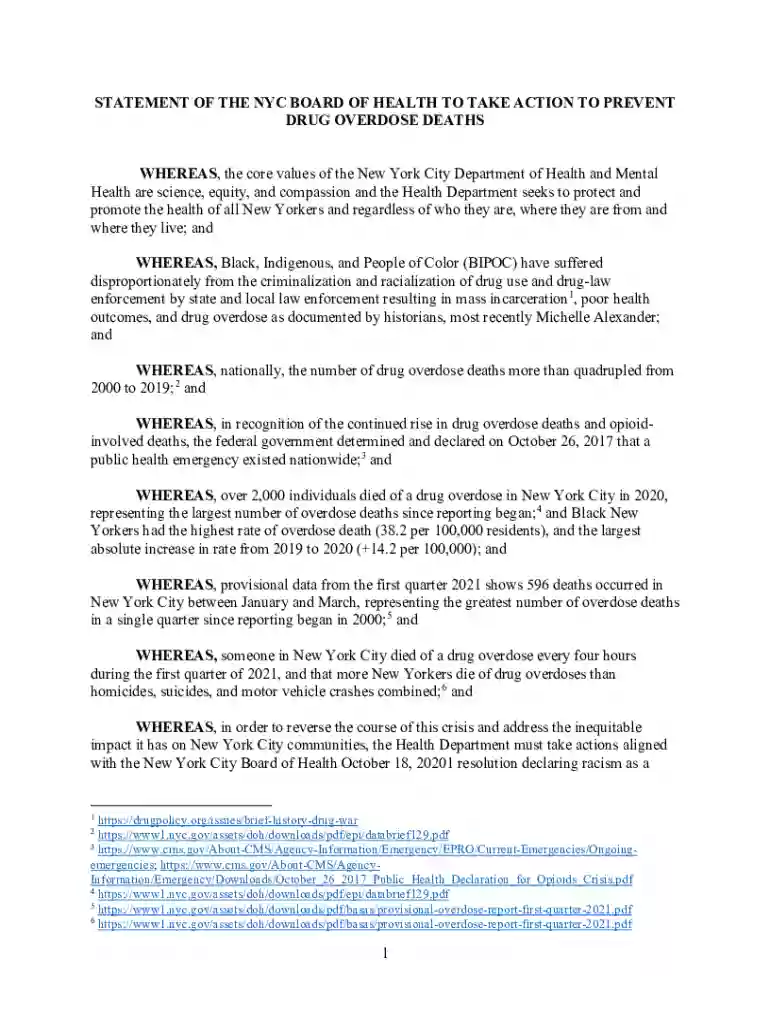
The "NY Statement of the NYC Board of Health to Take Action to Prevent Drug Overdose Deaths" is a crucial document aimed at addressing the increasing number of drug overdose deaths in New York City. This statement plays a vital role in outlining the strategies and actions that both local and federal entities can undertake to mitigate this public health crisis. Emphasis is placed on evidence-based harm reduction methodologies that are culturally and legally relevant within the U.S. context, highlighting its importance in safeguarding public health, especially within BIPOC communities severely affected by drug-related issues.
The statement incorporates several fundamental components designed to combat drug overdose deaths effectively:
Overdose Prevention Centers: Establishing centers aimed at reducing the risk of overdose by providing safe spaces for individuals to use substances under medical supervision.
Harm Reduction Strategies: Implementing strategies like increased access to Naloxone, a life-saving medication used to reverse opioid overdoses, and providing clean needles to prevent the spread of disease.
Treatment Accessibility: Enhancing access to opioid use disorder treatments, including Medication-Assisted Treatment (MAT), aligning with the latest findings in addiction treatment.
These elements are critical to the overall mission of the NYC Board of Health in their quest to significantly decrease the number of overdose deaths.
For stakeholders looking to utilize the NY Statement, a structured approach can enhance its implementation:
Review the Document Thoroughly: Understand all guidelines, frameworks, and recommendations.
Identify Key Actions: Focus on actions that are immediately applicable to your organization or community.
Implement Recommendations: Adapt the strategies outlined in the document to local conditions, ensuring community-specific needs are met.
Collaborate with Stakeholders: Engage with public health officials, community organizations, and policymakers to create united efforts.
This step-by-step utilization ensures that the document's recommendations are effectively leveraged to prevent overdose deaths.
Accessing the NY Statement is straightforward and essential for those involved in public health and policy advocacy:
Online Resources: The document can be accessed via the official NYC Department of Health website, ensuring easy availability for digital formats.
Public Health Offices: Physical copies may be obtained from local public health offices, allowing for broader reach and accessibility.
Ensuring widespread availability of this document enables a broader audience to engage with and implement its guidance.
The NY Statement carries significant legal implications, particularly in terms of compliance and policy development:
Policy Alignment: Organizations must align their practices with the document’s guidelines to ensure legal conformity, especially regarding new harm reduction facilities.
Regulatory Compliance: Stakeholders must adhere to local health regulations that may derive from the statement, ensuring lawful implementation of recommended practices.
Being aware of these legal considerations is paramount for lawful adherence to and effective implementation of the NY Statement.
Various real-world scenarios illustrate the impact and application of the NY Statement:
Community Health Initiatives: Local health departments using the statement to establish mobile units providing clean syringes and naloxone.
Educational Workshops: Non-profits conducting workshops on safe drug use and overdose prevention in line with the statement’s harm reduction strategies.
These examples showcase the diverse applications and positive outcomes resulting from the effective use of the NY Statement.
Different entities spanning various sectors engage with the NY Statement:
Public Health Officials: For policy development and health initiatives.
Community Organizations: To guide local programs and interventions aimed at reducing overdose rates.
Healthcare Providers: To inform clinical practices and the provision of substance use treatments.
This diverse usage underscores the statement’s broad relevance across different stakeholders addressing drug-related challenges.
The NY Statement's significance in public health cannot be overstated:
Reducing Mortality Rates: It directly targets the reduction of drug overdose deaths, offering practical approaches to save lives.
Supporting Vulnerable Populations: By focusing on BIPOC communities, it ensures that the most affected groups receive pertinent resources and support.
The statement serves as an indispensable tool for public health advocacy, providing prioritization on measures essential for reducing drug-related deaths in NYC.
We've got more versions of the NY Statement of the NYC Board of Health to Take Action to Prevent Drug Overdose Deaths form. Select the right NY Statement of the NYC Board of Health to Take Action to Prevent Drug Overdose Deaths version from the list and start editing it straight away!
At DocHub, your data security is our priority. We follow HIPAA, SOC2, GDPR, and other standards, so you can work on your documents with confidence.


