




01. Edit your cr 187 form online
Type text, add images, blackout confidential details, add comments, highlights and more.

Type text, add images, blackout confidential details, add comments, highlights and more.

Draw your signature, type it, upload its image, or use your mobile device as a signature pad.

Send cr187 form via email, link, or fax. You can also download it, export it or print it out.
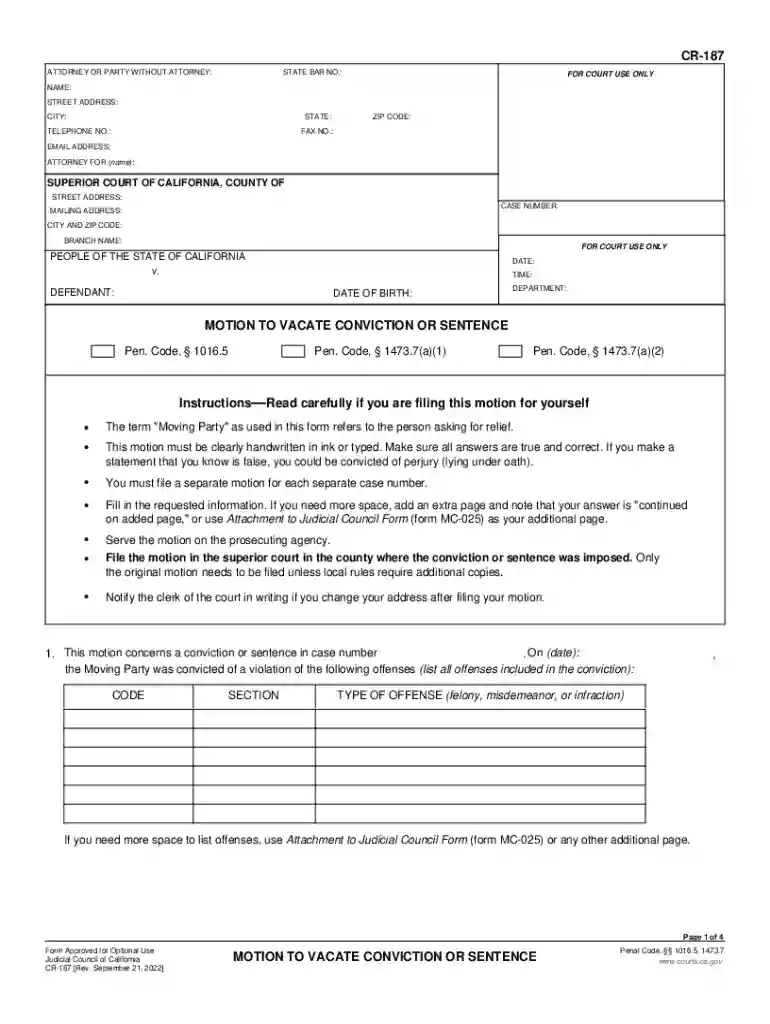
The CR-187 Motion to Vacate Conviction or Sentence is a legal form utilized in the Superior Court of California. This document is specifically designed for individuals who seek to have their conviction or sentence vacated, a legal term that means rendered null and void. The reason for filing this motion is often due to immigration consequences stemming from a plea, legal invalidity, or the discovery of new evidence proving actual innocence. This form ensures that individuals have the opportunity to challenge previous legal outcomes under certain circumstances.
Using the CR-187 involves a clear understanding of the grounds upon which a motion to vacate can be filed. Applicants must demonstrate specific criteria, such as newly discovered evidence or significant legal errors in the original process, which substantiate their request for a vacated conviction or sentence. The form should include detailed explanations of these grounds and any supporting evidence. Importantly, individuals should seek legal counsel to ensure that their motion is thoroughly prepared and complies with court requirements, as a misstep in the process can result in the motion being denied.
The CR-187 form can be obtained from the official website of the California Courts. Alternatively, individuals may acquire the form from a legal aid service or an attorney's office. Because the form is integral to the legal process involved in vacating a conviction, it is crucial to ensure that all sections are completed with accuracy and honesty. Individuals without direct access to the internet can also request the form at a local courthouse.
Identify the Grounds for the Motion: Detail the legal basis for vacating the conviction or sentence, such as ineffective assistance of counsel or new evidence.
Gather Supporting Documentation: Assemble necessary documents, such as affidavits, transcripts, or expert reports, to substantiate the claims made in the form.
Complete the Form: Fill in all fields accurately, providing thorough explanations where required. Be sure to include all relevant personal and case information.
Review with Legal Counsel: Consult with an attorney to review completed forms for accuracy and adherence to legal standards.
File with the Court: Submit the completed form along with any supporting documentation to the court. Some jurisdictions allow electronic submissions, while others require physical delivery.
Await Court Response: Track the status of the motion through court notifications and attend scheduled hearings if necessary.
Filing a CR-187 Motion is essential for individuals who face detrimental consequences due to their current conviction. Such consequences may include immigration issues, difficulty finding employment, or other legal limitations. By having a conviction vacated, the individual's record is effectively cleared of the conviction, mitigating these challenges. This motion is particularly pertinent when new evidence or procedural missteps could have influenced the original conviction.
This motion is commonly used by individuals who have been convicted of a crime in California and subsequently encounter negative collateral consequences, such as deportation or denial of naturalization for non-citizen immigrants. It is also crucial for individuals seeking redress due to procedural errors or rights violations during their initial court proceedings. Typically, those advised by legal counsel will be in the best position to use the CR-187 effectively.


In California, the CR-187 form is designed to cater to the state-specific legal framework regarding motions to vacate. It is imperative that individuals filing the form meet the criteria established under California law, which may differ from other states. For instance, the requirements for evidence or legal errors relevant to the case might be uniquely defined within California’s judicial system.
By comprehensively understanding the CR-187 Motion to Vacate Conviction or Sentence and its procedural requirements, individuals can better navigate the legal landscape to address unjust convictions.
We've got more versions of the cr 187 form form. Select the right cr 187 form version from the list and start editing it straight away!
At DocHub, your data security is our priority. We follow HIPAA, SOC2, GDPR, and other standards, so you can work on your documents with confidence.
Ask the court to vacate a conviction or sentence because you are not a citizen and did not understand the immigration consequences of the conviction,
As discussed in Section 1, a motion for a stay of removal asks the court to stop immigration officers from removing you from the U.S. while your case is inRead more


