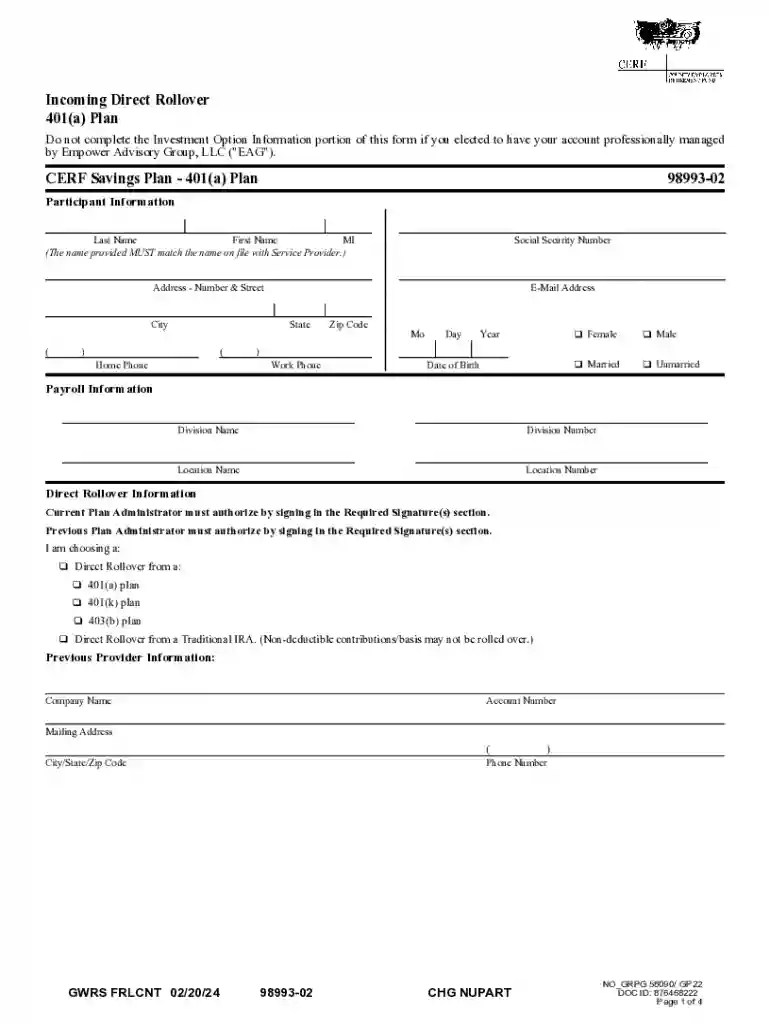
Incoming Direct Rollover 401(a) Plan 2026

Get Form
401a vs 401k Preview on Page 1

Here's how it works

01. Edit your 401a vs 401k online
Type text, add images, blackout confidential details, add comments, highlights and more.

02. Sign it in a few clicks
Draw your signature, type it, upload its image, or use your mobile device as a signature pad.

03. Share your form with others
Send 401a plan via email, link, or fax. You can also download it, export it or print it out.

Definition and Meaning of the Incoming Direct Rollover 401(a) Plan

The Incoming Direct Rollover 401(a) Plan is a mechanism that allows plan participants to transfer funds from previous retirement accounts, such as a 401(k) or other eligible plans, into their current employer's 401(a) retirement plan. This process is vital for individuals aiming to consolidate their retirement savings under a single plan, facilitating easier management and potentially enhancing their investment strategy.

Key Aspects of the Plan

  • Fund Transfer: Direct fund transfer from one tax-advantaged retirement account to another.
  • Tax Benefits: Preserves the tax-deferred status of retirement assets, preventing tax penalties.
  • Investment Opportunities: Provides access to the current employer's 401(a) plan investment options.
  • Plan Management: Simplifies tracking and managing retirement assets under a single account.

Steps to Complete the Incoming Direct Rollover 401(a) Plan

Successfully completing the Incoming Direct Rollover 401(a) Plan involves several precise steps to ensure compliance with regulations and seamless execution.

  1. Eligibility Verification: Confirm that your previous retirement plan allows for a direct rollover and that your current employer’s 401(a) plan accepts rollovers.
  2. Gather Required Documents: Collect necessary documents such as your previous plan statements and the Incoming Direct Rollover 401(a) Plan form.
  3. Consult Plan Administrator: Discuss the rollover process with both your previous and current plan administrators to receive guidance and confirm requirements.
  4. Complete the Rollover Form: Fill out sections detailing participant information, fund details, and desired investment options.
  5. Submit Required Documentation: Provide all necessary documentation, including the executed rollover form, plan statements, and identification proofs, to your current plan administrator.
  6. Follow-Up: Monitor the process and confirm with the plan administrator that the rollover has been executed.

Execution Tips

  • Double Check Entries: Ensure all information entered in the rollover form is accurate to avoid processing delays.
  • Retain Copies: Keep copies of all submitted forms and correspondence for your records.

Required Documents for an Incoming Direct Rollover 401(a) Plan

Facilitating a smooth rollover requires specific documentation to establish eligibility and compliance.

  • Completed Rollover Form: Accurate and complete with participant details, rollover specifics, and investment elections.
  • Prior Plan Statements: Recent statements from the account being rolled over to verify account balance and details.
  • Identification Proof: Government-issued ID to authenticate your identity.
  • Authorization Letter: If required, a letter authorizing the rollover from the previous plan administrator.

Importance of Documentation

  • Validates the participant’s identity and the source of funds.
  • Ensures compliance with IRS regulations regarding rollovers.
  • Facilitates an efficient and timely rollover process.

Eligibility Criteria for the Incoming Direct Rollover 401(a) Plan

Understanding who qualifies for an Incoming Direct Rollover 401(a) Plan aids in ensuring the correct execution of the rollover.


decoration image ratings of Dochub

Primary Eligibility Requirements

  • Employment Status: Must be an employee of the organization offering the 401(a) plan accepting the rollover.
  • Previous Account Type: Funds should originate from a compatible retirement account, such as a 401(k), 403(b), or another eligible plan.
  • Plan Agreement Compliance: Must adhere to both current and prior plan agreements related to rollovers.

Key Elements of the Incoming Direct Rollover 401(a) Plan

Several pivotal elements ensure the effective operation of the Incoming Direct Rollover 401(a) Plan.

  • Participant Information: Detailed personal and employment information to verify eligibility.
  • Rollover Amount: Precise financial figures regarding the rollover sum and related calculations.
  • Investment Selection: Options to elect how rolled-over funds should be invested within the new plan.
  • Signatures: Mandatory signatures from both the participant and the plan administrator to authorize the transfer and commitment to plan terms.

Examples of Using the Incoming Direct Rollover 401(a) Plan

Examples can provide clarity and context to the application of the rollover process.

Scenario One: Career Transition

A participant changes jobs and wishes to consolidate their previous 401(k) into the new employer's 401(a) plan, utilizing a direct rollover to maintain tax-advantaged status and access broader investment options.

Scenario Two: Merging Accounts for Simplicity

An individual nearing retirement decides to roll over several eligible retirement accounts into a single 401(a) plan to simplify asset allocation and account management, thus reducing administrative burdens.

IRS Guidelines on the Incoming Direct Rollover 401(a) Plan

IRS guidelines dictate the tax treatment and procedural compliance for rollovers.

IRS Framework

  • Tax-Deferred Status: Direct rollovers do not incur immediate taxes or penalties since funds maintain their tax-deferred nature.
  • 60-Day Rule: Ensures that the rollover is completed within a specific time frame to avoid taxes and penalties.

Legal Use of the Incoming Direct Rollover 401(a) Plan

Understanding the legal implications adds a layer of assurance to the rollover process.

  • Compliance: Adherence to IRS regulations ensures the preservation of tax-deferred status and legality of the rollover.
  • Documentation: Proper documentation fulfills legal requirements, substantiating the transfer of funds under statutory provisions.

By following these structured steps and understanding the crucial components and legalities involved, individuals can effectively manage their Incoming Direct Rollover 401(a) Plan, ensuring financial continuity and strategic retirement planning.

See more Incoming Direct Rollover 401(a) Plan versions

We've got more versions of the Incoming Direct Rollover 401(a) Plan form. Select the right Incoming Direct Rollover 401(a) Plan version from the list and start editing it straight away!
Versions Form popularity Fillable & printable
2024 4.9 Satisfied (32 Votes)
2019 4.6 Satisfied (56 Votes)
2018 4.3 Satisfied (45 Votes)
be ready to get more

Complete this form in 5 minutes or less

Get form

Got questions?

We have answers to the most popular questions from our customers. If you can't find an answer to your question, please contact us.
Contact us
Limitations of a 401(a) Plan Limited employee control: In a 401(a) plan, the employer typically has docHub control over the plans structure. This includes the contribution rates and investment options. Employees often have little to no say in how much they contribute or where their money is invested.

Security and compliance

At DocHub, your data security is our priority. We follow HIPAA, SOC2, GDPR, and other standards, so you can work on your documents with confidence.

Learn more
ccpa2
pci-dss
gdpr-compliance
hipaa
soc-compliance