Ttb treasury process wine 2026

Get Form
contains natural Preview on Page 1

Here's how it works

01. Edit your contains natural online
Type text, add images, blackout confidential details, add comments, highlights and more.
02. Sign it in a few clicks
Draw your signature, type it, upload its image, or use your mobile device as a signature pad.
03. Share your form with others
Send peanut contains via email, link, or fax. You can also download it, export it or print it out.

How to use or fill out ttb treasury process wine with our platform

Form edit decoration
9.5
Ease of Setup
DocHub User Ratings on G2
9.0
Ease of Use
DocHub User Ratings on G2
  1. Click ‘Get Form’ to open it in the editor.
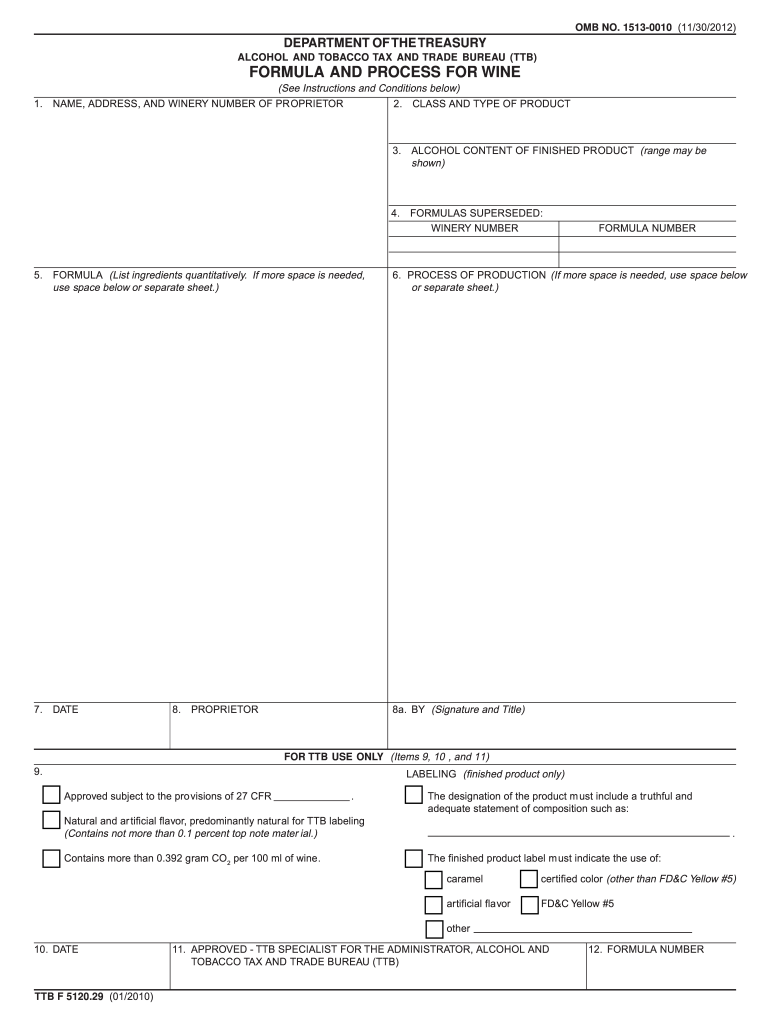
  2. Begin by entering the name, address, and winery number of the proprietor in Item 1. Ensure all details are accurate for compliance.
  3. In Item 2, specify the class and type of product. Follow the regulations under the Federal Alcohol Administration Act without including any brand names.
  4. For Item 3, indicate the alcohol content of your finished product. If there is a range, make sure to include it clearly.
  5. In Item 5, list all ingredients quantitatively. Use additional sheets if necessary to provide complete information.
  6. Detail the production process in Item 6, outlining each step and timing for adding materials.
  7. Complete Items 7 and 8 with the date and signature of the proprietor to finalize your submission.

Start using our platform today to streamline your TTB form completion for free!

See more ttb treasury process wine versions

We've got more versions of the ttb treasury process wine form. Select the right ttb treasury process wine version from the list and start editing it straight away!
Versions Form popularity Fillable & printable
2010 4.9 Satisfied (60 Votes)
be ready to get more

Complete this form in 5 minutes or less

Get form

Got questions?

We have answers to the most popular questions from our customers. If you can't find an answer to your question, please contact us.
Contact us
75 percent or more of the wine is made from the named grape variety, with exceptions provided in 4.23(c) ; and. the entire 75 percent of the named grape variety was grown in the labeled appellation of origin.
Heres what the numbers mean: 75: For a wine to be labeled as a varietal chardonnay, say, or cabernet sauvignon 75 percent of the wine has to be made from that varietal. 85: List an appellation, such as Livermore Valley or Santa Cruz Mountains, on the label, and 85 percent of the grapes must come from that AVA.
The U.S. Alcohol and Tobacco Tax and Trade Bureau (TTB) requires alcohol tax bonds to guarantee that wine businesses pay federal taxes for selling, producing, importing and warehousing wine. A TTB wine bond holds wine producers, cellars and wholesalers responsible for paying all taxes, penalties and fees.
Trockenbeerenauslese (German: [ˈtʁɔkn̩beːʁənˌʔaʊ̯sleːzə], lit. dried berry selection), or TBA, is a German or Austrian botrytized wine made entirely from the individually selected grapes fully dried from Botrytis cinerea (noble rot), hence the name.
If a wine label includes an appellation of origin (Napa Valley or Sonoma County), at least 85% of the grapes used must come from that designated area. And, when a wine includes a vintage year (2020 or 2021), at least 95% of the grapes must have been harvested during the specific year.

Security and compliance

At DocHub, your data security is our priority. We follow HIPAA, SOC2, GDPR, and other standards, so you can work on your documents with confidence.

Learn more
ccpa2
pci-dss
gdpr-compliance
hipaa
soc-compliance
be ready to get more

Complete this form in 5 minutes or less

Get form

People also ask

Heres an easy rule of thumb we can experiment with to help find our best temperatures. I call it 30 in or 30 out. If our red is at house temp, pop it in the fridge for 30 minutes before drinking. If our white is at fridge temp, put on the counter for 30 minutes prior to pulling the cork.
Understand the 80/20 Rule When applied to your wine list, the 80/20 Rule suggests that the Top 20% of the wines on your wine list will account for 80% of the total sales. In other words, if your wine list has 100 wines on it, there will be 20 wines that are going to be your bestsellers and your staff favorites.

Related links