Type text, add images, blackout confidential details, add comments, highlights and more.
02. Sign it in a few clicks
Draw your signature, type it, upload its image, or use your mobile device as a signature pad.
03. Share your form with others
Send it via email, link, or fax. You can also download it, export it or print it out.
How to use or fill out doh form 2094 with our platform
Ease of Setup
DocHub User Ratings on G2
Ease of Use
DocHub User Ratings on G2
Click ‘Get Form’ to open it in the editor.
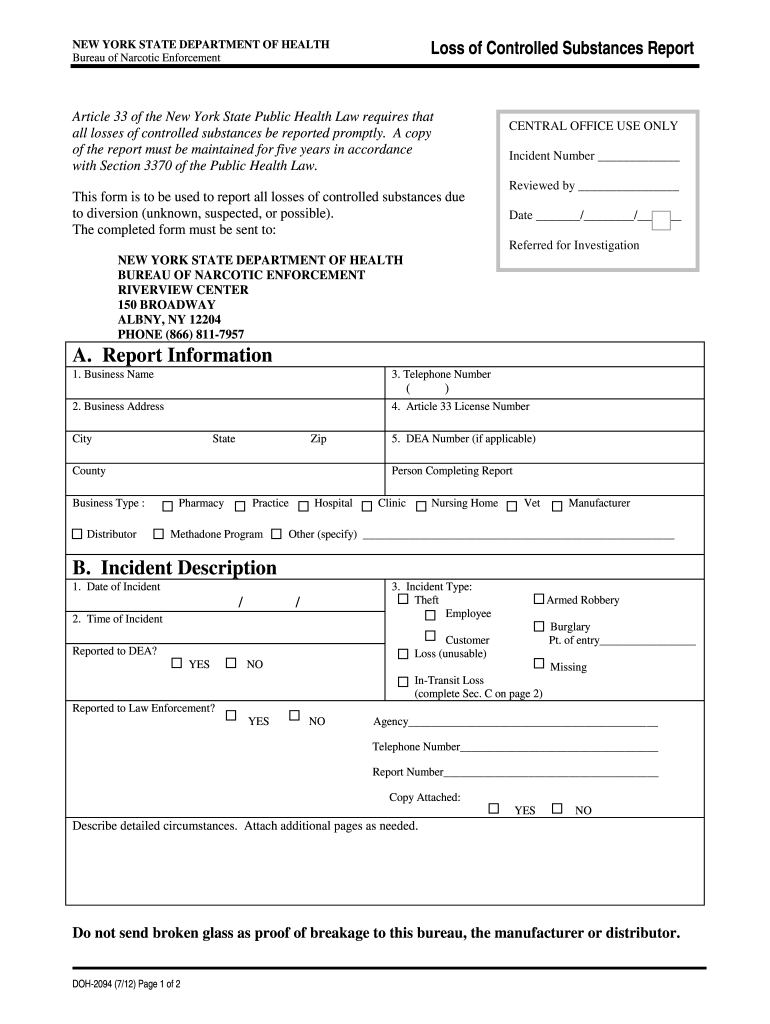
Begin by filling out Section A, 'Report Information.' Enter your business name, address, telephone number, and Article 33 License Number. If applicable, include your DEA Number and specify the type of business.
Proceed to Section B, 'Incident Description.' Record the date and time of the incident. Select the incident type from options such as theft or loss. Indicate whether you reported it to the DEA and law enforcement.
If applicable, complete Section C for 'In-Transit Losses.' Provide sender and shipper details along with notification dates and contact information.
In Section D, list all lost or stolen controlled substances including their brand names, dosage forms, strengths, quantities, and total value.
Finally, in Section E, certify that all information is accurate by printing your name, signing the form, and providing any required license numbers.
Start using our platform today to fill out your doh form 2094 online for free!
Some examples are morphine, , oxycodone (OxyContin), , methylphenidate (Ritalin), and dextroamphetamine (Dexedrine). Schedule III, IV, or V drugs with an abuse risk less than Schedule II. These drugs also have safe and accepted medical uses in the United States.
What are the requirements for Schedule 2 drug storage?
Schedule II: Store in a safe or in a substantially constructed steel cabinet equivalent with a double lock system. (e.g. Narcotics cabinets or a steel lockbox within a lockable desk drawer or cabinet.) Schedule III - V: Store in a locked drawer or cabinet that is inaccessible from above or below.
Who can prescribe Adderall in NYS?
The only person who can prescribe Adderall to you is a physician or psychiatrist who is familiar with your symptoms, overall medical history, and treatments attempted in the past. If you feel Adderall may be right for you, schedule an appointment with your doctor and mention your symptoms.
What counts as a controlled substance?
A drug or other substance that is tightly controlled by the government because it may be abused or cause addiction. The control applies to the way the substance is made, used, handled, stored, and distributed. Controlled substances include opioids, stimulants, depressants, hallucinogens, and anabolic steroids.
What are the 5 class categories of controlled substances?
There are established five schedules of controlled substances, to be known as schedules I, II, III, IV, and V. Such schedules shall initially consist of the substances listed in this section.
Related Searches
Printable doh form 2094Doh form 2094 pdfDoh form 2094 templateDoh form 2094 instructionsDoh form 2094 onlineDOH-5733 FormDOH 5797 FormDOH-4330 form PDF
Security and compliance
At DocHub, your data security is our priority. We follow HIPAA, SOC2, GDPR, and other standards, so you can work on your documents with confidence.
What are the 7 categories of controlled substances?
7 Drug Categories (1) Central Nervous System (CNS) Depressants. CNS depressants slow down the operations of the brain and the body. (2) CNS Stimulants. (3) Hallucinogens. (4) Dissociative Anesthetics. (5) Narcotic Analgesics. (6) Inhalants. (7) Cannabis.
What drugs are not considered controlled substances?
Non-controlled medications include over-the-counter medications and medications that are prescribed to treat medical conditions such as high blood pressure, diabetes, and bacterial infections.
What are the requirements for a DEA safe?
Each safe needs to weigh at least 750 pounds. If the safe weighs less than 750 pounds, it must be bolted to the floor. The DEA requires that any Schedule I II drugs need to be stored in a minimum of a TL-30 rated safe and it must also have an Underwriters Laboratory listed Group 1R dial combination lock.
Related links
Controlled Substances | Environmental Health and Safety
Form DOH-2094 must be filled out and submitted within one business day. The DEA requires researchers to notify the local DEA Diversion Field office inRead more
Cookie consent notice
This site uses cookies to enhance site navigation and personalize your experience.
By using this site you agree to our use of cookies as described in our Privacy Notice.
You can modify your selections by visiting our Cookie and Advertising Notice.