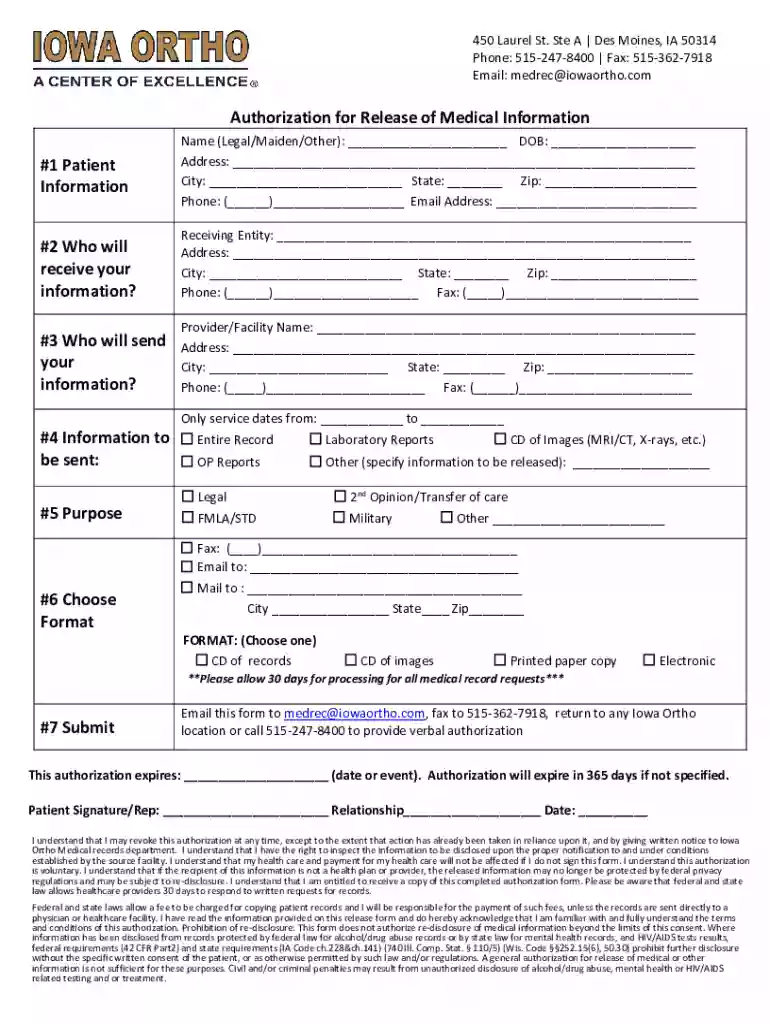
Authorization for Release of Medical Information #1 Patient 2026

Get Form
Authorization for Release of Medical Information #1 Patient Preview on Page 1

Here's how it works

01. Edit your form online
Type text, add images, blackout confidential details, add comments, highlights and more.

02. Sign it in a few clicks
Draw your signature, type it, upload its image, or use your mobile device as a signature pad.

03. Share your form with others
Send it via email, link, or fax. You can also download it, export it or print it out.

Definition and Meaning of the Authorization for Release of Medical Information

The Authorization for Release of Medical Information #1 Patient form is a legal document that permits healthcare providers to disclose a patient's medical information to designated individuals or entities. This form is essential in facilitating the sharing of medical records while ensuring compliance with privacy laws. It specifies the types of information that can be released, the purpose of the disclosure, and the duration of the authorization. Understanding the intricacies of this form is crucial for both healthcare providers and patients to ensure that sensitive medical data is handled appropriately.

Key Components

  • Patient Information: The form includes sections for the patient’s personal details, such as their name, date of birth, and contact information.
  • Recipient Details: Identifies who will receive the information, such as another healthcare provider, family member, or insurance company.
  • Purpose of Release: Specifies why the information is being released, which can include treatment coordination, insurance claims, or legal proceedings.

Steps to Complete the Authorization for Release of Medical Information

Navigating the completion of the form can be straightforward by following a structured approach. Each step ensures adherence to necessary legal and procedural requirements.

Detailed Instructions

  1. Provide Patient Details: Start by entering the patient's full name, date of birth, and contact information.
  2. Identify the Recipient: Clearly specify the individual or organization authorized to receive the medical information.
  3. Specify Information Types: Enumerate the types of medical records to be disclosed, such as lab results or treatment summaries.
  4. State Disclosure Purpose: Indicate the reason for the record release to provide context and justification.
  5. Sign and Date the Form: Ensure the patient or their legal representative signs and dates the document to validate the authorization.

Legal Use of the Authorization for Release of Medical Information

The legal framework surrounding this form is designed to protect patient privacy while allowing necessary information sharing under specific circumstances. Compliance with the Health Insurance Portability and Accountability Act (HIPAA) is mandatory.

HIPAA Compliance

  • Protected Health Information (PHI): By aligning with HIPAA, the form ensures PHI is disclosed only as per the authorization.
  • Patient Rights: Patients retain the right to revoke authorization at any time, emphasizing their control over personal information.

Key Elements of the Authorization for Release of Medical Information

To use the form effectively, understanding its primary components is essential. Each element plays a specific role in guiding the release process.

Major Components

  • Consent and Revocation Clauses: These highlight the patient's ability to consent to or revoke the authorization.
  • Duration of Authorization: Specifies how long the release is valid, allowing for temporal control over the process.

Who Typically Uses the Authorization for Release of Medical Information

This form serves various stakeholders in the healthcare ecosystem.

decoration image ratings of Dochub

Common Users

  • Healthcare Providers: Physicians and clinics frequently use this form to share information with other healthcare entities.
  • Patients: Individuals use it to transfer records between providers or for personal use, such as incorporating them into a personal health organizer.
  • Insurance Companies: Insurers require this form to process claims and verify treatments.
decoration image

Important Terms Related to the Authorization for Release of Medical Information

The form encompasses several legal and medical terminologies that necessitate clear understanding to ensure compliance.

Definitions

  • Disclosure: This refers to the action of permitting access to or releasing health information.
  • Revocation: The act of the patient canceling the previously granted permission, ceasing further disclosures.

Examples of Using the Authorization for Release of Medical Information

To illustrate the form's application in real-world settings, consider these scenarios.

Practical Scenarios

  • Medical Referrals: When a general practitioner refers a patient to a specialist, this form authorizes sharing relevant medical history.
  • Insurance Claims: Patients submit it to insurance companies as part of the documentation to process claims for reimbursement.

State-Specific Rules for the Authorization for Release of Medical Information

Regulations can vary significantly across states, making it critical to be aware of local laws.

Regional Variations

  • California: Has stringent patient privacy laws that may demand additional authorization criteria.
  • Texas: Requires distinct acknowledgments for the release of psychiatric records, underlining the need for careful compliance with state-specific mandates.

Understanding these aspects of the Authorization for Release of Medical Information #1 Patient provides a comprehensive foundation for its proper use. Recognizing legal implications, state-by-state differences, and practical applications will ensure the process remains both compliant and efficient.

See more Authorization for Release of Medical Information #1 Patient versions

We've got more versions of the Authorization for Release of Medical Information #1 Patient form. Select the right Authorization for Release of Medical Information #1 Patient version from the list and start editing it straight away!
Versions Form popularity Fillable & printable
2020 4.7 Satisfied (28 Votes)
be ready to get more

Complete this form in 5 minutes or less

Get form

Got questions?

We have answers to the most popular questions from our customers. If you can't find an answer to your question, please contact us.
Contact us
0:43 1:58 A description of the protected. Health information to be used and disclosed. The person authorizedMoreA description of the protected. Health information to be used and disclosed. The person authorized to make the use or disclosure. The person to whom the covered entity may make the disclosure.
5 steps to write a letter of authorization. Identify the parties involved. Specify the authority granted. Define the duration of the agreement. Include any necessary details. Sign the document.
Clearly state your name and that youre writing to grant authorization to another individual or organization. In the body of your letter, identify the parties involved, specify the authority youre granting, define the duration, and include any other necessary information.
8 Key Elements of a Compliant Medical Records Release Form Patient Information. Purpose of Request. Dates of Service. Recipient Information. Valid Authorization Signature. Date of Signature. Restrictions or Limitations. Revocation Clause.
This Disclosure Authorisation Letter (previously known as an Authorisation to Release Confidential Information) refers to a Confidentiality Agreement and authorises a party to that agreement to release certain information to a named party.

Security and compliance

At DocHub, your data security is our priority. We follow HIPAA, SOC2, GDPR, and other standards, so you can work on your documents with confidence.

Learn more
ccpa2
pci-dss
gdpr-compliance
hipaa
soc-compliance

People also ask

Begin by specifying your name, the entity authorized to disclose information, and the individuals or entities you authorize to receive it. Indicate the specific information and purpose for which it will be disclosed, add an expiration date or event, and sign and date the form to confirm your consent.

Related links