470-4019 PS-MAPP Family Profile-2026

Get Form
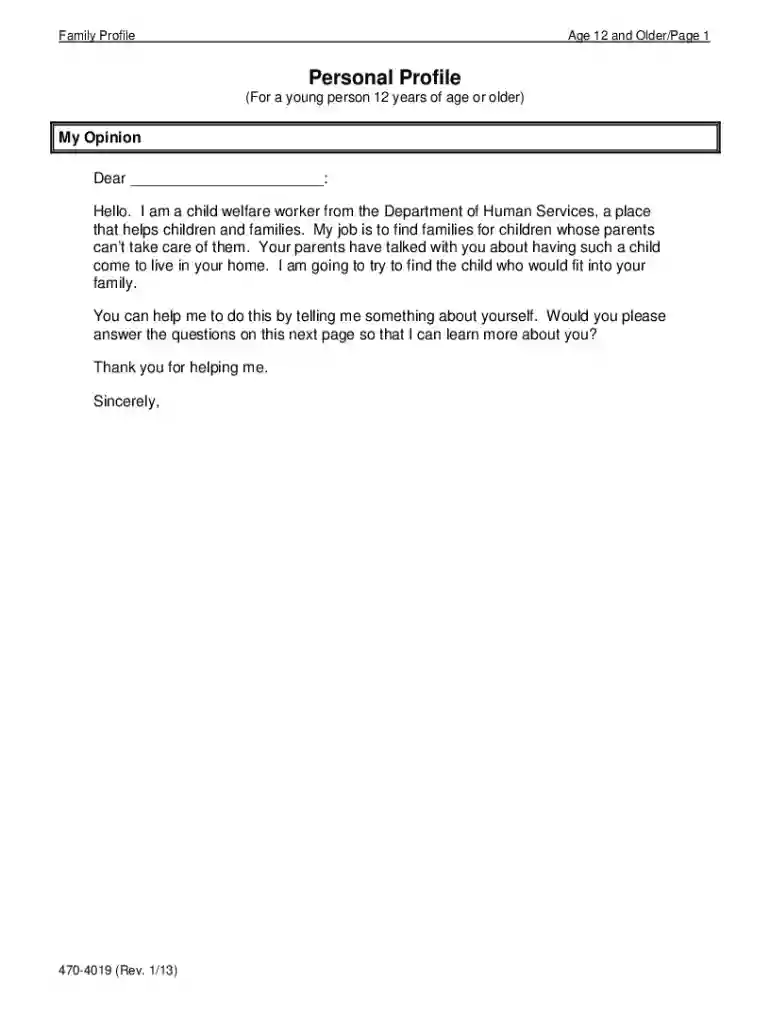
470-4019 PS-MAPP Family Profile Preview on Page 1

Here's how it works

01. Edit your form online
Type text, add images, blackout confidential details, add comments, highlights and more.

02. Sign it in a few clicks
Draw your signature, type it, upload its image, or use your mobile device as a signature pad.

03. Share your form with others
Send it via email, link, or fax. You can also download it, export it or print it out.

Definition and Purpose of the PS-MAPP Family Profile

The PS-MAPP Family Profile is a form used by child welfare workers to collect essential information about children aged 12 and older. Designed by the Department of Human Services, this form assists in matching children with new potential siblings or family members who might live with them. Its core aim is to gather comprehensive data regarding personal attributes, such as personality traits, appearance, and family dynamics, to facilitate a smoother transition and integration into a new family environment.

Steps to Complete the PS-MAPP Family Profile

  1. Gather Necessary Information:

    • Begin by collecting all relevant personal details about the child, including preferences and characteristics.
    • Ensure you have a clear understanding of the child’s school and social interactions, as these are vital for accurate completion.
  2. Complete the Form Sections:

    • Fill out each section meticulously, focusing on questions about the child's personality, family similarities, and school preferences.
    • Use clear and concise language to provide precise responses.
  3. Review and Submission:

    • Thoroughly review the completed form to ensure all information is accurate and complete.
    • Submit the form according to state-specific guidelines, which may include online, mail, or in-person submission.

Who Typically Uses the PS-MAPP Family Profile

  • Child Welfare Workers:

    • These professionals utilize the form to evaluate and coordinate the placement of children in new family settings.
  • Prospective Foster or Adoptive Families:

    • Families interested in fostering or adopting can use the form to gain insights into the children they might welcome into their home.
  • Department of Human Services:

    • This department uses the profile to ensure a systematic approach to child placements, facilitating better matches and successful family dynamics.
decoration image ratings of Dochub

Key Elements of the PS-MAPP Family Profile

  • Personal Information Section:

    • Collects data on the child's identity, including name, age, and appearance.
  • Family Dynamics and Preferences:

    • Includes questions about similarities and differences within the family, helping assess potential fits with new family members.
  • Social and Educational Considerations:

    • Evaluates the child's school involvement and preferences, crucial for academic support and social adjustments.

Important Terms Related to the PS-MAPP Family Profile

  • PS-MAPP (Permanency and Safety Model Approach to Partnerships in Parenting):

    • A process utilized to train and support foster and adoptive parents.
  • Child Welfare Services:

    • Government services aimed at ensuring the well-being of children.
  • Foster Care:

    • Temporary placement of children with families until a permanent solution is found.

Legal Use of the PS-MAPP Family Profile

  • Confidentiality:

    • Information collected through the form must be handled according to privacy laws, ensuring the child's data is protected.
  • Compliance with State Laws:

    • The form must be filled and processed in line with state-specific child welfare regulations.

How to Obtain the PS-MAPP Family Profile

  • Through the Department of Human Services:

    • The form is accessible via direct request from the relevant department.
  • Online Resources:

    • Many states offer downloadable versions of the form through their official government websites.

Examples of Using the PS-MAPP Family Profile

  • Sibling Placement:

    • A child welfare worker successfully uses the form to place twins with a family that shares their interest in outdoor activities.
  • Academic Alignment:

    • The form helps identify a family close to the child's current school district, minimizing disruptions in academic progress.

State-Specific Rules for the PS-MAPP Family Profile

  • Rules may vary concerning how the form is filled out and submitted based on local legislation, making it essential to consult state-specific guidelines to ensure compliance.

See more 470-4019 PS-MAPP Family Profile versions

We've got more versions of the 470-4019 PS-MAPP Family Profile form. Select the right 470-4019 PS-MAPP Family Profile version from the list and start editing it straight away!
Versions Form popularity Fillable & printable
2013 4.5 Satisfied (30 Votes)
be ready to get more

Complete this form in 5 minutes or less

Get form

Got questions?

We have answers to the most popular questions from our customers. If you can't find an answer to your question, please contact us.
Contact us
Did you know that up to 60% of foster parents quit within their first year of fostering? This causes children to experience the trauma of losing a family all over again. But π™π™Šπ™‚π™€π™π™ƒπ™€π™, we can change that.
We all have heard the stat that nearly 50% of foster parents quit in the first year. Ive spent almost three years supporting foster parents through harder seasons, and I wish I could tell you there was an easy, quick way to feel less overwhelmed or burned out.
It is purported that continued contact is beneficial for children; it helps maintain family ties, lessens feelings of grief, and increases an overall sense of well-being (Sanchirico Jablonka, 2000).
The average length of time a foster family remains in the system is approximately two to three years, but this depends on the circumstances of each individual family. Some families may foster for longer periods or even adopt their foster child.
U.S. ADOPTION FOSTER CARE STATISTICS 53% of the children and youth who left foster care were reunited with their families or living with a relative; 25% were adopted.

Security and compliance

At DocHub, your data security is our priority. We follow HIPAA, SOC2, GDPR, and other standards, so you can work on your documents with confidence.

Learn more
ccpa2
pci-dss
gdpr-compliance
hipaa
soc-compliance

People also ask

25% wont graduate high school. 50% will develop a substance abuse dependence. 70% of young women will become pregnant before age 21. 3% of kids who age out will earn a college degree.
Many people believe fostering is solely caring for children you have never met. Although this is a piece of the foster care system, there is also the option to foster a specific childa child you know.
Yes, it is possible to regain custody of a child after they have been placed in foster care, but the process can be complex and varies by jurisdiction. Here are some key points to consider:

Related links