
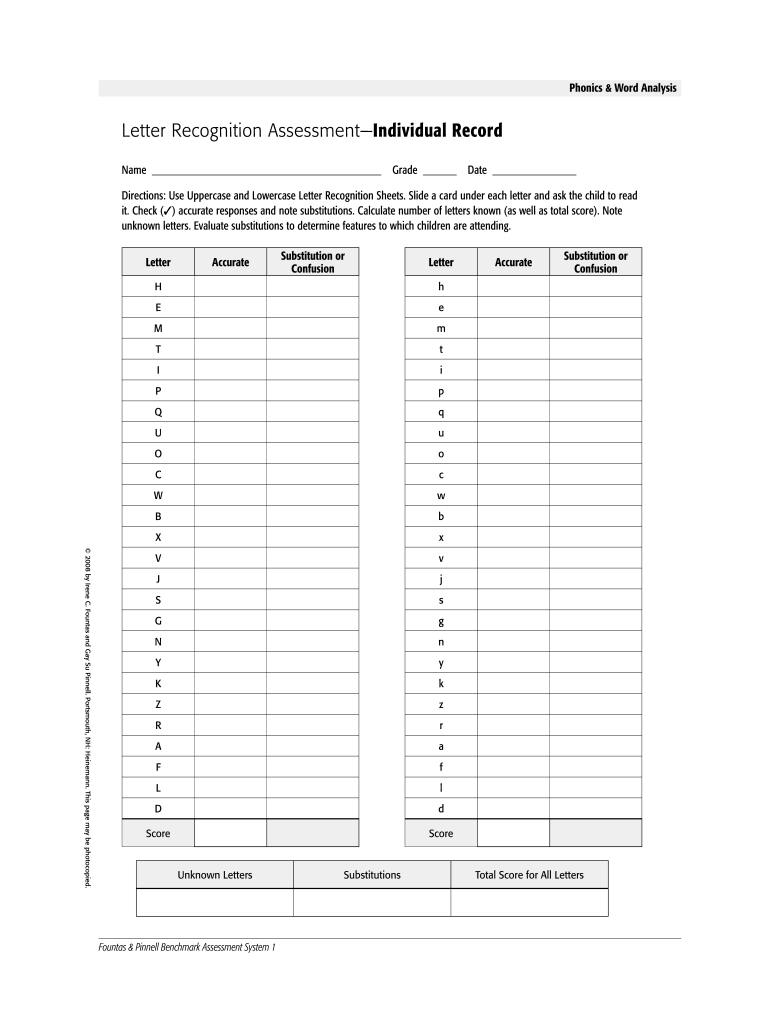







Definition and Purpose of the Letter Recognition Assessment Individual Record
The Letter Recognition Assessment Individual Record is a specialized document designed to evaluate a child’s ability to recognize both uppercase and lowercase letters. This assessment is primarily used in educational settings to gauge phonics and word analysis skills, which are foundational for reading and writing proficiency. It typically includes fields for documenting individual students' responses, substitutions made by the student, and any letters that were not identified during the assessment. This structured approach helps educators assess each child's letter recognition capabilities systematically and ensures that the educational needs of each student can be addressed effectively.
Essential Features of the Assessment
-
Structured Recording Sheets: The assessment provides both individual and class record sheets, allowing educators to track performance across multiple students while identifying trends or areas needing additional support.
-
Comprehensive Evaluation: Focuses on identifying correct responses as well as substitutions and unknown letters, ensuring a holistic view of each child's abilities.
-
Phonics Alignment: The framework aligns with phonics instruction, facilitating its use in conjunction with evidence-based literacy programs like the Fountas and Pinnell phonics assessments.
Steps to Complete the Letter Recognition Assessment Individual Record
The process of conducting the Letter Recognition Assessment involves several systematic steps to ensure accurate and reliable results.
-
Preparation:
- Gather necessary materials, including the individual record sheets and letter cards.
- Ensure a quiet environment to minimize distractions during the assessment.
-
Administration:
- Present each letter to the student one at a time.
- Allow the student to identify whether the letter is uppercase or lowercase and record their responses on the assessment sheet.
-
Observation:
- Pay attention to any sections where the student struggles, including letters they cannot identify or substitutions they make when unsure.
-
Documentation:
- Fill out the individual record sheet by noting each correct response, any substitutions, and letters that were not recognized.
-
Review and Reflect:
- After completing the assessment, analyze the results to identify developmental patterns and inform future instructional strategies.
Who Typically Uses the Letter Recognition Assessment Individual Record
The Letter Recognition Assessment is primarily utilized by:
-
Educators: Teachers in preschool, kindergarten, and early elementary grades administer this assessment to evaluate letter recognition skills and adjust literacy instruction accordingly.
-
Speech-Language Pathologists: Professionals may use the assessment as part of broader evaluations to determine a child's communication capabilities, particularly those related to literacy.
-
Parents and Caregivers: Family members can employ the assessment to track progress at home, fostering a supportive learning environment by reinforcing letter recognition skills.


Important Terms Related to the Letter Recognition Assessment Individual Record
Understanding specific terminology associated with the Letter Recognition Assessment is essential for effective administration and analysis:
-
Phonics: The method of teaching reading and spelling that stresses symbol-sound relationships, crucial for letter recognition.
-
Substitutions: Instances where a child replaces a correct letter with another similar-looking letter or produces an incorrect response.
-
Scoring: The method used to quantify the results of the assessment, often involving tallying correct responses and analyzing errors.
Examples of Using the Letter Recognition Assessment Individual Record
The application of the Letter Recognition Assessment Individual Record can be demonstrated in several educational contexts:
-
Classroom Settings: An educator administers the assessment at the beginning of the school year to form baseline data for all students, enabling tailored instruction throughout the academic year.
-
School Readiness Assessments: Pre-kindergarten programs frequently integrate this tool to determine which students are prepared for the literacy demands of kindergarten, facilitating appropriate placements.
-
Personalized Learning Plans: After conducting the assessment, a teacher identifies a student who requires additional support in letter recognition. As a result, they tailor individual learning activities that focus specifically on the letters that were challenging for the student.
The Letter Recognition Assessment Individual Record is not only a tool for evaluation but also serves to inform and enhance educational practices in early literacy development.




