




01. Edit your trial management conference brief online
Type text, add images, blackout confidential details, add comments, highlights and more.

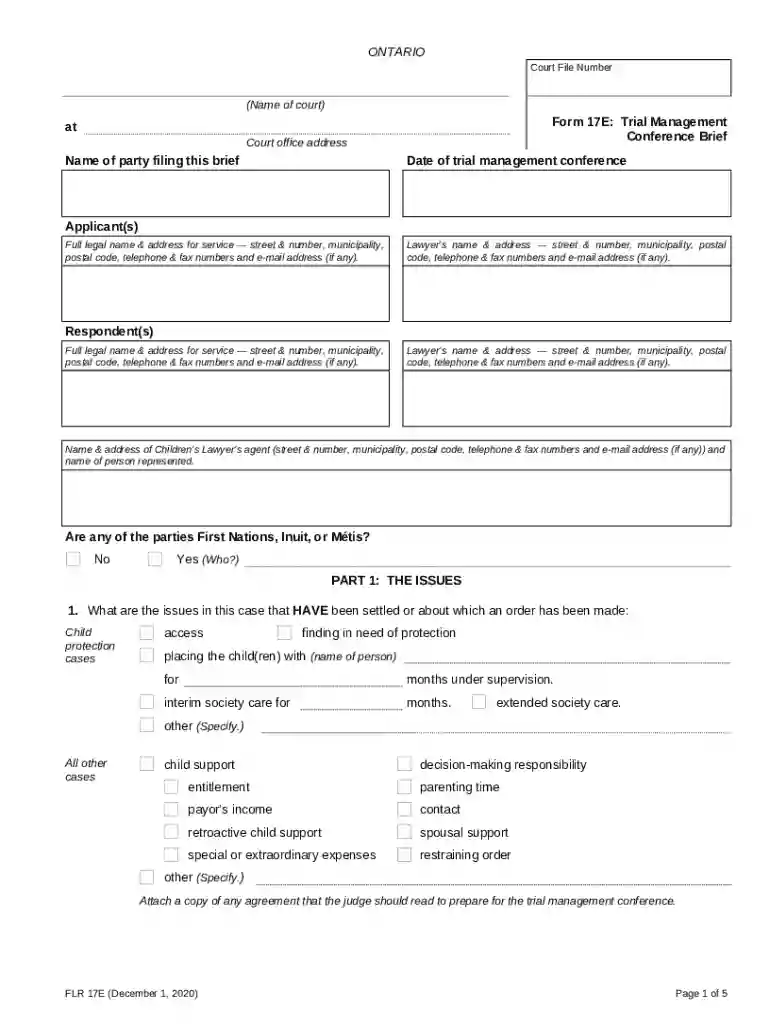
Type text, add images, blackout confidential details, add comments, highlights and more.

Draw your signature, type it, upload its image, or use your mobile device as a signature pad.

Send form 17e via email, link, or fax. You can also download it, export it or print it out.
The FLR 17E - Ontario Court Form serves as a Trial Management Conference Brief used in family law cases in Ontario. It is a comprehensive document aimed at streamlining the trial process, ensuring that all involved parties are adequately prepared and informed about the status of the case. This form is crucial for managing the procedural dynamics of family law cases, particularly within the contexts of child protection and other related legal matters.
In practice, this form is used by attorneys and legal representatives to present a clear picture of what will be addressed in the trial, making it easier for the court to manage time and resources effectively.
Completing the FLR 17E form requires attention to detail and an understanding of the case specifics.
Several key components make up the FLR 17E form, each addressing different aspects of trial management.
This section ensures that all critical information required for a smooth trial process is accounted for and accessible to the court.
Utilizing the form correctly can impact the efficiency of the trial preparation process.
An attorney uses the FLR 17E form to prepare for a family law trial involving child custody. They gather all necessary documentation, ensure all issues are clearly outlined, and submit the form to the court, ensuring a comprehensive briefing for everyone involved.
The legal role of the FLR 17E form extends beyond just organizational purposes. It is a binding document within the Ontario judicial system for trial preparation.
In cases involving litigations and disputes, the FLR 17E form serves as evidence of preparedness and facilitates a smoother judicial process.
Real-world examples highlight the utility and application of this form.
In an Ontario family court, the legal representatives of both parties use the FLR 17E form to outline their arguments and data, leading to a more organized and less contentious trial process.
Understanding specific terms related to the FLR 17E form can assist in its completion and application.
Familiarity with these terms ensures accurate completion and understanding of the form, facilitating smooth interactions during court proceedings.
While this form is used in Ontario, its structure and use may vary slightly based on specific court requirements or legal interpretations.
These distinctions are important for legal representatives who operate across different jurisdictions in Ontario.
We've got more versions of the trial management conference brief form. Select the right trial management conference brief version from the list and start editing it straight away!
At DocHub, your data security is our priority. We follow HIPAA, SOC2, GDPR, and other standards, so you can work on your documents with confidence.
by AC Mole 1932 Cited by 215 The trial court charged in accordance with the Ontario statute that the burden of proving contributory negligence was upon the defendant
Manatee County Property Appraiser. Circuit Court Supervisor. Address: 1509 24TH AVENUE DR W, BRADENTON, FL 34205-6458 wp/Rge: 35-34S-17E Neighborhood:


