




01. Edit your form online
Type text, add images, blackout confidential details, add comments, highlights and more.

Type text, add images, blackout confidential details, add comments, highlights and more.

Draw your signature, type it, upload its image, or use your mobile device as a signature pad.

Send it via email, link, or fax. You can also download it, export it or print it out.
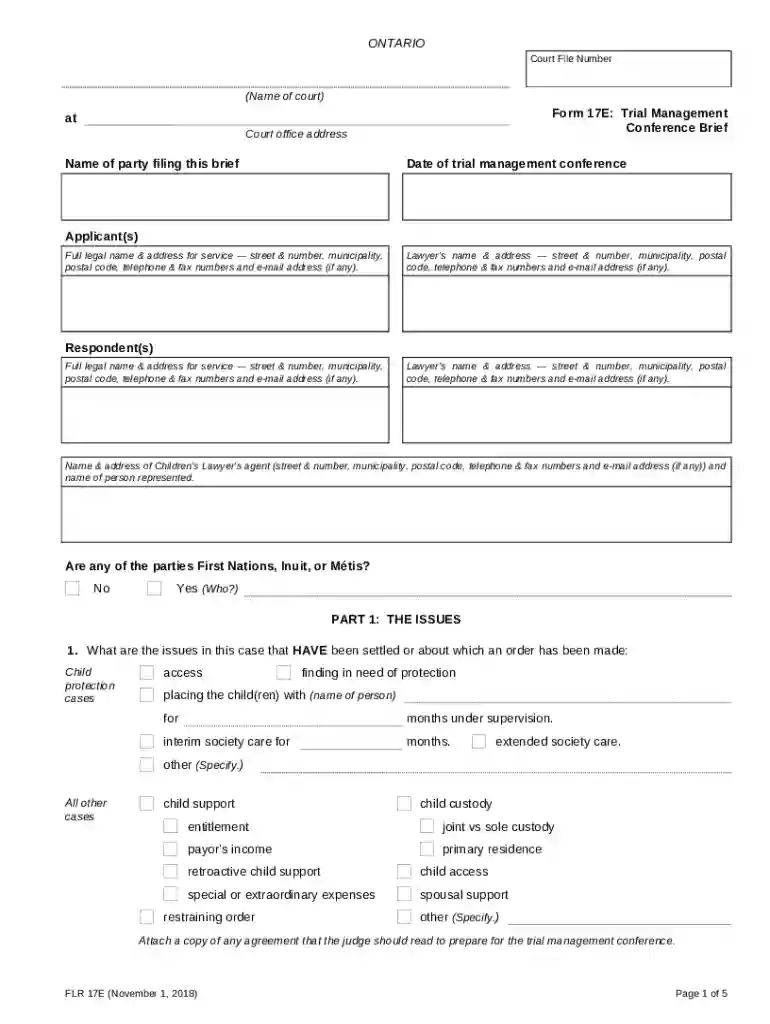
The FLR 17E Form 17E, also known as the Trial Management Conference Brief, is a critical document used within Ontario's family law courts to streamline trial preparation and management. This form provides a structured outline for summarizing the key elements of a case that need to be addressed during a trial management conference. It includes necessary details such as parties involved, settled and unsettled issues, and anticipated evidence like witness lists and expert reports. The purpose of this form is to facilitate efficient trial proceedings by enabling all parties and the presiding judge to have a clear overview of the case status and the issues that remain unresolved.
Using the FLR 17E Form requires careful attention to detail to ensure all pertinent information is accurately captured. Users must first familiarize themselves with each section of the form to understand what information is needed. This includes identifying parties, clearly stating both settled and unsettled matters related to child protection, custody, and support, and listing procedural aspects like necessary expert reports. The form should be completed comprehensively to avoid delaying the trial process. Legal representatives typically assist in filling out the form, ensuring that all relevant case details are presented clearly to align with Ontario court requirements.
Completing the FLR 17E Form involves several key steps to ensure that all required elements are addressed. This structured approach helps optimize the form's utility in court proceedings.
Gather Required Information: Begin by collecting all necessary documents and information. This includes orders, agreements, reports, and any other evidence intended for use during the trial.
Follow Section Guidelines: Understand each section of the form to ensure detailed and precise entries. Pay close attention to instructions regarding specific fields.
Detail Procedural Matters: Clearly list witness and expert testimonies along with any procedural requirements impacting the trial.
Review and Finalize: Thoroughly review the form for completeness and accuracy. Missing or incorrect information can delay court proceedings.
Submission: Ensure that the form is filed according to court deadlines and submission guidelines stipulated for your jurisdiction.
The FLR 17E Form consists of several critical components designed to facilitate an organized trial management process. Understanding these elements is crucial for users to prepare an effective conference brief.
The FLR 17E Form is legally mandated for use in Ontario family law cases reaching the trial stage. This legal requirement ensures that all necessary information is presented to the court efficiently, reducing delays and helping to manage case load. It provides a transparent overview for judges to assess pending issues, thereby facilitating informed decision-making. Legal representatives leverage this form to prioritize issues requiring judicial intervention, optimizing trial processes within the Canadian legal framework.
In family law cases, the FLR 17E Form is typically used by legal professionals, including lawyers and legal assistants, representing clients in court. Clients themselves may also be involved in its completion, particularly for providing signature or verification of details. It is primarily intended for use in Ontario's judicial system by individuals involved in trial management processes. The form ensures all parties have a cohesive understanding of the case dynamics and necessary trial components.


Understanding the terminology associated with the FLR 17E Form is essential for accurate completion and effective use.
Ontario's family law system mandates the use of the FLR 17E Form, ensuring structured and fair trial preparatory proceedings. As legal frameworks can differ significantly by jurisdiction, it is crucial to refer to provincial guidelines to understand any unique requirements influencing how the form should be completed and submitted. These rules may impact procedural timelines and dictate the exact documentation required for consideration in family law trials. Legal counsel familiar with Ontario's specific processes will be invaluable in navigating these jurisdictional nuances efficiently.
We've got more versions of the FLR 17E Form 17E, Trial Management Conference Brief form. Select the right FLR 17E Form 17E, Trial Management Conference Brief version from the list and start editing it straight away!
At DocHub, your data security is our priority. We follow HIPAA, SOC2, GDPR, and other standards, so you can work on your documents with confidence.
A subpoena must state the courts name and the title of the proceeding, include the seal of the court, and command the witness to attend and testify at the time
Arizona Rules of Civil Procedure (would simplify the procedure for getting a jury trial to ensure against waiver by mere inadvertence and to eliminate the jury
Herbal medicines for the management of opioid addiction. Patients using mitragynine for pain management report


