







Definition and Meaning of the Creighton Competency Evaluation Instrument
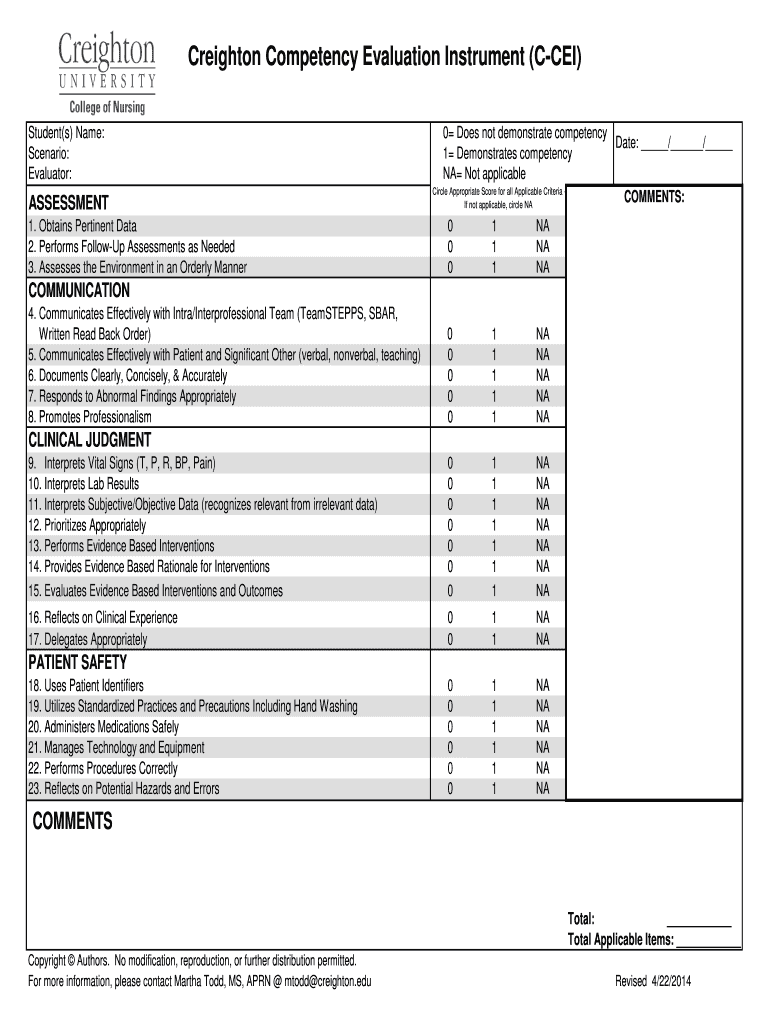
The Creighton Competency Evaluation Instrument (C-CEI) is a structured tool used to assess the competencies of healthcare students in clinical settings. It is specifically designed to evaluate essential nursing skills and their application. The instrument provides criteria for various competencies, including:
- Data Collection: How effectively students gather relevant patient information during assessments.
- Clinical Judgment: Assessment of decision-making skills when interpreting vital signs and lab results.
- Prioritizing Interventions: The ability to identify and prioritize urgent interventions to ensure patient safety.
- Communication Skills: Evaluating the ability to communicate effectively with patients and healthcare teams.
The C-CEI also emphasizes evidence-based practices and professionalism in clinical practice, ensuring students are prepared to meet the standards expected in the healthcare field.
How to Use the Creighton Competency Evaluation Instrument
Utilizing the Creighton Competency Evaluation Instrument involves a systematic approach to assessing the competencies of students. Here is a step-by-step guide on how to effectively implement the C-CEI:
-
Familiarization: Educators and evaluators must become familiar with the criteria outlined in the C-CEI. Understanding what each competency entails is crucial for accurate evaluation.
-
Preparation: Set up the evaluation environment to ensure it simulates real clinical conditions. This includes preparing scenarios or clinical cases relevant to the competencies being assessed.
-
Conduct Assessments: As students perform clinical tasks, evaluators should observe and document their actions against the established criteria in the C-CEI.
-
Feedback and Scoring: After assessments, provide students with feedback based on specific competencies. Use the scoring system to quantify their performance, indicating areas of strength and improvement.
-
Follow-Up: Discuss with students how they can enhance their competencies based on the evaluation results. Create improvement plans tailored to individual needs.
Important Terms Related to the Creighton Competency Evaluation Instrument
Familiarity with key terms associated with the Creighton Competency Evaluation Instrument aids in understanding its application and importance. Significant terms include:
- Competency: The ability to perform tasks or skills to a defined standard, especially within clinical care settings.
- Evaluator: A trained individual responsible for assessing the student's performance using the C-CEI.
- Clinical Simulation: A method of assessing students through role-playing or realistic clinical scenarios that mimic real-life situations.
- Feedback Loop: The process of providing immediate feedback to students during or after evaluations to enhance learning outcomes.
By grasping these concepts, users of the C-CEI can engage more effectively in the assessment process.
Examples of Using the Creighton Competency Evaluation Instrument
Practical examples showcase how the Creighton Competency Evaluation Instrument is effectively implemented in various educational settings. Here are several scenarios:
-
Nursing Students: In a nursing program, instructors use the C-CEI to evaluate students' skills in managing patient care during clinical rotations. The assessment may include direct supervision of tasks such as administering injections, interpreting chest x-rays, and communicating care plans to colleagues.
-
Healthcare Workshops: Workshops focusing on advanced clinical skills may employ the C-CEI to assess participants' preparedness for real-world medical challenges. For instance, an advanced cardiac life support course might use the instrument to assess teamwork and decision-making in emergency situations.
-
Simulation Labs: In simulation labs, students enact complex patient care scenarios, followed by evaluations using the C-CEI. In this environment, the instrument helps ensure adherence to best practices and educational standards concerning patient safety and quality care.
Steps to Complete the Creighton Competency Evaluation Instrument
Completing the Creighton Competency Evaluation Instrument requires careful adherence to the outlined process. The following steps guide the evaluation from start to finish:
-
Preparation: Review the criteria in the C-CEI. Gather necessary materials or documentation that may be pertinent to the assessment.
-
Set the Scene: Create a clinical scenario that aligns with the competencies being evaluated, ensuring it mirrors authentic clinical cases.
-
Observation: As students engage in the clinical scenario, evaluators carefully observe their performance, taking notes on specific actions related to each competency.
-
Documentation: After the scenario, document evaluations according to the C-CEI criteria. Use a structured scoring rubric to ensure clarity and objectivity.
-
Feedback: Provide constructive feedback to the student, focusing on strengths and areas for growth in relation to the competencies assessed.
By following these steps, educators and evaluators can ensure effective and meaningful assessments using the Creighton Competency Evaluation Instrument.




