
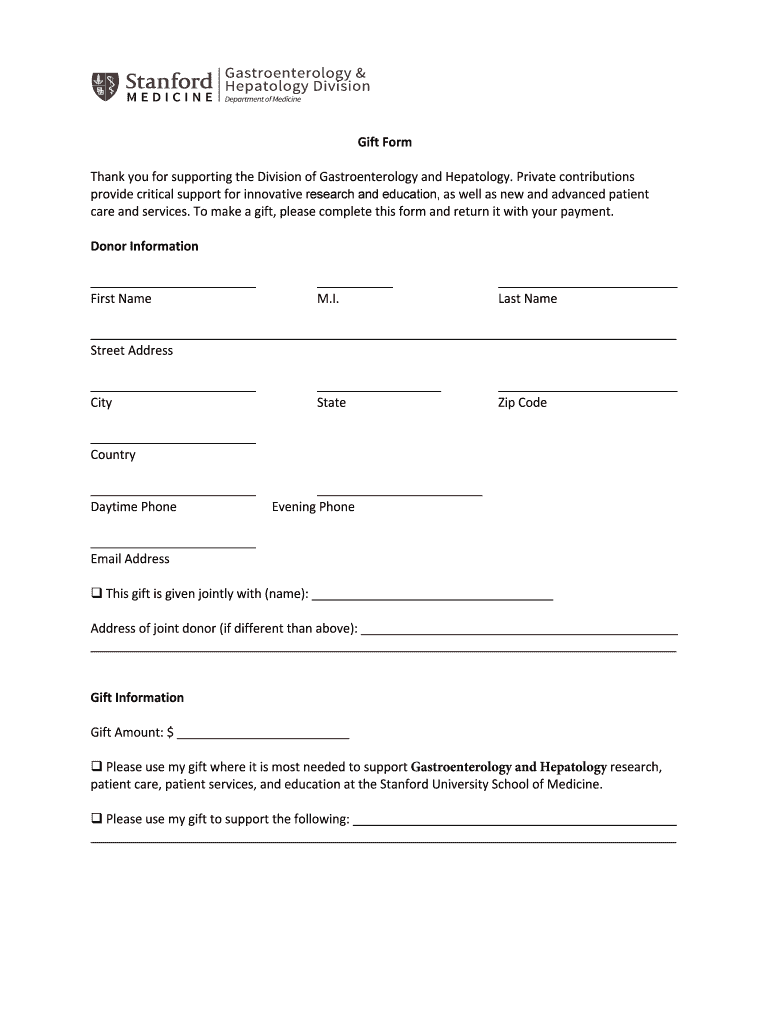







Definition and Purpose of the GI-Gift-Form
The GI-Gift-Form is a specialized donation form used to facilitate contributions to the Division of Gastroenterology and Hepatology at Stanford University. Its primary function is to streamline the process for donors who wish to support research, education, and patient care initiatives within the division. By using this form, donors can efficiently provide necessary personal and donation information, select specific allocation options for their contributions, and ensure that their financial gifts are directed to the areas of most significant impact.
Key Elements of the GI-Gift-Form
The GI-Gift-Form is composed of several essential sections that help donors provide accurate and comprehensive information. These key elements include:
- Donor Information: This section collects the donor's name, contact details, and other identifying information necessary for processing the donation.
- Gift Allocation Options: Donors can specify areas within the Division of Gastroenterology and Hepatology where they would like their contributions to be used. This personalization ensures that funds are allocated according to the donor's wishes.
- Tribute Gifts: This option allows donors to make a contribution in honor or memory of someone special, providing an additional personal touch to the donation.
- Payment Instructions: Clear guidelines on how to complete the payment process are provided, ensuring that donors can fulfill their pledges without complications.
How to Use the GI-Gift-Form
Utilizing the GI-Gift-Form effectively involves several straightforward steps, enabling donors to complete the process with ease:
- Access the Form: Secure the GI-Gift-Form either through Stanford University's development office or their official website.
- Fill Out Donor Information: Enter all required personal details, ensuring accuracy for record-keeping and communication purposes.
- Select Gift Allocation: Choose how to allocate your donation among the various projects and initiatives within the division.
- Consider Tribute Gifts: If desired, provide details for tribute donations, specifying whom you are honoring or memorializing.
- Complete Payment Instructions: Follow the form's payment guidelines to finalize the contribution, using the available payment methods.
Steps to Complete the GI-Gift-Form
Filling out the GI-Gift-Form properly ensures that your donation is processed without delay. Follow these steps for a seamless experience:
- Download or Request the Form: Access the GI-Gift-Form from the designated source.
- Prepare Necessary Information: Gather the required donor information and details about the gift allocation.
- Fill in Personal and Donation Details: Enter your information in the appropriate sections, ensuring accuracy and completeness.
- Specify Allocation Preferences: Indicate which areas within the division should benefit from your donation.
- Include Tribute Details: If applicable, provide information regarding any tribute associated with your gift.
- Review and Submit: Double-check all entries for correctness. Submit the form as instructed, either online or via mail.
Who Typically Uses the GI-Gift-Form
The GI-Gift-Form is predominantly used by individuals and organizations committed to advancing the research and educational goals of Stanford University’s Division of Gastroenterology and Hepatology. Typical users include:
- Alumni and Family Members: Those with personal connections to the university seeking to give back to the institution.
- Medical Professionals: Doctors and researchers aiming to support innovations in gastroenterology and hepatology.
- Philanthropic Organizations: Groups dedicated to funding medical research and education.
- Current and Former Patients: Individuals looking to express gratitude for care received by contributing financially to ongoing medical advancements.


Examples of Using the GI-Gift-Form
Practical use cases of the GI-Gift-Form highlight its utility in various scenarios:
- Commemorative Donations: An alumnus donates in memory of a family member who received care at the center and specifies funds for liver disease research.
- Corporate Sponsorship: A healthcare company uses the form to allocate a substantial contribution towards a cutting-edge clinical study.
- Annual Alumni Giving: Graduates from the medical school collectively use the form for the annual alumni fund drive, directing their resources to the most pressing departmental needs.
Legal Use of the GI-Gift-Form
In the context of U.S. law, the GI-Gift-Form adheres to regulations concerning charitable contributions:
- Tax Deductible Contributions: As a contribution to a recognized institution, donations made via this form qualify for tax deductions under IRS guidelines, provided all documentation is accurately maintained.
- Compliance with ESIGN Act: If the form is completed and submitted electronically, it complies with digital transaction laws, ensuring the validity of electronic submissions and signatures.
Important Terms Related to GI-Gift-Form
Understanding certain terminology is crucial for comprehending the full scope of the GI-Gift-Form:
- Donor Relations: The process of managing and nurturing relationships with individuals who provide support to the institution.
- Gift Stewardship: The oversight and management of charitable contributions to ensure they are used according to donor specifications.
- Allocation Funds: Designated financial resources allocated to specific areas or projects within the university.
By covering these aspects in detail, the GI-Gift-Form can serve not only as a tool for contributions but as a bridge between donors and impactful advancements in gastroenterology and hepatology.




