




01. Edit your w9 formulario online
Type text, add images, blackout confidential details, add comments, highlights and more.

Type text, add images, blackout confidential details, add comments, highlights and more.

Draw your signature, type it, upload its image, or use your mobile device as a signature pad.

Send w9 descargar via email, link, or fax. You can also download it, export it or print it out.
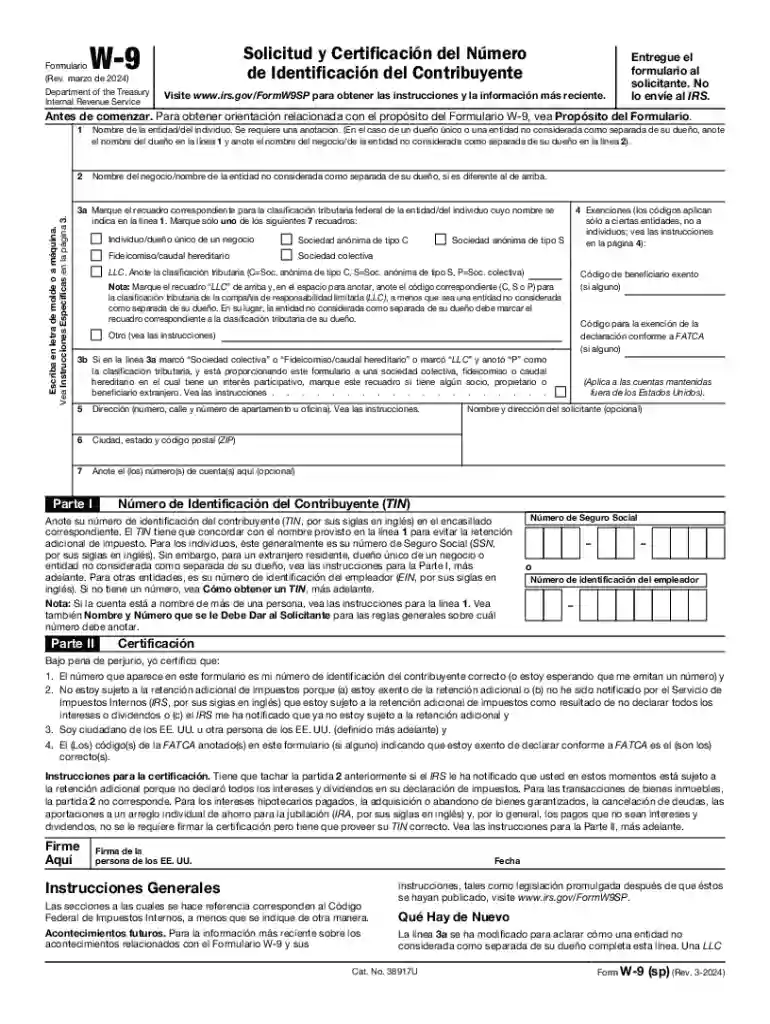
The Form W-9 is a document requested by the IRS that allows individuals and entities in the U.S. to provide their Taxpayer Identification Number (TIN). The revised March 2024 version includes updated instructions and requirements. The Spanish version, Form W-9 (sp), serves the same purpose but is translated to aid Spanish-speaking taxpayers. This form is essential for providing accurate information for tax reporting purposes, ensuring compliance with IRS guidelines.
Enter Your Information: Fill out your name as it appears on your tax return, and if applicable, your business name.
Tax Classification: Indicate your federal tax classification. Options include individual, corporation, and partnership.
Exemptions: Identify any applicable exemptions from backup withholding or FATCA reporting.
Address: Provide your address, including street, city, state, and ZIP code.
Taxpayer Identification Number: Enter your Social Security Number (SSN) or Employer Identification Number (EIN).
Certification: Sign and date the form to certify the truthfulness of the information. This is crucial for the form's validity.
Personal Information: Includes essential identifiers such as name and address.
Tax Status: Highlights your classification and any exemptions.
TIN Details: Key section where you provide your TIN to the requester.
Signature Box: Certifies that the information provided is correct under penalty of perjury.
The IRS uses the data from Form W-9 to verify the taxpayer's identity and to report income that can be taxable. The updated guidelines emphasize precision in filling the form accurately to align with FATCA and backup withholding laws. Utilizing the Spanish version ensures comprehension and accuracy for Spanish-speaking individuals, preventing potential misunderstandings.
The form ensures compliance with FATCA by having individuals declare if they're exempt from foreign account reporting.
Common exemptions include some non-financial entities and corporations.
Legally, the Form W-9 is a certification document used for tax purposes, indicating the correct TIN and tax classification. Failure to provide accurate information can result in penalties or withholding by the IRS. As of the March 2024 revision, specific legal requirements for disregarded entities have been clarified, promoting transparency and compliance.
Inaccurate or missing information may lead to penalties up to $50 per infraction.
Deliberate falsifications carry harsher penalties under IRS law.
Primarily, this form is utilized by U.S. citizens and residents, businesses, and other entities that need to provide TINs to entities requesting the information for tax purposes. Contractors, freelancers, and business entities, particularly in industries with diverse workforces, benefit from using the Spanish version to accommodate team members for whom Spanish is the first language.


Submitting a W-9 has become more flexible with options like online submission, using secure document management platforms, or traditional mailing. The choice can depend on user preference and the requester's instructions.
Online: Utilize secure platforms that comply with IRS guidelines for electronic submission.
Mail: Send a hard copy via USPS, ensuring proper documentation of the mailing process.
In-Person: Physical delivery might be required in certain cases of direct tax agency involvement.
Different taxpayer groups have varied uses for the form. Self-employed and freelancers often submit this form to clients to report revenue. Retired individuals may use it when receiving pension or annuity income, while students on scholarships might need it to report educational grants.

A graphic designer beginning a new contract with a firm completes Form W-9 to ensure the client's records are accurate for year-end tax documentation.
Partnerships in consulting may require each partner to submit separate Form W-9s to consolidate tax information efficiently.
Non-profit entities serving diverse communities often request the Spanish version to ensure their contributors accurately provide necessary information without language barriers.
For property managers collecting rental income, providing a Form W-9 ensures that income is properly documented without withholding complications.
We've got more versions of the w9 formulario form. Select the right w9 formulario version from the list and start editing it straight away!
At DocHub, your data security is our priority. We follow HIPAA, SOC2, GDPR, and other standards, so you can work on your documents with confidence.


