







Definition & Meaning
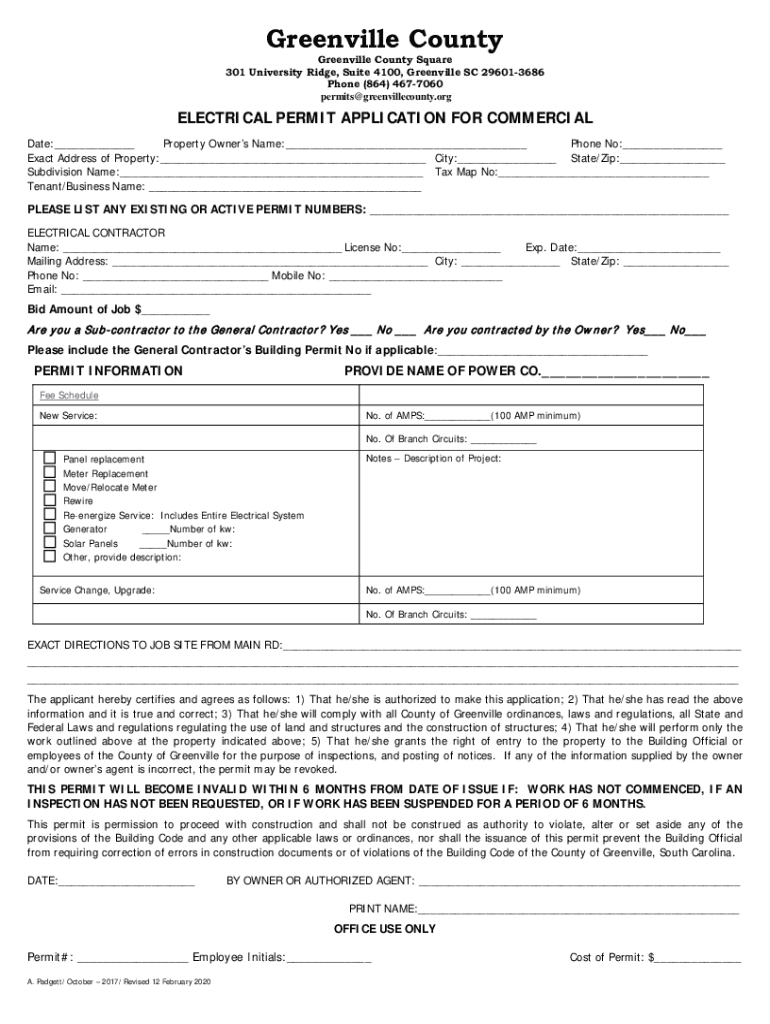
Greenville County Building Safety forms are official documents used to ensure compliance with local building regulations in Greenville County, South Carolina. These forms are essential for the administration of building codes related to construction, renovation, or modification of properties within the county. They serve as a means to collect critical data on property and project specifications, ensuring that all safety measures and regulatory requirements are adhered to. By using these forms, applicants can convey detailed information about their building projects, which is crucial for obtaining necessary permits and approvals from local authorities.
How to Use Greenville County Building Safety Forms
To effectively use the Greenville County Building Safety forms, it’s important to understand their structure and required components. Users must start by accurately filling in sections regarding the property's address, owner's details, and contractor information. Following this, project specifics such as type, scope, and estimated costs need to be detailed. Each form may also include sections for outlining compliance with local safety regulations. It's vital to follow each section carefully, providing all necessary information as incomplete forms can lead to delays in processing and approval.
- Begin by downloading the form from the official Greenville County website.
- Fill out personal and project details, ensuring accuracy to avoid any discrepancies.
- Attach supporting documents, such as project blueprints and compliance certifications.
- Ensure that all fields are completed; use the instructions provided with the form for guidance.
Steps to Complete Greenville County Building Safety Forms
Completing these forms involves a systematic approach to ensure all necessary information is included:
- Gather Information: Collect all necessary details about the property and project, including contractor and architectural data.
- Fill Out the Form: Begin by entering basic personal and contact information, then move on to more detailed sections about the construction project.
- Include Compliance Data: Ensure all relevant safety and compliance data is accurately filled in, affirming adherence to local building codes.
- Review and Double-Check: Carefully review all entered information for accuracy and completeness.
- Submit the Form: Submit the form as directed, whether in-person, online, or via mail, ensuring it reaches the correct office.
Important Terms Related to Greenville County Building Safety Forms
Understanding specific terms commonly used in these forms will enhance the accuracy and efficiency of the submission process:
- Permit: An official document granting permission to carry out specific construction, renovation, or modification tasks.
- Compliance: Adherence to established laws, regulations, and guidelines related to building standards.
- Inspection: An official examination of the construction site to ensure conformity with safety and building regulations.
- Zoning: Regulations that define how particular areas of land can be used for specific purposes or types of development.
Legal Use of Greenville County Building Safety Forms
The legal use of these forms is vital for ensuring the safety and legality of construction projects. They are designed to uphold public safety by verifying that construction activities comply with building codes and regulations specific to Greenville County. Contractors and property owners are required by law to obtain the necessary permits before commencing any construction work. Failure to do so may result in legal penalties, fines, or the halting of the project.
Key Elements of Greenville County Building Safety Forms
The forms typically contain the following key elements:
- Property Information: Details about the location and specifications of the property where work is to be done.
- Project Scope: Description of the type and extent of work planned.
- Contractor Details: Information about the contractor, including licensing and insurance details.
- Compliance Assurance: Sections to confirm that the planned work meets all necessary building and safety standards.
State-Specific Rules for Greenville County Building Safety Forms
Greenville County adheres to state-specific regulations that are tailored to local environmental and urban planning needs. It is essential for applicants to be aware of these regulations, which might include unique zoning laws, environmental protections, and regional building codes. Failure to comply with these can result in delays or denial of the permit application.
Examples of Using Greenville County Building Safety Forms
Consider an example where a property owner intends to add an extension to an existing building. The owner must use the Building Safety forms to document necessary project details, such as the proposed dimensions of the extension and materials to be used. Accurate submission of this information allows the county to assess compliance with local codes and, upon approval, issue the necessary construction permit.
Eligibility Criteria
To be eligible to submit a Greenville County Building Safety form, the applicant must be either the property owner, a designated representative, or a licensed contractor. Proof of ownership or a legal agreement may be required to validate the application. Contractors must ensure that all licenses and insurances are current and valid according to local law.


Application Process & Approval Time
The process for submitting the forms begins with gathering all required information and documentation, followed by completing the form with careful accuracy. Submission methods vary: it can be done online, via mail, or in person. Approval times can vary depending on the project's complexity and workload at the relevant county office. Typically, straightforward applications are processed more swiftly, while complex projects might require additional reviews and inspections, extending the approval time.
Software Compatibility
For digital submission, ensure compatibility with relevant tools and platforms like DocHub, which can facilitate electronic form filling, signing, and submission. These platforms often support various document formats like PDF, making it easier to compile and organize necessary paperwork for online submission.




