
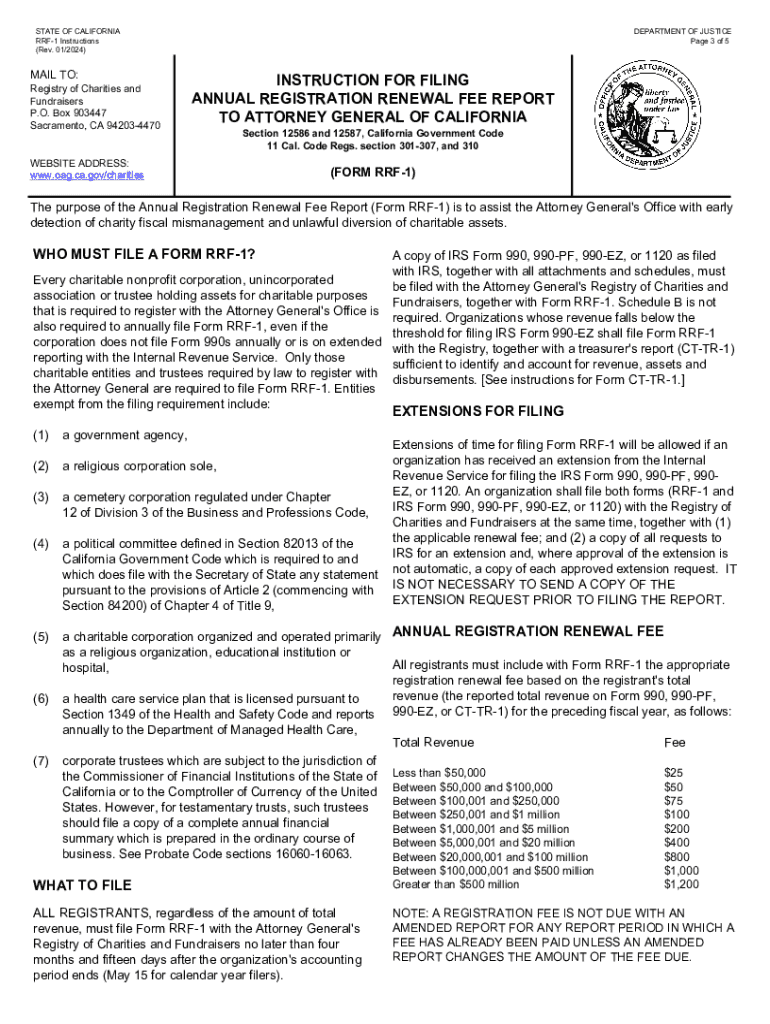







Definition and Purpose of Form RRF-1
Form RRF-1, or the Annual Registration Renewal Fee Report, is a requirement for charitable organizations operating in California, as regulated by the Attorney General’s Office. This form is designed to ensure these organizations maintain transparency and accountability in their financial operations. By requiring disclosures of financial activities, the form aims to protect public interest and maintain public trust in charitable activities.
Important Details
- Who Must File: Most charitable organizations registered in California must submit the RRF-1 annually, unless exempt.
- Information Required: Total revenue, any supporting IRS documentation, and details of specific financial activities must be included.
How to Use Form RRF-1 Effectively
Using Form RRF-1 properly involves understanding both its content requirements and filing timelines. Organizations should prepare by gathering detailed financial records and coordinating with all relevant parties responsible for financial management.
Step-by-Step Usage
- Gather Necessary Financial Documents: Include IRS Form 990, 990-EZ, or 990-PF, as applicable.
- Complete Financial Details: Provide accurate totals for revenues, assets, and other financial metrics as required.
- Verify All Information: Ensure that all details on the form are correct and consistent with submitted IRS forms.
- Designate Signatures: The form must be signed by one of the organization's directors or trustees.
Submission Methods for Form RRF-1
Charitable organizations have several options for submitting the RRF-1, depending on their preferences for convenience and security.
Available Submission Methods
- Online Submission: Through the California Attorney General's website; provides instant confirmation of receipt.
- Mail Submission: Send the completed form and supporting documents to the relevant address.
- In-Person Submission: Available at the designated offices, though less common.
Filing Deadlines and Important Dates for Form RRF-1
Timeliness is crucial when filing the RRF-1 to avoid penalties and maintain good standing with regulatory bodies.
Key Dates
- Initial Deadline: Typically four months and 15 days after the end of the fiscal year.
- Extension Requests: Can be submitted for valid reasons, but must conform to guidelines set by the Attorney General.
Required Documents to Accompany Form RRF-1
Supporting documentation is essential to provide a complete picture of the organization's financial health.
Essential Documents
- IRS Forms: Include IRS Form 990, 990-EZ, or 990-PF for the corresponding tax year.
- Financial Statements: Audited if the total revenue exceeds thresholds specified by California law.
Eligibility for Filing Form RRF-1
Understanding who is required to file ensures compliance and avoids unnecessary audits or penalties.
Eligibility Criteria
- Registered Status: Organizations must be actively registered as charitable entities in California.
- Exemptions: Certain religious organizations and educational institutions may be exempt, depending on their activities.


Penalties for Non-Compliance with Form RRF-1
Failure to submit the RRF-1 correctly and on time can lead to serious consequences, affecting the organization's operational capacity.
Possible Penalties
- Fines and Fees: Monetary penalties may be assessed for late or incorrect filings.
- Revocation of Registration: Continued non-compliance could result in the loss of the organization’s ability to legally solicit donations within the state.
Examples of Using Form RRF-1 in Practice
Learning from real-world scenarios can help organizations better understand the filing process and avoid common pitfalls.
Practical Scenarios
- Small Non-Profits: May only need to report essential revenue information if under specific asset thresholds.
- Large Charities: Require comprehensive documentation, including detailed financial audits, due to higher revenue and asset values.
By adhering to these structured guidelines and conducting due diligence before submission, organizations can successfully navigate the complexities of the RRF-1 filing process, ensuring transparency and accountability to their donors and regulatory entities.




