




01. Edit your ea 100 info online
Type text, add images, blackout confidential details, add comments, highlights and more.

Type text, add images, blackout confidential details, add comments, highlights and more.

Draw your signature, type it, upload its image, or use your mobile device as a signature pad.

Send ea 100 form via email, link, or fax. You can also download it, export it or print it out.
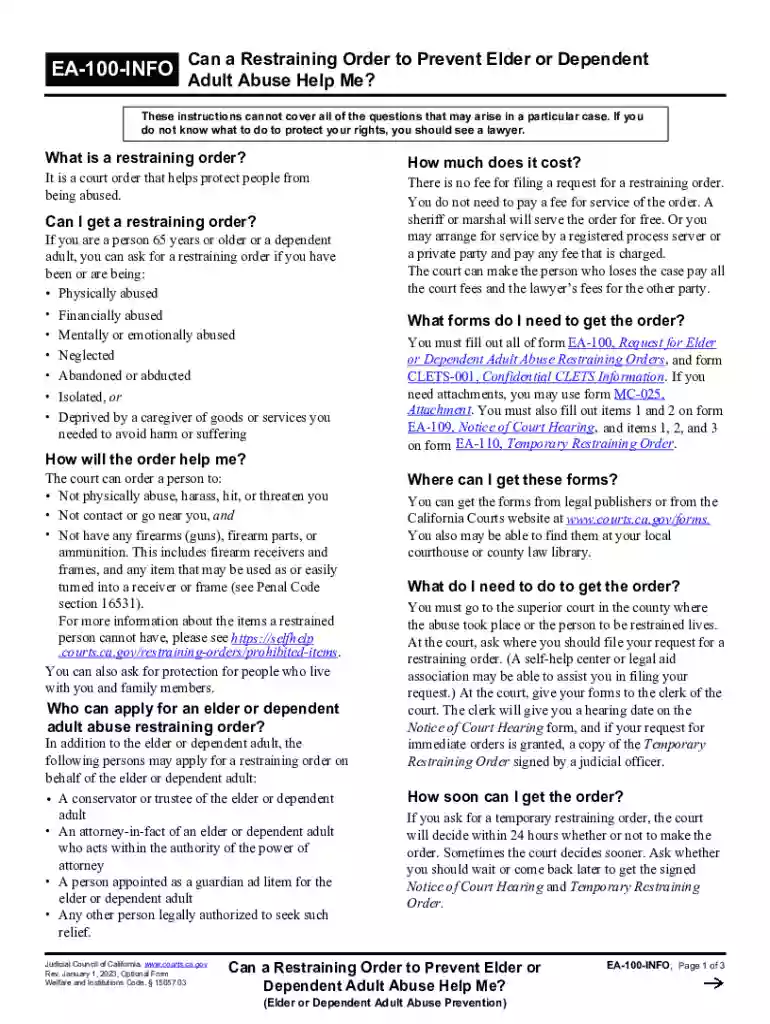
Restraining orders are legal documents issued by a court designed to protect individuals from abuse or harassment. Specifically, restraining orders to prevent elder or dependent adult abuse aim to safeguard those over 65 or adults 18-64 with physical or mental limitations that restrict their ability to perform normal functions. These orders can prevent various forms of harm, including physical, financial, or emotional abuse, ensuring the safety and well-being of vulnerable individuals.
These orders can impose several restrictions, such as prohibiting contact or requiring the abuser to stay away from the protected person. It's a crucial tool to prevent further harm, allowing elders and dependent adults to live without fear. Understanding the order's framework and requirements is essential for effectively utilizing this legal protection.
Obtaining a restraining order to prevent elder or dependent adult abuse involves several key steps. Here’s a detailed look at the process:
Identify the Need: Determine if the situation involves abuse or threats that necessitate a restraining order. Consulting with legal professionals can help clarify if the case qualifies for a restraining order.
Collect Evidence: Gather any necessary evidence, such as photographs, medical reports, or eyewitness accounts, to support the claim of abuse or potential harm.
Complete Necessary Forms: Obtain and fill out the appropriate forms, often starting with a petition for a restraining order. These might include forms that outline the nature of the abuse and provide details about the parties involved.
File the Forms: Submit the completed forms to the appropriate court. In many states, there are specialized departments or clerks who handle elder abuse restraining orders.
Attend the Hearing: Once filed, a court hearing will be scheduled. Present the case, including evidence and any witness testimony, to support the need for a restraining order.
Receive the Order: If the court agrees, a temporary restraining order may be issued. Depending on the jurisdiction, a permanent order may be granted after additional hearings.
Completing the necessary forms for a restraining order is a detailed process that requires accuracy:
Personal Information: Clearly list the details of the person seeking protection and the respondent (abuser) including names, addresses, and relationships.
Nature of the Abuse: Provide specific incidents, including dates and descriptions of abuse. Highlight immediate threats or past patterns of behavior.
Request for Relief: Specify the type of protection needed, such as no contact orders or mandatory distance requirements.
Supporting Documents: Attach any supporting evidence, such as medical records or police reports, that corroborate the claims made in the form.
The restraining order holds significant legal weight. Violating the terms of a restraining order is a criminal offense and can result in penalties such as fines or imprisonment. The order serves as a legal tool to prevent potential harm and maintain the safety of vulnerable individuals.
Courts enforce these orders rigorously, and law enforcement agencies have the authority to arrest individuals who breach the order’s terms. This legality reinforces the restraining order’s effectiveness in deterring abuse and ensuring protection.
Eligibility for a restraining order to protect an elder or dependent adult typically requires that the individual is over 65 years old or has a dependent status due to mental or physical limitations. They must be experiencing abuse or credible threats of harm.
The restraining order can be sought by the individual themselves, their legal representative, or a concerned party acting on their behalf. It's important to note the specific state regulations that may apply to eligibility, as local jurisdictions can have specific criteria stipulating who can file and under what circumstances.


State regulations dictate specific processes and criteria for obtaining restraining orders. For instance:
California: In California, the process involves submitting an EA-100 form along with evidence and attending a court hearing. The state emphasizes assistance for elder abuse and provides avenues for emergency orders.
Florida: Florida law requires evidence of imminent harm and swiftly processes restraining orders through dedicated legal pathways for elder abuse.
Understanding state-specific rules is crucial, as it impacts filing procedures and eligibility criteria. Consulting with local legal resources can clarify these variations.
To successfully obtain a restraining order, comprehensive documentation and evidence are essential.
Witness Statements: Testimonies from individuals who have witnessed abuse or threatening behavior.
Medical Reports: Documentation of physical injuries or psychological assessments.
Financial Records: Proof of financial exploitation, if applicable.
Police Reports: Any previous complaints or incidents officially recorded can strengthen the case.
Properly organizing and presenting this evidence can significantly influence the court's decision and ensure the protection order is granted and enforced.
Restraining orders for the protection of elders or dependent adults are applicable in various scenarios:
Physical Abuse: An elder being physically harmed by a caregiver or family member can seek protection through a restraining order.
Financial Exploitation: Instances where a dependent adult's financial resources are being manipulated can lead to a court-mandated order.
Emotional Abuse: Persistent verbal abuse or psychological manipulation can justify the need for legal intervention via a restraining order.
Analyzing these scenarios helps in understanding when a restraining order becomes necessary and the protection it offers against abuse.
We've got more versions of the ea 100 info form. Select the right ea 100 info version from the list and start editing it straight away!
At DocHub, your data security is our priority. We follow HIPAA, SOC2, GDPR, and other standards, so you can work on your documents with confidence.
The prevention of sepsis is dependent on good practice to avoid nosocomial infections and using antimicrobial prophylaxis and therapy in a prudent and well-.Read more
Elderly Persons and Persons with Disabilities Abuse Prevention Act (EPPDAPA) Obtaining a Restraining Order Forms Renewing a Restraining Order Forms.Read more


