




01. Edit your app 012 online
Type text, add images, blackout confidential details, add comments, highlights and more.

Type text, add images, blackout confidential details, add comments, highlights and more.

Draw your signature, type it, upload its image, or use your mobile device as a signature pad.

Send court form california via email, link, or fax. You can also download it, export it or print it out.
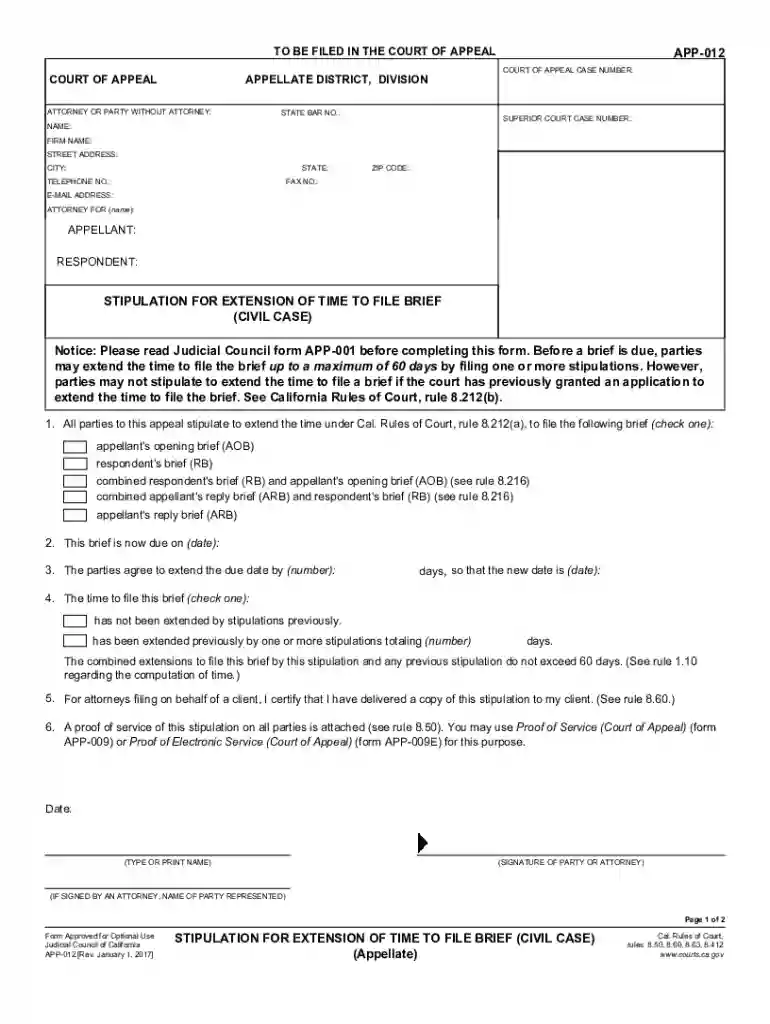
The APP-012 form is a Judicial Council form used in the California Court of Appeal to stipulate an extension of time for filing various types of briefs in a civil case. This form facilitates an agreement between parties to delay the deadline for submitting briefs, such as the appellant's opening brief or the respondent's brief. The maximum extension allowed is 60 days. The form ensures both parties have sufficient time to prepare their documentation and arguments, thus promoting fairness and thoroughness in legal proceedings.
Utilizing the APP-012 form involves several steps to ensure it is completed correctly.
Completing the APP-012 form accurately is critical to the stipulation process.
Several critical elements are essential to successfully completing the APP-012 form:
The APP-012 form serves a legal function by enabling parties to mutually agree on an extension for filing briefs, ensuring compliance with judicial processes. Non-compliance or incorrect use can lead to the default of rights to an extension, potentially impacting case outcomes.
While the form is used specifically within California's legal system, different states might have varying procedures or forms for managing extension requests.
Methods for submitting the APP-012 form vary, accommodating different preferences and capabilities:
Practical examples illustrate the form’s usage in real-world scenarios:
Failure to properly complete or submit the APP-012 form can result in penalties or forfeiting the right to an extension. To prevent this:
These sections collectively provide in-depth coverage of the APP-012 form’s uses, compliance requirements, and practical considerations, offering essential insights for legal practitioners and parties involved in civil cases.
We've got more versions of the app 012 form. Select the right app 012 version from the list and start editing it straight away!
At DocHub, your data security is our priority. We follow HIPAA, SOC2, GDPR, and other standards, so you can work on your documents with confidence.
Tell the Court of Appeal that all the parties in an appeal in a civil case have agreed to give one of the parties more time to file a brief.Read more
The supreme court has mandated electronic filing in civil cases, including family and probate cases, by attorneys in appellate courts, district courts,


