




01. Edit your ch 130 online
Type text, add images, blackout confidential details, add comments, highlights and more.

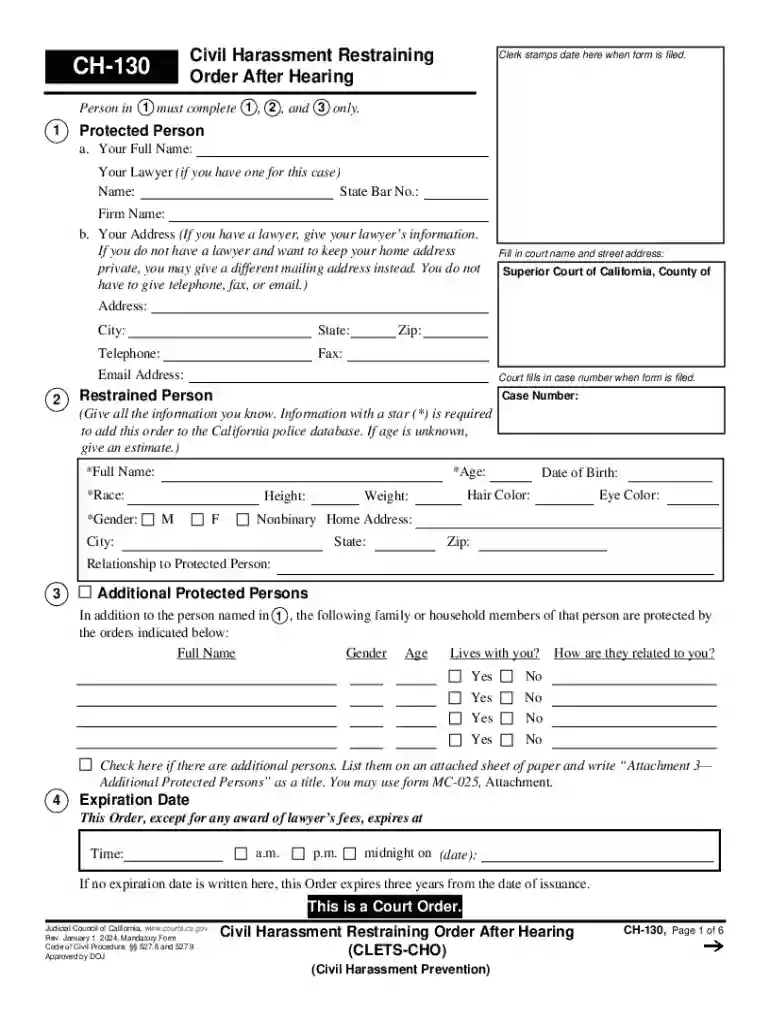
Type text, add images, blackout confidential details, add comments, highlights and more.

Draw your signature, type it, upload its image, or use your mobile device as a signature pad.

Send ch 130 form via email, link, or fax. You can also download it, export it or print it out.
The CH-260 Proof of Service of Order After Hearing by Mail is a legal document that verifies the delivery of a court order from a hearing. This document is essential in civil harassment cases processed through the Superior Court of California. It confirms that the required parties have been notified of the court's decision via mail, ensuring compliance with legal procedures. The form includes information about the type of order served, such as personal conduct or stay-away provisions, and identifies the individuals involved, namely the Protected Person and the Restrained Person.
The CH-260 form consists of several critical components that must be completed accurately to ensure its validity:
The CH-260 form is utilized by individuals involved in civil harassment cases within California's jurisdiction. It is mainly used by legal professionals, such as attorneys and paralegals, to ensure that court orders are appropriately served after a hearing. Additionally, individuals acting as servers, who must be persons over 18 and not a party to the action, rely on this document to complete their duty effectively and legally.


Legally, the CH-260 Proof of Service of Order After Hearing by Mail is used to validate that due process has been followed in notifying parties of a court's decision. This ensures that both the Protected and Restrained Persons have received the legally mandated information about the orders. Failure to provide proper proof of service may lead to legal repercussions, including the invalidation of the enforcement of the order.
In California, specific rules govern the use of the CH-260 form. The state mandates that service be conducted by someone who is not a party to the case and is 18 years or older. California courts require strict adherence to the form's completion guidelines to ensure it meets the required legal standards. Failure to follow these rules can result in complications or delays in the legal process.
Understanding the terminology related to the CH-260 form is crucial:
Non-compliance with the service requirements of the CH-260 form can lead to significant legal penalties, such as:
While the CH-260 form is available in both digital and paper formats, legal professionals often use the digital version for convenience, especially for filing and record-keeping purposes. The digital form can be completed and stored electronically, ensuring easy access and submission through compatible legal software systems. However, the server must ensure that the physical copy is mailed correctly to meet the legal requirements for the proof of service.
We've got more versions of the ch 130 form. Select the right ch 130 version from the list and start editing it straight away!
At DocHub, your data security is our priority. We follow HIPAA, SOC2, GDPR, and other standards, so you can work on your documents with confidence.
A 4-week exposure to 500 ppm of toluene resulted in more severe disturbances in hearing than were seen after 1 week, but the effects were still reversible.Read more
(1), and you can use Form CH-260, Proof of. Service of Order After Hearing by Mail. If the terms of the Order differ from the TRO, then the defendant must beRead more
Download EA-260 Proof of Service of Order After Hearing by Mail Effective: January 1, 2012 See form info der or Dependent Adult Restraining Order


