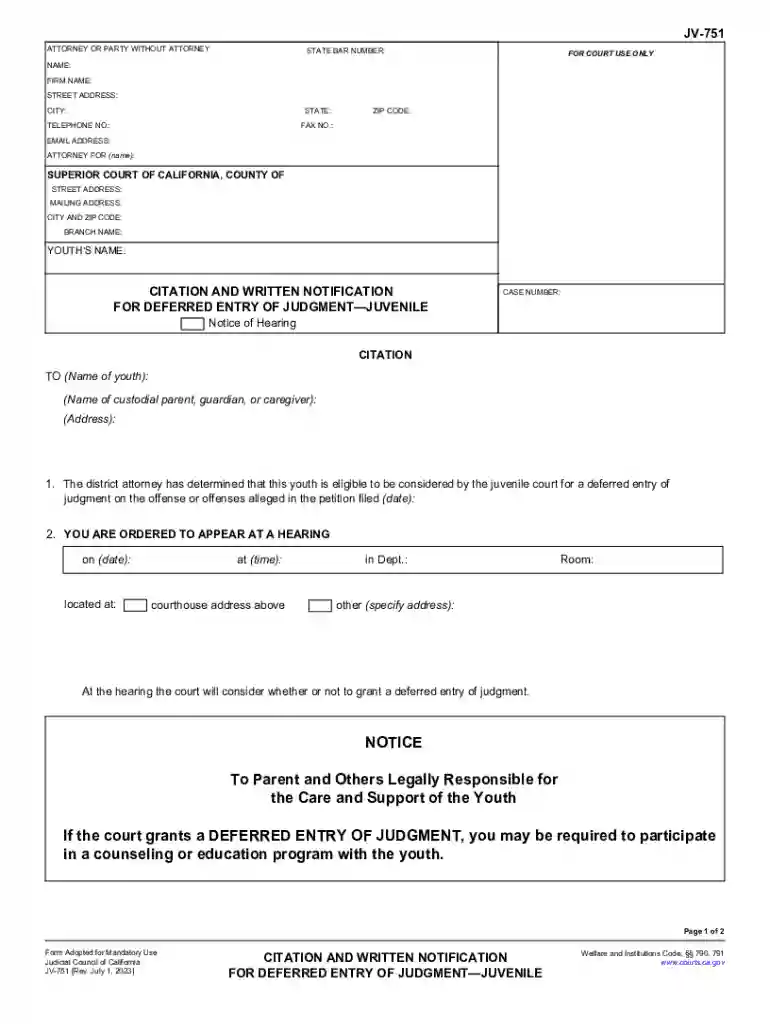
JV-751 CITATION AND WRITTEN NOTIFICATIONFOR DEFERRED ENTRY OF JUDGMENTJUVENILE Judicial Council form 2026

Get Form
jv 751 Preview on Page 1

Here's how it works

01. Edit your jv 751 online
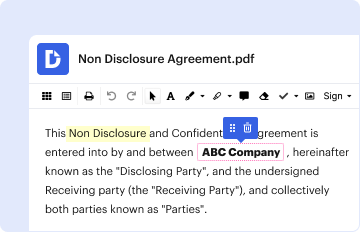
Type text, add images, blackout confidential details, add comments, highlights and more.

02. Sign it in a few clicks
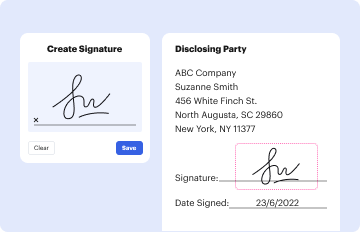
Draw your signature, type it, upload its image, or use your mobile device as a signature pad.

03. Share your form with others
Send it via email, link, or fax. You can also download it, export it or print it out.

Definition & Purpose of the JV-751 Form

The JV-751 form, known as the Citation and Written Notification for Deferred Entry of Judgment for Juveniles, is an official document utilized within the California judicial system. This form serves to notify a juvenile and their guardians about eligibility and requirements for entering a Deferred Entry of Judgment (DEJ) program. This legal process allows eligible youth to complete court-ordered rehabilitation without a formal judgment, potentially leading to the sealing of juvenile records upon successful completion.

Key Elements

  • Eligibility Requirements: The juvenile must meet specific criteria, such as age and type of offense, to qualify for DEJ.
  • Program Participation: The form outlines what participation in this program entails, including any probation terms.
  • Consequences of Completion: Upon successful completion, the juvenile may have their record sealed, eliminating the impact of their past offense.
  • Notification Responsibilities: Guardians and the juvenile will receive detailed instructions about their roles and responsibilities during this process.

How to Use the JV-751 Form

Using the JV-751 form involves several careful steps to ensure compliance with court requirements and the proper processing of a DEJ program application.

Detailed Steps

  1. Read Instructions Thoroughly: Begin by reading all instructions on the form to understand what information is required and the specific legal terms used.
  2. Complete All Sections: Fill out each section of the form completely and accurately.
  3. Provide Supporting Documents: Attach any required documents, such as prior court records or proof of eligibility, as specified in the form instructions.
  4. Review and Verify: Double-check all information for accuracy before submission to avoid errors that may delay the process.
  5. Submit as Instructed: Follow the instructions provided to submit the form to the appropriate court authority, ensuring it reaches the right department for handling juvenile cases.

Submission Details

  • Format Options: The JV-751 can typically be submitted in paper form or electronically if the court permits digital submissions.
  • Follow-Up: Maintain a copy of the submitted form and check for any follow-up communications from the court regarding the processing of the form.

Who Typically Uses the JV-751 Form

The JV-751 form is primarily used by juveniles, along with their guardians and legal representatives, who are seeking entry into the Deferred Entry of Judgment program in California.


decoration image ratings of Dochub

Common Users

  • Juveniles Charged with Certain Offenses: Those charged with specific offenses that qualify for DEJ.
  • Legal Guardians: Parents or guardians responsible for ensuring the minor's compliance with court orders.
  • Legal Counsel: Attorneys representing the juvenile may assist in preparing and submitting the form.
decoration image

Involved Parties

  • Juvenile Court Officials: They process and evaluate the form to determine the suitability of the applicant for the DEJ program.
  • Probation Officers: These officers may be involved in overseeing the juvenile's progress in the DEJ program.

Eligibility Criteria for the JV-751 Form

Eligibility for using the JV-751 form involves specific criteria, primarily focusing on the nature of the offense and the juvenile's legal history.

decoration image

Essential Eligibility Factors

  • Age and Offense Type: Typically, the applicant must be a minor facing charges for offenses suitable for DEJ.
  • First-Time Offenders: Preference is often given to first-time offenders who demonstrate potential for rehabilitation.
  • Court Assessment: The court must assess and approve the applicant’s eligibility based on the detailed information provided in the form.

Special Considerations

  • Exceptions: There might be exceptions based on unique circumstances, such as serious felonies or repeat offenses, which may disqualify applicants from DEJ.

Steps to Complete the JV-751 Form

Completing the JV-751 form requires attention to detail and an understanding of legal requirements.

Step-by-Step Process

  1. Gather Information: Collect all necessary personal and case information before filling out the form.
  2. Enter Personal Details: Accurately input the juvenile's name, address, and contact information.
  3. Detail Offense Information: Provide specifics about the offense and any related court cases.
  4. Legal Representation: If applicable, include information about legal representation or advisors.
  5. Review Legal Obligations: Understand the program's requirements, including any probationary terms.

Finalizing the Form

  • Signature: Ensure the juvenile and guardian sign the form, indicating agreement to the DEJ terms.
  • Submission: Submit the completed form with all necessary attachments within the designated timeframe.

Importance of the JV-751 Form

The JV-751 form is critical in the legal process as it facilitates a juvenile’s opportunity to enter the DEJ program, offering a chance to rehabilitate rather than facing a conviction.

Benefits of DEJ Participation

  • Avoidance of Conviction: Successful completion prevents a formal conviction from appearing on the juvenile's record.
  • Focus on Rehabilitation: Emphasis on rehabilitation over punishment can lead to better long-term outcomes for the juvenile.
  • Record Sealing: Eligibility for record sealing can enhance future opportunities in employment and education.

Real-World Impact

  • Case Study Example: A first-time juvenile offender charged with a minor property crime successfully completed DEJ, leading to record sealing and improved prospects for higher education.

Legal Use and Compliance with the JV-751 Form

The legal use of the JV-751 form involves understanding its implications within the California judicial system and ensuring compliance with statutory requirements.

Legal Framework

  • California Jurisdiction: The form is specifically for use within the state of California and subject to its legal standards.
  • Judicial Oversight: The court monitors the juvenile's progress to ensure compliance with DEJ terms.

Compliance Requirements

  • Accuracy and Honesty: Ensure all information provided on the form is truthful and accurate to avoid legal repercussions.
  • Timely Submission: Adherence to submission deadlines is essential for the form to be considered valid by the court.

See more JV-751 CITATION AND WRITTEN NOTIFICATIONFOR DEFERRED ENTRY OF JUDGMENTJUVENILE Judicial Council form versions

We've got more versions of the JV-751 CITATION AND WRITTEN NOTIFICATIONFOR DEFERRED ENTRY OF JUDGMENTJUVENILE Judicial Council form form. Select the right JV-751 CITATION AND WRITTEN NOTIFICATIONFOR DEFERRED ENTRY OF JUDGMENTJUVENILE Judicial Council form version from the list and start editing it straight away!
Versions Form popularity Fillable & printable
2023 4.4 Satisfied (25 Votes)
2010 4.8 Satisfied (355 Votes)
be ready to get more

Complete this form in 5 minutes or less

Get form

Got questions?

We have answers to the most popular questions from our customers. If you can't find an answer to your question, please contact us.
Contact us
Even though successful completion of a deferred sentence results in a dismissal of charges and guilty plea withdrawal, most states still consider it to be a conviction since a plea of guilt was entered and the defendant was considered convicted for the duration of the program.
Deferred judgment means that if you plead guilty or no contest to a crime youve been charged with, the court will put off (or defer) entering judgment against you or handing down a sentence. Instead, youll be placed on probation or ordered into a program like drug diversion.
A deferred judgment is a sentencing option where a defendant pleads guilty and is placed on probation. The judge sets the conditions of probation. The conditions vary, but may include the following: Monetary fine (also called a civil penalty) Substance abuse evaluation and treatment.
The Deferred Entry of Judgment (DEJ) Program allows you to enroll and complete an education workshop for a dismissal of your case. If the District Attorney determines you are eligible and you choose to enroll in the DEJ Program, you will be referred to Pacific Education Services who will administer the program.
Deferred entry of judgment, or Penal Code Section 1000, refers to someone entering a guilty plea to a crime but not being sentenced when they do so. The case is usually put over for approximately a year.

Security and compliance

At DocHub, your data security is our priority. We follow HIPAA, SOC2, GDPR, and other standards, so you can work on your documents with confidence.

Learn more
ccpa2
pci-dss
gdpr-compliance
hipaa
soc-compliance