




01. Edit your teenage affidavit financial responsibility online
Type text, add images, blackout confidential details, add comments, highlights and more.

Type text, add images, blackout confidential details, add comments, highlights and more.

Draw your signature, type it, upload its image, or use your mobile device as a signature pad.

Send minor teenage affidavit form via email, link, or fax. You can also download it, export it or print it out.
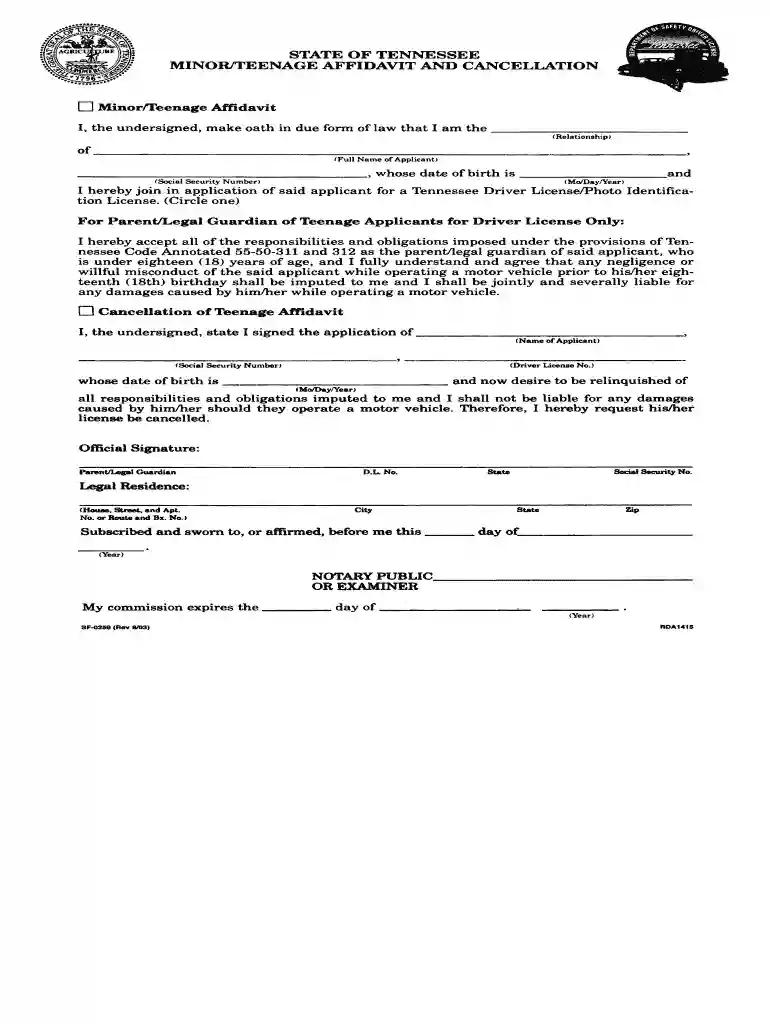
The minor teenage affidavit and cancellation form serves as a legal document that allows a minor, usually under the age of eighteen, to affirm specific facts or declare the cancellation of a previous statement or agreement. This form is often utilized in scenarios where a minor requires legal recognition of their statements, such as claims related to financial responsibility, school attendance verification, or the authorization of certain actions by a responsible adult.
The process involves notarizing the affidavit, which establishes its legality and gives it binding authority. Depending on the jurisdiction, this form might be known by other names or have variations that cater to specific needs, like verifying the identity of a minor or providing consent for participation in activities such as sports or other programs. The cancellation component allows for the revocation of prior declarations, adding flexibility for the minor or the responsible adult in managing affairs related to the minor's status.
Utilizing the minor teenage affidavit and cancellation form involves several key steps. First, identify the specific purpose for which the affidavit is required, such as a statement of financial responsibility or an authority to act on behalf of the minor.
Step 1: Determine Requirements
Consult state-specific regulations to ascertain the requirements surrounding the use of this form. This may include consulting with legal counsel to understand implications fully.
Step 2: Obtain the Form
Download the necessary form from a reputable source or obtain it from a legal office. Ensure you have the correct version, as regulations may differ by state.
Step 3: Complete the Form
Fill in the required information accurately. This might include personal details about the minor, the nature of the affidavit, and the circumstances that necessitate the cancellation.
Step 4: Notarization
The completed affidavit must be notarized, which involves signing the document in the presence of a notary public to validate the claims made.
Step 5: Submission
Submit the affidavit to the relevant authority or retain copies as needed for personal records. Additional actions may be required depending on the specific situation it pertains to.
The minor teenage affidavit and cancellation form comprises numerous essential components that must be accurately filled out to ensure its legal standing.
Identifying Information
This includes names, addresses, and contact details of the minor and the responsible adult signing on their behalf.
Statement of Facts
A clear declaration of the statements being made, whether regarding financial responsibility or another purpose.
Cancellation Statement
If applicable, clearly state which prior affidavits or statements are being cancelled.
Signatures
The signatures of both the minor (if applicable) and the responsible adult must be included. Signatures should be placed in front of a notary public.
Notary Section
This part verifies the document’s authenticity, including the notary's signature and seal, date, and other pertinent details demonstrating legal verification.
These elements not only help in maintaining clarity and accuracy but also serve to uphold the integrity of the affidavit for legal purposes.
Each state in the U.S. has specific laws regarding the execution and use of affidavit forms, including those for minors. Thus, understanding your state's regulations is crucial when preparing to submit the minor teenage affidavit and cancellation form.
Age of Majority
The age at which a minor may independently sign an affidavit may differ by state.
Notary Regulations
Some states may require that the document be notarized in-person, while others allow for remote notarization.
Specific Language
Certain jurisdictions may require specific language or terms to be explicitly stated within the form. It’s advisable to review any state-specific forms that might be available.
Being aware of state-specific nuances helps ensure that the affidavit complies with local laws, avoiding potential legal challenges in the future.
Familiarity with the terminology associated with the minor teenage affidavit and cancellation form is vital for understanding its application and implications.
Affidavit
A written statement confirmed by oath, legally binding in a court of law.
Notarization
The process of having a document verified by a notary public, which lends legal validity to the document.
Cancelation
The act of officially declaring that a previous statement or affidavit is no longer valid.
Responsible Adult
An individual, often a parent or guardian, who assumes legal responsibility for a minor.
Legal Guardian
An adult with legal authority over a minor, who can represent the minor in legal matters.
Understanding these terms enhances comprehension and facilitates smoother interactions with authorities requiring the execution of the form.
We've got more versions of the teenage affidavit financial responsibility form. Select the right teenage affidavit financial responsibility version from the list and start editing it straight away!
At DocHub, your data security is our priority. We follow HIPAA, SOC2, GDPR, and other standards, so you can work on your documents with confidence.
For Parent/Legal Guardian of Teenage Applicants for Driver License Only: I hereby accept all of the responsibilities and obligations imposed under theRead more
Minor/Teenage Affidavits. Applicants under eighteen years old must have an adult sign a. Minor/Teenage Affidavit and Cancellation form, available at all.Read more


