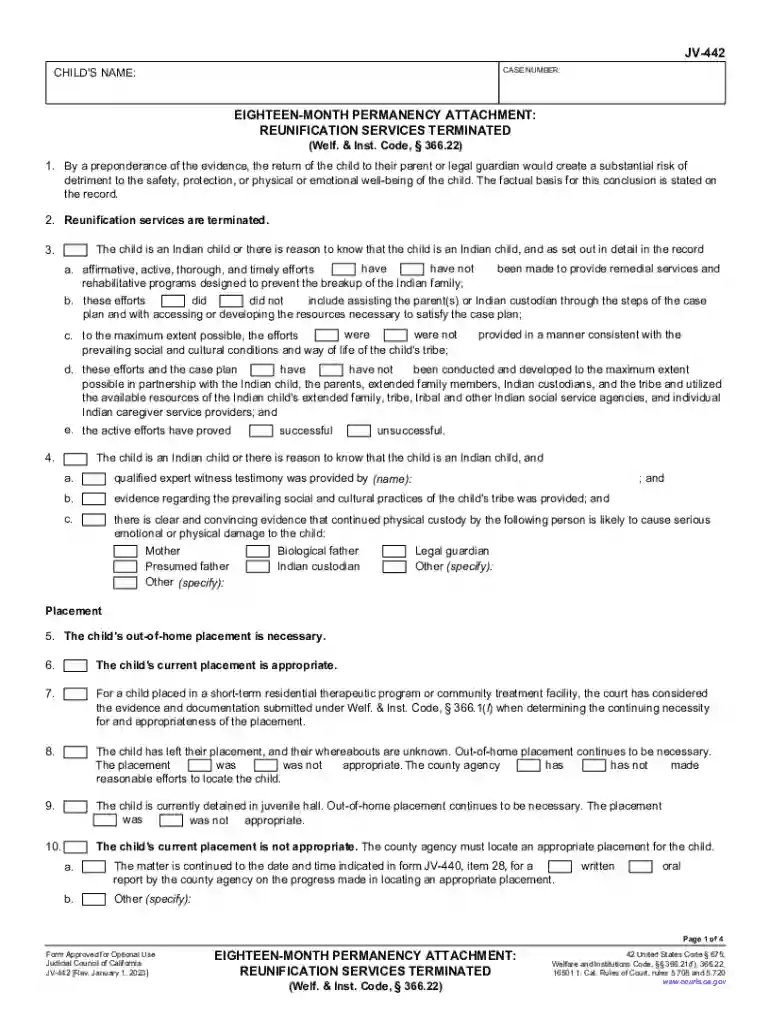
JV-442 Eighteen-Month Permanency Attachment: Reunification Services Terminated (Welf and Inst Code,3 2026

Get Form
ca eighteen permanency Preview on Page 1

Here's how it works

01. Edit your ca eighteen permanency online
Type text, add images, blackout confidential details, add comments, highlights and more.

02. Sign it in a few clicks
Draw your signature, type it, upload its image, or use your mobile device as a signature pad.

03. Share your form with others
Send jv442 pdf via email, link, or fax. You can also download it, export it or print it out.

Definition and Purpose of JV-442 Eighteen-Month Permanency Attachment

The JV-442 form, known as the Eighteen-Month Permanency Attachment: Reunification Services Terminated, is a legal document used within the United States to outline the cessation of reunification services for a child. This typically occurs when the court decides that continuing efforts to reunite the child with their parents or legal guardians poses a significant risk to the child's safety and well-being. The form includes details about the services provided to the family, reasons for termination, and alternative permanency plans like adoption or guardianship.

How to Use the JV-442 Form

Using the JV-442 form requires careful consideration of the instructions provided by the court. The form must be filled out accurately, reflecting the child's current situation, the remedial services offered, and the reasons supporting the termination decision. As it involves legal care decisions for a child, the form must be reviewed by a legal professional to ensure compliance with federal and state regulations, particularly those related to the welfare and institutions code.

Steps to Complete the JV-442 Form

  1. Gather Required Information: Collect all relevant case materials, including reports from social services, court orders, and records of services provided to the family.
  2. Complete Relevant Sections: Fill out sections detailing the child's current placement, past services, and reasoning for terminating reunification efforts.
  3. Consult Legal Counsel: Work with an attorney familiar with child welfare law to verify accuracy and thoroughness.
  4. Submit the Form to the Appropriate Court: Ensure submission meets deadlines and is filed in the correct jurisdiction.
  5. Follow Up: Obtain confirmation of receipt and review any feedback or requests for additional information from the court.

Legal Use of the JV-442 Form

The legal premise of the JV-442 form lies in its adherence to the Welfare and Institutions Code, which governs child welfare proceedings in the United States. It is primarily used in situations where a child's reunification with their parent or guardian is deemed not feasible within a safe and supportive environment. Legal reviews and compliance checks are critical to ensure that the form's application respects the child's rights and aligns with federal guidelines, including the Indian Child Welfare Act when applicable.

Key Elements of the JV-442 Form

The JV-442 form contains several crucial components that detail:

  • Child's current placement and future plans
  • Summary of reunification services provided
  • Reasons behind the decision to terminate services
  • Alternative permanency plans
  • Comments on the child's best interest and safety factors

Who Typically Uses the JV-442 Form

The JV-442 form is used by:

  • Child Welfare Agencies: To document and formalize the termination of services.
  • Legal Professionals: To advise and represent parties involved in child welfare cases.
  • Judicial Authorities: To assess and approve the decision.
decoration image ratings of Dochub

Important Terms Related to the JV-442 Form

  • Reunification Services: Efforts aimed at safely returning a child to their family.
  • Permanency Planning: The process of ensuring a stable and long-term home for a child.
  • Termination of Services: The formal discontinuation of reunification efforts.
  • Indian Child Welfare Act Compliance: Special provisions when the child involved belongs to an Indigenous community.

State-Specific Rules for the JV-442 Form

Different states might have varying rules regarding the JV-442 form, particularly in how it interacts with state-specific child welfare laws and codes. It is essential to consult state resources or a local attorney to understand guidelines and ensure proper compliance with local regulations.

Examples of Using the JV-442 Form

  • Case Study: A child placed in foster care after parental neglect. After numerous failed interventions and analysis of the child's situation, the court determines that returning the child home is not in their best interest.
  • Scenario Analysis: An Indian child under the jurisdiction of the Indian Child Welfare Act, where additional considerations are factored in, such as cultural background and heritage, before decision-making.

These examples illustrate the form's practical application in real-world scenarios, highlighting its role in making informed and sensitive decisions about children's welfare.

See more JV-442 Eighteen-Month Permanency Attachment: Reunification Services Terminated (Welf and Inst Code,3 versions

We've got more versions of the JV-442 Eighteen-Month Permanency Attachment: Reunification Services Terminated (Welf and Inst Code,3 form. Select the right JV-442 Eighteen-Month Permanency Attachment: Reunification Services Terminated (Welf and Inst Code,3 version from the list and start editing it straight away!
Versions Form popularity Fillable & printable
2023 4.1 Satisfied (57 Votes)
2018 4.8 Satisfied (113 Votes)
2011 4.3 Satisfied (226 Votes)
be ready to get more

Complete this form in 5 minutes or less

Get form

Got questions?

We have answers to the most popular questions from our customers. If you can't find an answer to your question, please contact us.
Contact us
If you dont participate in the services set forth in your reunification plan, the court can terminate your services. If your services are terminated that means that the goal for your case has changed from getting you back together with your child to finding a permanent home (that is not with you) for your child.
You should have received a copy from your lawyer after the termination. If you cannot find it, contact the District Clerk in the county where your rights were terminated. If there is no such a paperwork then your parental rights have not been terminated.
Reunification refers to the process of returning a child who has been removed from their parents due to abuse or neglect. The primary goal of the state is to reunite the child with their parents, as long as it is in the best interest of the child.
Family Reunification services may be ordered by the Court for the parents to regain physical custody of their child. The family reunification services are meant to alleviate the circumstances that led to the removal of their child.
(1) Unless the court makes a finding that reunification services need not be provided under subdivision (b) of section 361.5 if a child is removed from the custody of a parent or legal guardian, the court must order the county welfare department to provide reunification services to the child and the childs mother and

Security and compliance

At DocHub, your data security is our priority. We follow HIPAA, SOC2, GDPR, and other standards, so you can work on your documents with confidence.

Learn more
ccpa2
pci-dss
gdpr-compliance
hipaa
soc-compliance
be ready to get more

Complete this form in 5 minutes or less

Get form

People also ask

If a reunification or repair attempt is refused or partially/dysfunctionally attempted, the child moves experiences the third option and unhealthiest option - a damaged and unresolved primary attachment.

jv 442