Elder and Dependent Adult Abuse Prevention (revise forms 2026

Get Form
abuse restraining Preview on Page 1

Here's how it works

01. Edit your abuse restraining online
Type text, add images, blackout confidential details, add comments, highlights and more.

02. Sign it in a few clicks
Draw your signature, type it, upload its image, or use your mobile device as a signature pad.

03. Share your form with others
Send elder abuse restraining via email, link, or fax. You can also download it, export it or print it out.

How to Use or Fill Out Elder and Dependent Adult Abuse Prevention (Revise Forms)

Form edit decoration
9.5
Ease of Setup
DocHub User Ratings on G2
9.0
Ease of Use
DocHub User Ratings on G2
  1. Click ‘Get Form’ to open it in the editor.
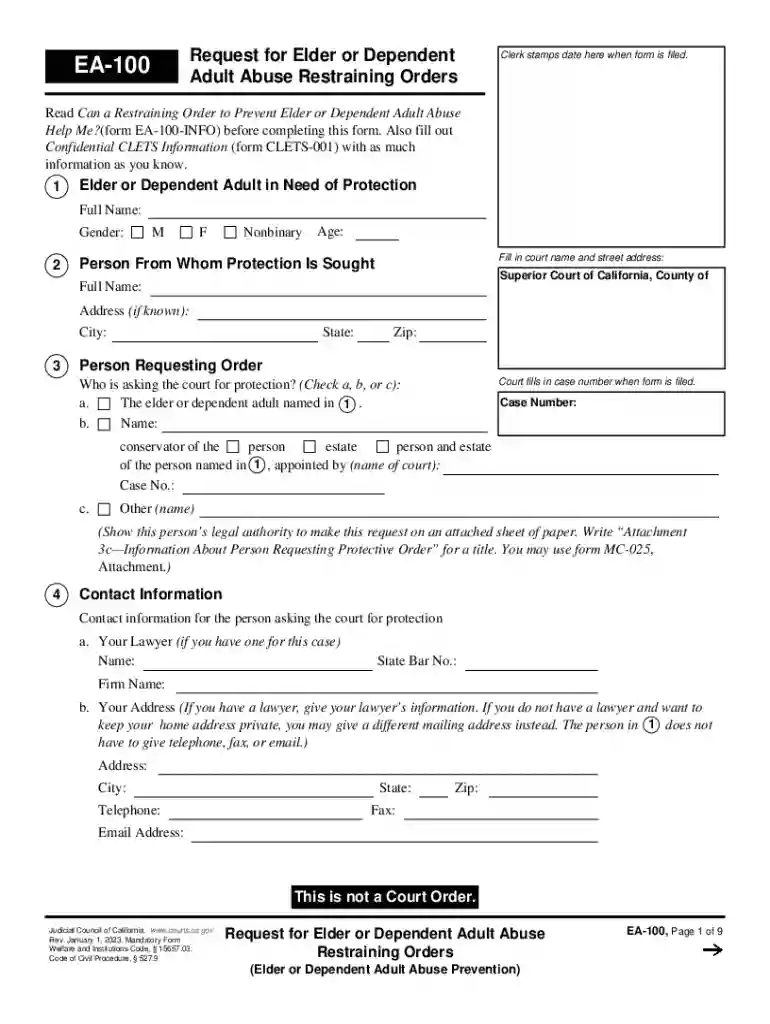
  2. Begin by filling out the 'Elder or Dependent Adult in Need of Protection' section. Enter the full name, gender, and age of the individual requiring protection.
  3. In the 'Person From Whom Protection Is Sought' section, provide the full name and address of the individual from whom protection is being requested.
  4. Complete the 'Person Requesting Order' section by checking the appropriate box indicating your relationship to the elder or dependent adult. If applicable, include details about your legal authority.
  5. Fill in your contact information accurately. If you have a lawyer, provide their details; otherwise, you may use an alternative mailing address for privacy.
  6. Continue through each section detailing descriptions of abuse, relationships between parties, and any additional protected persons as necessary. Use attachments if more space is needed.

Start using our platform today to fill out your forms online for free!

See more Elder and Dependent Adult Abuse Prevention (revise forms versions

We've got more versions of the Elder and Dependent Adult Abuse Prevention (revise forms form. Select the right Elder and Dependent Adult Abuse Prevention (revise forms version from the list and start editing it straight away!
Versions Form popularity Fillable & printable
2023 4.9 Satisfied (20 Votes)
2018 4.8 Satisfied (88 Votes)
2014 4.3 Satisfied (154 Votes)
be ready to get more

Complete this form in 5 minutes or less

Get form

Got questions?

We have answers to the most popular questions from our customers. If you can't find an answer to your question, please contact us.
Contact us
Educate yourself and others. Simple support for children and parents can be the best way to prevent child abuse. After-school activities, parent education classes, mentoring programs, and respite care are some of the many ways to keep children safe from harm.
Relay your concerns to the local adult protective services, long-term care ombudsman, or the police. If you have been the victim of abuse, exploitation, or neglect, you are not alone. Many people care and can help.
Elder abuse can take several forms, including neglect and physical, emotional, financial, or sexual maltreatment. Adult self-neglect is the most common form of elder abuse2 (Table 124).
Listen to the person, acknowledge what they are saying and validate their feelings. Determine the level of urgency is it an emergency, urgent call 000 or non-urgent? Follow agency procedures, including informing line managers. Take steps to safeguard the older person and others in any response to the abuse.
The first step in preventing elder abuse is educating yourself. You need to know what the common signs of it are and get rid of any stereotypes you may have. Educate others. Once you know more about the issue, you can do your part to educate others.

Security and compliance

At DocHub, your data security is our priority. We follow HIPAA, SOC2, GDPR, and other standards, so you can work on your documents with confidence.

Learn more
ccpa2
pci-dss
gdpr-compliance
hipaa
soc-compliance
be ready to get more

Complete this form in 5 minutes or less

Get form

People also ask

1417. Governor Gavin Newsom signed Assembly Bill No. 1417 into law in late 2024. AB 1417 alters the mandatory reporting obligations in California for alleged, suspected, or known elder or dependent adult abuse in long-term care facilities.

adult restraining