
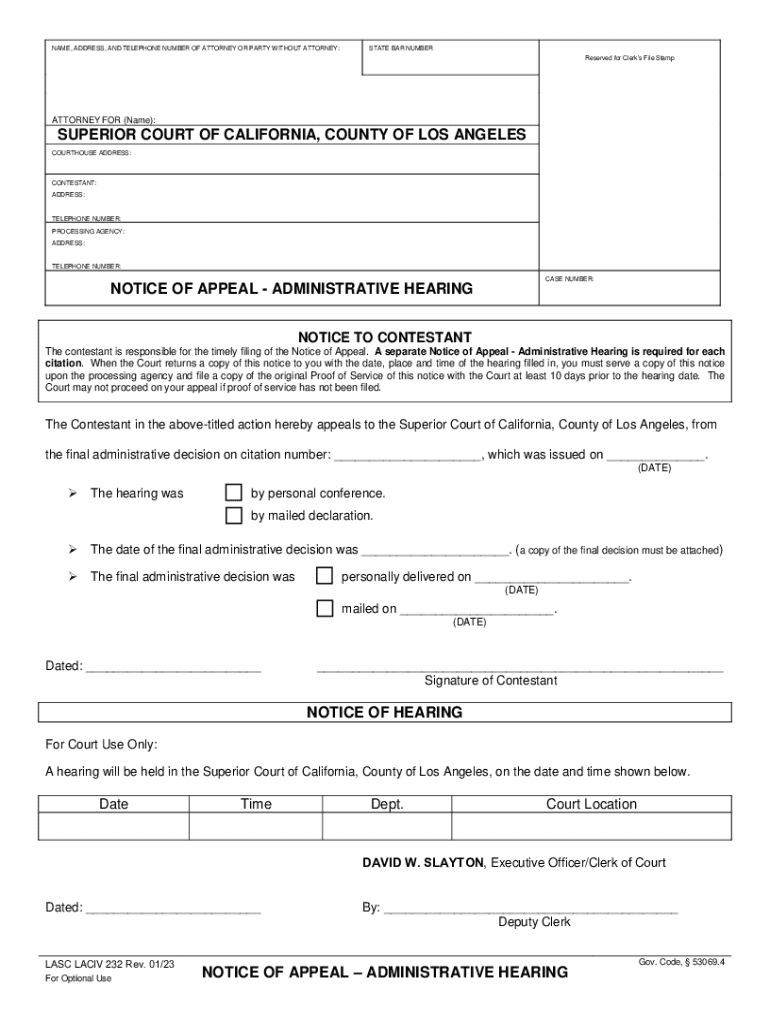







Definition and Role of the Superior Court of California
The Superior Court of California is a statewide system responsible for a wide range of legal matters. It deals with civil, criminal, family, juvenile, probate, and small claims cases. This court acts as a trial court, meaning that it is the first level at which most legal cases are heard. Each of California's 58 counties has its own Superior Court, and the court structure is essential for maintaining the rule of law across such a geographically and demographically diverse state.
Case Types Handled by the Superior Court
- Civil Cases: These involve legal disputes between parties, which might include contract disputes, personal injury, and property damage cases.
- Criminal Cases: The court handles felonies, misdemeanors, and infractions. It is where individuals are tried for alleged criminal conduct.
- Family Law: Matters such as divorce, child custody, and support are resolved in family law courts.
- Probate Cases: These involve the legal process for distributing a deceased person's estate.
- Juvenile Cases: Includes cases where the well-being of a minor is in question or when a minor is accused of violating the law.
How to Use the Superior Court of California
Accessing the services of the Superior Court of California typically begins by identifying the specific division relevant to your case. For instance, if filing a divorce, you would start with the Family Law division. It's crucial to file the right documents within the correct division for efficient legal process initiation.
Steps for Effective Court Use
- Identify the Correct Division: Determine whether your case is civil, criminal, probate, etc.
- Complete Required Forms: Ensure you're using the proper forms specific to the division of your case.
- File Documents: Submit necessary forms to the clerk’s office of the appropriate division either in-person, by mail, or electronically if available.
- Attend Court Dates: Appear for scheduled hearings or trials as required.
How to Obtain Forms for the Superior Court of California
Obtaining forms is a critical initial step in engaging with the Superior Court of California. These forms can often be found directly through the court's official website or at local court clerk’s offices. Many courts also provide electronically fillable forms.
Methods of Acquisition
- Online Access: Most Superior Courts offer downloadable forms online. Check the specific county court’s website for available forms.
- Clerk’s Office: Forms are also available at the clerk’s office in the courthouse. Courthouse staff can provide guidance on which forms are needed but cannot offer legal advice.
- Legal Aid Services: Some nonprofit organizations provide assistance in acquiring and completing court forms.
Steps to Complete the Forms for the Superior Court of California
Accurate completion of forms is essential when interacting with the Superior Court of California. Forms must be filled out completely and accurately to avoid delays or rejections.
Form Completion Procedure
- Download or Collect Forms: Obtain the necessary forms from the court’s website or the local clerk’s office.
- Read Instructions Carefully: Each form usually comes with specific instructions; ensure you understand each step.
- Complete All Required Fields: Provide all the requested information; incomplete forms can result in processing delays.
- Attach Any Required Documents: Include any supplemental documents as indicated by the form’s instructions.
- Sign and Date Forms: Ensure all signatures are completed; some forms might require notarization.
Key Elements of the Superior Court of California Forms
Understanding the main components of the Superior Court of California forms can simplify the filing process.
- Parties Involved: Identification of the plaintiff, defendant, petitioner, or respondent.
- Case Information: Includes case type and court division.
- Filing Instructions: Provides details on how to submit forms correctly.
- Signature Lines: Legal acknowledgment required from involved parties.
- Court Dates and Deadlines: Lists important dates for filing and appearances.
Important Legal Terms Related to the Superior Court
Several legal terms are essential for individuals engaging with the Superior Court of California.
- Petitioner: The party who initiates a case.
- Respondent: The party who answers or responds to a petition.
- Jurisdiction: The court’s authority to hear a case.
- Appeal: Requesting a higher court to review the decision made by the Superior Court.
- Subpoena: An order to attend court or produce documents.
Filing Deadlines and Important Dates
Meeting filing deadlines is critical to ensuring that a case proceeds without issue in the Superior Court of California.
- Initial Filing Deadlines: Typically stated in the court's procedural rules or on the document itself.
- Response Deadlines: There are usually specific time frames within which a respondent must answer a petition.
- Hearing and Trial Dates: After filing, you will be notified of any hearings or trial dates.
- Deadline Extensions: It's sometimes possible to request extensions, but they must be approved by the court.
State-Specific Rules and Considerations
California has particular legal standards and rules that govern proceedings in the Superior Court system. Familiarity with these can influence the success of a case.
- Local Rules: Each county may have additional rules governing procedure and decorum in its courtrooms.
- Statewide Legal Precedents: California courts are bound by legal precedents set by the state’s appellate courts.
- Mandatory Forms and Procedures: Some procedural elements are mandatory statewide, such as certain forms for family law cases.
With these guidelines, navigating the complexities of the Superior Court of California becomes more manageable, allowing for efficient legal proceedings.




