




01. Edit your form online
Type text, add images, blackout confidential details, add comments, highlights and more.

Type text, add images, blackout confidential details, add comments, highlights and more.

Draw your signature, type it, upload its image, or use your mobile device as a signature pad.

Send it via email, link, or fax. You can also download it, export it or print it out.
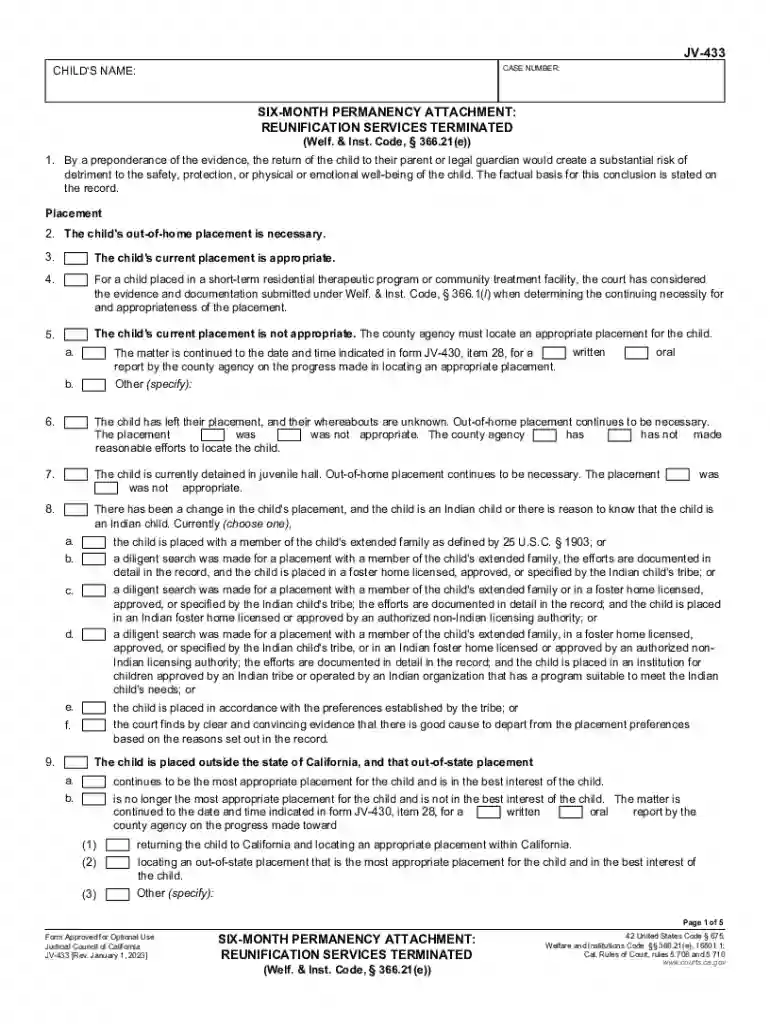
The JV-433 form is an official document utilized in California's juvenile dependency court proceedings. It is specifically employed to document the termination of reunification services. This form signifies that efforts to reunify a child with their parents or guardians have ended, typically due to the potential risk posed to the child's well-being. Its completion is crucial as it provides detailed information about why the reunification services were terminated, outlining the tangible risks to the child's safety if they were to return to their original home environment.
To effectively utilize the JV-433 form, appropriately document observations and findings pertinent to the child's situation. It involves highlighting the child’s current placements, examining the suitability of these placements, and specifying the future plans for the child’s care. Ensure all information is current and thorough, as this document serves as a basis for legal decisions regarding the child's long-term welfare. Accurately fill out sections detailing the efforts made by the agency to establish a safe and stable home, including efforts made towards adoption or guardianship when reunification is not viable.
Gather Information: Collect comprehensive data on the child’s current circumstances, including psychological evaluations and reports from social services.
Complete Child Placement Details: Accurately fill out sections detailing the current placement of the child and any proposed future permanent placements.
Document Termination Reasons: Provide specific reasons for the termination of reunification services that detail the risks associated with returning the child to their previous environment.
Outline Agency Efforts: Include detailed descriptions of the county agency's efforts to find a suitable placement for the child and attempts to comply with both state and federal permanency planning requirements.
Submit for Review: Ensure the form is reviewed, appropriately signed, and submitted by the required deadline to the appropriate court handling the dependency case.
The JV-433 is legally used within the juvenile dependency system to formalize the decision to terminate reunification services. This form acts as a part of the child's court records and is essential in ensuring that decisions made are documented according to legal standards. Its use must be consistent with legal protocols and timelines mandated by the California court system, ensuring the child’s rights and safety remain a priority within the legal process.
In a real-world scenario, a social services department may submit the JV-433 form after repeated attempts to reunite a child with their parents have failed due to persistent safety concerns. The form would document evidence obtained from child welfare assessments and court-mandated evaluations to support the termination decision. Another example would be incorporating this form during court hearings to substantiate the move towards adoption when reunification remains unachievable.
The JV-433 form can be submitted through several methods depending on court requirements:
While the form is specific to California, subtle variances may exist within county rules on submission protocols and review timelines. Legal practitioners must be aware of these differences to ensure proper compliance and avoid procedural errors.
We've got more versions of the JV-433 Six-Month Permanency Attachment: Reunification Services Terminated (Welf and Inst Code, 366 2 form. Select the right JV-433 Six-Month Permanency Attachment: Reunification Services Terminated (Welf and Inst Code, 366 2 version from the list and start editing it straight away!
At DocHub, your data security is our priority. We follow HIPAA, SOC2, GDPR, and other standards, so you can work on your documents with confidence.
by GK Lamon 2025 A speedy path to permanency with nonrelative foster parents should not be pursued when family preservation via reunification is possible. Foster parentRead more
Jan 1, 2026 Reunification services are terminated for the mother biological father. Indian custodian presumed father legal guardian. Other (specify):. OtherRead more


