




01. Edit your kentucky employment application online
Type text, add images, blackout confidential details, add comments, highlights and more.

Type text, add images, blackout confidential details, add comments, highlights and more.

Draw your signature, type it, upload its image, or use your mobile device as a signature pad.

Send ky employment job via email, link, or fax. You can also download it, export it or print it out.
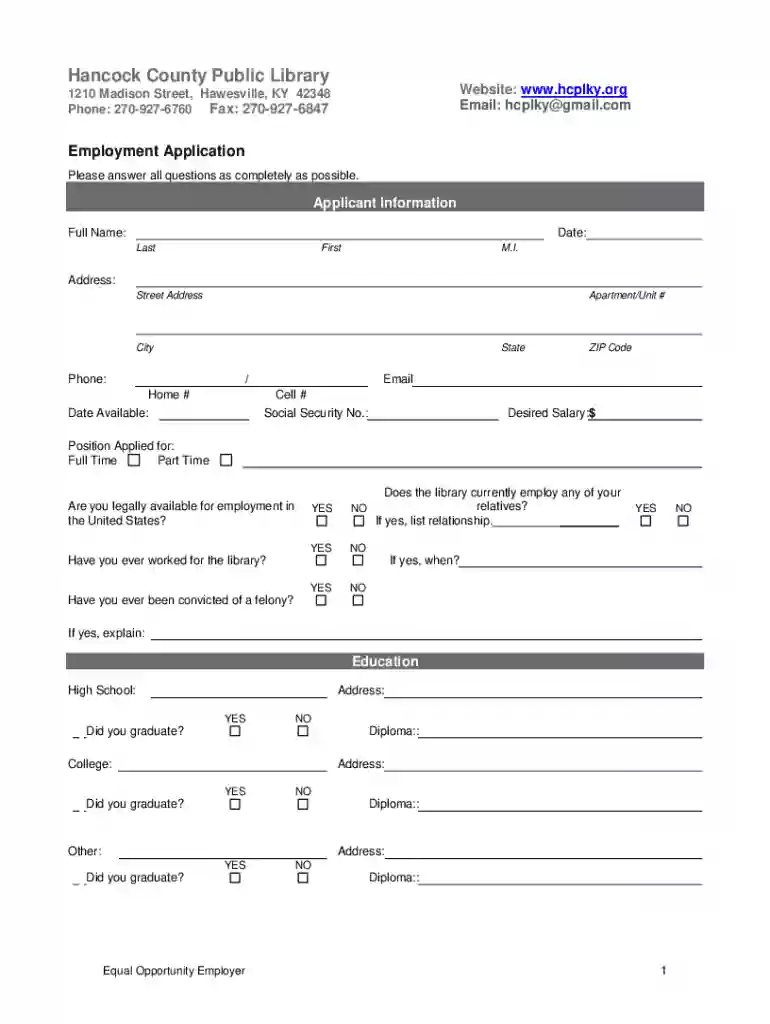
The employment application for the Hancock County Public Library serves as an official document used by individuals seeking employment at the library. This specific application collects comprehensive details about the applicant's qualifications, including personal information, education, past work experiences, references, and relevant skills. Emphasizing the library's commitment to equal opportunity employment, the application aims to ensure that all applicants are evaluated based on their qualifications, without discrimination.
To access the employment application, prospective applicants can visit the Hancock County Public Library website or contact their HR department directly. The application might also be available for download on platforms like DocHub, which facilitates the editing and submission process. By making the document accessible online, the library ensures that applicants can conveniently apply from anywhere, simplifying the hiring process for both candidates and the HR team.
Personal Information: Begin with your full name, address, phone number, and email address, ensuring all contact details are current.
Educational Background: List your educational qualifications, starting from the most recent. Include names of institutions, degrees earned, and graduation dates.
Employment History: Provide a detailed account of your work experience, highlighting roles and responsibilities at each position. Start with your most recent employer.
References: Include at least three professional references, with their names, phone numbers, and relationship to you.
Skills and Qualifications: Elaborate on any relevant skills that align with the job vacancy, such as library management, data organization, or public speaking abilities.
Application Verification: Carefully read and agree to the terms regarding the accuracy of the information provided and consent to background checks if necessary.
This employment application is pivotal in matching the right candidates with available positions at the library. By thoroughly capturing a candidate's qualifications, the library ensures they select individuals who can efficiently meet the organizational needs and contribute positively to the community’s cultural and informational enrichment.
The employment application complies with legal standards and mandates that protect both the applicants and the employer. It includes necessary clauses validating the truthfulness of the information and authorization for conducting background checks. Compliance with equal opportunity laws ensures all candidates are given fair consideration.
Applicants must consider state-specific rules regarding employment applications in Indiana, where Hancock County is located. This can include specific non-discrimination clauses, permissible questions regarding past convictions, and the handling of applicant data. Understanding these helps ensure compliance with both state and federal employment regulations.
The employment application is available in both digital and paper formats. The digital version, accessible via DocHub, allows for seamless completion and submission online, enabling more efficient processing. On the other hand, the paper version, which can be obtained from the library, accommodates those who might prefer or require traditional methods. Both formats are designed to cater to a diverse range of applicant preferences.
We've got more versions of the kentucky employment application form. Select the right kentucky employment application version from the list and start editing it straight away!
At DocHub, your data security is our priority. We follow HIPAA, SOC2, GDPR, and other standards, so you can work on your documents with confidence.


