





Definition and Meaning of Munipay
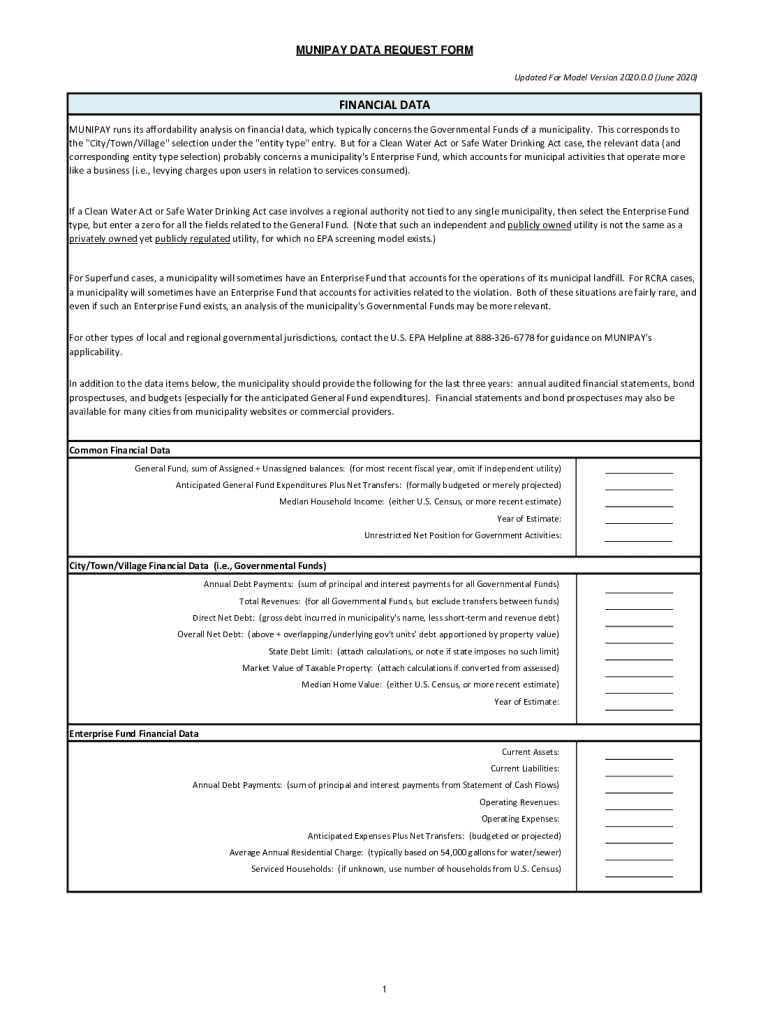
Munipay serves as a comprehensive model designed to evaluate the economic conditions of a municipality. This model provides a structured framework that allows municipalities to assess their financial health. By analyzing key financial metrics such as revenue sources, expenditure patterns, and financial obligations, Munipay enables accurate evaluations of a municipality's economic capabilities. Its primary function is to support local governments in making informed decisions about budgeting, investments, and compliance with environmental regulations like the Clean Water Act. Munipay guides municipalities in identifying financial pressures and strategizing appropriately for sustainable development.
How to Use the Munipay Model
Utilizing the Munipay model involves a multi-step approach to gather and evaluate the necessary financial data. The steps are as follows:
-
Data Collection: Municipalities should gather annual financial statements, budget projections, and demographic information. This data should include revenue from governmental and enterprise funds.
-
Data Analysis: Input the collected data into the Munipay model to assess the municipality's economic strength. This includes scrutinizing income patterns, expenditure levels, and funding challenges.
-
Scenario Planning: Use the model to simulate various financial scenarios. This helps in understanding potential economic outcomes under different conditions.
-
Reporting: Generate reports that provide insights into the municipality's economic standing. These reports can guide policy recommendations and investment decisions.
-
Decision Making: Leverage the insights from Munipay to inform strategic decisions regarding budgeting, regulatory compliance, and fiscal policies.
Steps to Complete the Munipay Model
Completing the Munipay model requires attentive gathering and processing of relevant financial information. Follow these steps:
-
Prepare the Necessary Documentation: Compile all required financial documents, including revenue statements and U.S. Census Bureau demographic data.
-
Input Data Accurately: Ensure precise entry of financial data into the model. This is crucial for the reliability of the outcomes.
-
Cross-verify Data Points: Cross-check data entries against original documents to ensure accuracy.
-
Run the Model: Execute the Munipay model, using the inputted data for processing.
-
Interpret Results: Analyze the outcome generated by the model to understand the financial position of the municipality.
-
Implement Findings: Use the insights to guide financial planning and decision-making processes. Consider adjustments to budgets or financial strategies based on the analysis.
Key Elements of the Munipay Model
The Munipay model is constructed from key components that facilitate comprehensive economic evaluations:
-
Revenue Analysis Tools: Evaluate streams of revenue and their sustainability.
-
Expenditure Tracking: Analyze patterns in spending across different sectors.
-
Financial Obligations: Assess outstanding debts and obligations to provide a full picture of economic health.
-
Scenario Simulation: Tools for projecting future financial positions under various assumptions and conditions.
-
Regulatory Compliance Evaluation: Check alignment with environmental regulations, such as the Clean Water Act.
Important Terms Related to the Munipay Model
Understanding important terminology is essential when using Munipay. Key terms include:
-
Governmental Funds: Money acquired and utilized for public sector funding.
-
Enterprise Funds: Revenues generated from services provided by the municipality, often aimed at covering costs.
-
Demographic Data: Statistical data related to the population, often sourced from the U.S. Census Bureau.
-
Expenditure Patterns: Spending habits and allocations within the municipality's budget.
Required Documents for Munipay Analysis
To effectively employ the Munipay model, municipalities need to compile a range of documents:
-
Annual Financial Statements: Provide a snapshot of the municipality’s fiscal status over a year.
-
Budget Projections: Future financial plans outlining expected income and expenses.
-
Demographic Reports: U.S. Census Bureau data to understand population trends impacting economic decisions.
-
Regulatory Compliance Reports: Assess adherence to laws like the Clean Water Act.
Software Compatibility
When implementing Munipay evaluations, it's beneficial to use compatible software tools:
-
Accounting Software: Platforms like QuickBooks can manage transactional data crucial for accurate modeling.
-
Excel or Spreadsheet Tools: For data analysis and reporting, these tools help process and visualize financial information.
-
GIS Software: For demographic data integration and geographic mapping essential in economic analysis.
Important Deadlines and Filing Dates
Municipalities should be aware of key dates to ensure timely analysis:
-
Annual Reporting Deadlines: Align with the fiscal year end to provide comprehensive year-end assessments.
-
Regulatory Compliance Dates: Adhere to deadlines for environmental regulation reporting (e.g., Clean Water Act requirements).
Maintaining knowledge and readiness concerning these elements is crucial for maximizing the utility of the Munipay model in evaluating and managing municipal finances effectively.


