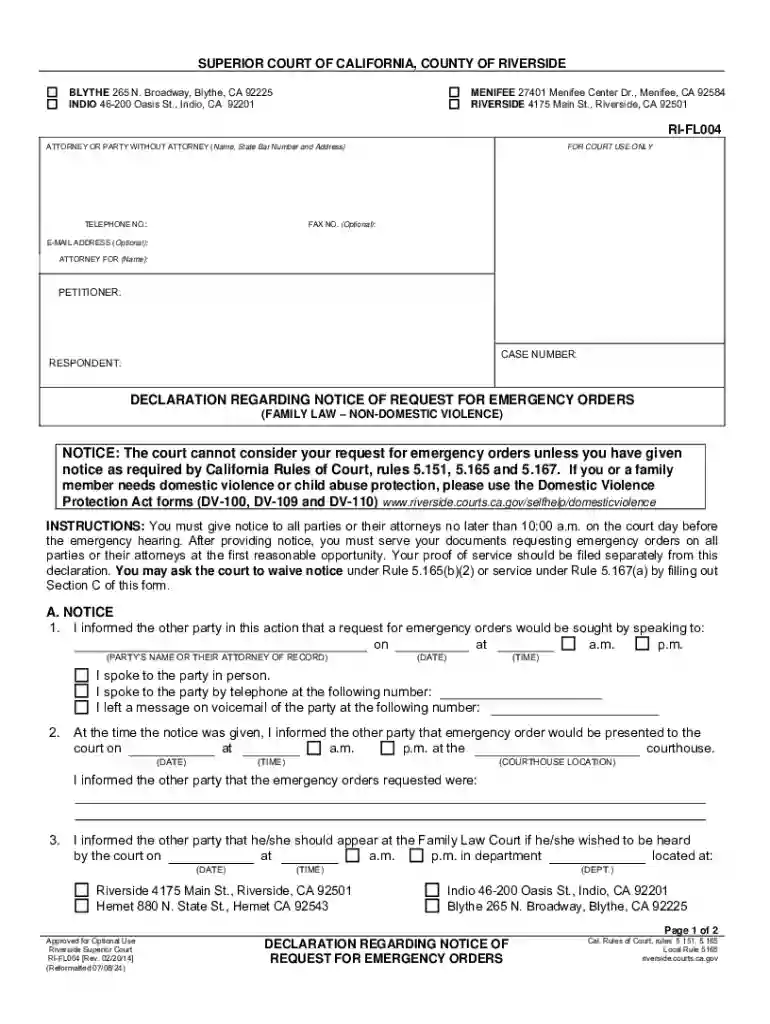
NOTICE: The court cannot consider your request for emergency 2026

Get Form
ri fl004 Preview on Page 1

Here's how it works

01. Edit your ri fl004 online
Type text, add images, blackout confidential details, add comments, highlights and more.

02. Sign it in a few clicks
Draw your signature, type it, upload its image, or use your mobile device as a signature pad.

03. Share your form with others
Send fl004 via email, link, or fax. You can also download it, export it or print it out.

Definition & Meaning

The "NOTICE: The court cannot consider your request for emergency" form is crucial in legal procedures, primarily within the Superior Court of California, County of Riverside. It pertains to family law cases where parties seek urgent court orders. This form alerts applicants that their request for an emergency court order cannot be processed, often due to procedural deficiencies or unmet legal requirements. Understanding its purpose helps in recognizing what corrective measures may be necessary to move forward with a legal request effectively.

How to Use the NOTICE: The court cannot consider your request for emergency

To utilize this form accurately, identify the specific reason the court cannot process your emergency request. This could involve issues such as improper notification to the other party, incomplete documentation, or insufficient rationale for the emergency's urgency. By addressing these issues, applicants can take corrective actions like re-submitting the request with detailed documentation or providing proper notice to the involved parties.

Steps to Complete the NOTICE: The court cannot consider your request for emergency

  1. Review the Form: Carefully read the form to understand why the court cannot consider the request.
  2. Identify the Issue: Determine the specific area that led to the form being issued, such as notification failure or document deficiencies.
  3. Gather Required Information: Collect all the necessary documents and information that address the outlined issues.
  4. Correct the Issues: Take corrective measures, like ensuring proper notification to all relevant parties.
  5. Resubmit the Request: Once adjustments are made, resubmit the revised request to the court.

Each step should be taken carefully to ensure compliance and prompt resolution.

Key Elements of the NOTICE: The court cannot consider your request for emergency

  • Reason for Denial: Clear indication of why the emergency request cannot be considered.
  • Communication Record: Details about prior communications with the other party regarding the emergency.
  • Opportunity to Correct: Guidance on how to amend the deficiencies highlighted by the form.
  • Procedural Instructions: Steps required to resubmit the request properly.

Understanding these elements ensures clarity in addressing the form's requirements.

Legal Use of the NOTICE: The court cannot consider your request for emergency

The legal implication of this form is significant; it serves as an official notice about procedural non-compliance in emergency requests. It underscores the necessity for legal requirements such as adequate notification, deadlines, and proper documentation. Legal professionals often use this form as a checkpoint to avoid similar issues in future filings, ensuring all legal protocols are followed correctly.

Important Terms Related to NOTICE: The court cannot consider your request for emergency

  • Emergency Orders: Orders issued by the court that address urgent matters needing immediate attention.
  • Service of Notice: The procedure of formally notifying concerned parties about legal actions or orders.
  • Documentation Requirements: The set of documents needed to accompany an emergency request for its consideration.
  • Procedural Compliance: Adherence to the rules and processes established by the legal system for filing requests.

Familiarity with these terms enhances understanding and interaction with the form.

State-Specific Rules for the NOTICE: The court cannot consider your request for emergency

In the United States, legal forms like this one can have variations based on state-specific rules. For instance, in California, particularly Riverside County, specific procedural requirements for family law emergency orders must be followed. Other states might have different timelines for notification or requirements for information disclosed in emergency requests. Understanding these state-by-state nuances ensures compliance with local legal standards.

Who Typically Uses the NOTICE: The court cannot consider your request for emergency

This form is frequently utilized by:

  • Family Law Practitioners: Attorneys specializing in family law cases dealing with urgent matters.
  • Self-Represented Litigants: Individuals representing themselves in court needing to file emergency orders.
  • Legal Aid Services: Organizations helping individuals navigate through legal documentation in family law cases.

Recognizing the typical users of this form helps in targeting the guidance and assistance required for compliance.


decoration image ratings of Dochub

Examples of Using the NOTICE: The court cannot consider your request for emergency

One common example includes a request for an emergency child custody order where the applicant fails to notify the other parent adequately. The form serves as a reminder of required procedural corrections, such as proper service of notice or addressing omitted documentation. These scenarios highlight the importance of strict adherence to court procedures in emergency filings.

See more NOTICE: The court cannot consider your request for emergency versions

We've got more versions of the NOTICE: The court cannot consider your request for emergency form. Select the right NOTICE: The court cannot consider your request for emergency version from the list and start editing it straight away!
Versions Form popularity Fillable & printable
2024 4.6 Satisfied (45 Votes)
2014 4.8 Satisfied (67 Votes)
2011 4.4 Satisfied (528 Votes)
be ready to get more

Complete this form in 5 minutes or less

Get form

Got questions?

We have answers to the most popular questions from our customers. If you can't find an answer to your question, please contact us.
Contact us
You can ask the judge to take some kind of action while your case is ongoing by filing or making a motion. A motion is a request that the judge grant some kind of relief related to your court case.
An order to show cause is a type of court order that requires one or more of the parties to a case to justify, explain, or prove something to the court. Courts commonly use orders to show cause when the judge needs more information before deciding whether or not to issue an order requested by one of the parties.
If the material is part of a file in the court in which the matter is being heard, the party must specify in writing the part of the court file sought to be judicially noticed and make arrangements with the clerk to have the file in the courtroom at the time of the hearing. Rule 5.115 adopted effective January 1, 2013.
An Order to Show Cause is used for temporary relief in a family law case, but is obtained very differently than an ordinary motion and has a very different procedure. An Order to Show Cause is one that is filed in order to obtain emergency relief.
An Order to Show Cause is one that is filed in order to obtain emergency relief. In the case of a show cause, an attorney will draft and file particular pleadings and a supporting letter brief with the court explaining why the situation is an emergency, and why it is not appropriate to wait for a typical hearing.

Security and compliance

At DocHub, your data security is our priority. We follow HIPAA, SOC2, GDPR, and other standards, so you can work on your documents with confidence.

Learn more
ccpa2
pci-dss
gdpr-compliance
hipaa
soc-compliance

People also ask

Understanding Emergency Child Custody Orders in California Concerned parents or guardians must understand the process and requirements for obtaining an emergency custody order. These orders establish temporary custody arrangements until the court makes a final judgment.
An order to show cause (O.S.C.), is a court order or the demand of a judge requiring a party to justify or explain why the court should or should not grant a motion or a relief . For example, if a party requests a restraining order from a judge, the judge may need more information.
After both parties have argued their case and presented evidence, the judge will render a decision. The judge can order a non-compliant party to take steps to remedy the situation, and impose legal penalties upon the non-compliant party.

Related links