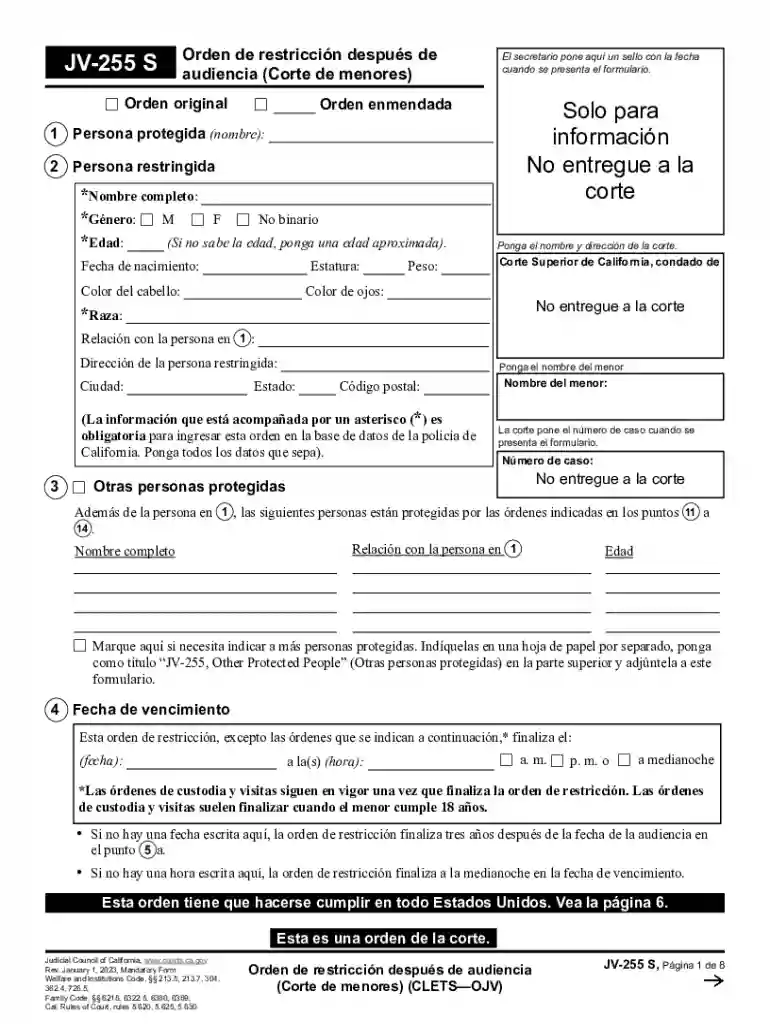
JV-255 S Judicial Council forms 2026

Get Form
JV-255 S Judicial Council forms Preview on Page 1

Here's how it works

01. Edit your form online
Type text, add images, blackout confidential details, add comments, highlights and more.

02. Sign it in a few clicks
Draw your signature, type it, upload its image, or use your mobile device as a signature pad.

03. Share your form with others
Send it via email, link, or fax. You can also download it, export it or print it out.

Definition and Purpose of JV-255 S Judicial Council Forms

JV-255 S Judicial Council forms are legal documents used within the juvenile court system. They play a crucial role in cases involving juveniles, such as delinquency, dependency, or custody matters. These forms are designed to standardize proceedings and ensure all necessary legal protocols are followed. Commonly, JV-255 S forms might include information pertaining to restraining orders or protection of minors.

Key Elements of JV-255 S Forms

  • Section for Personal Information: Includes fields for the protected person and the restrained person.
  • Prohibitions and Restrictions: Lists specific prohibitions such as firearm possession and any form of contact.
  • Compliance Instructions: Outlines what is required to comply with the order.
  • Enforcement Details: Instructions for how law enforcement officers should enforce the order.

Steps to Complete the JV-255 S Judicial Council Forms

  1. Gather Necessary Information: Collect all relevant personal details of the involved parties.
  2. Understand the Form Requirements: Review prohibitions and compliance sections to ensure full understanding.
  3. Fill Out Personal Details: Enter the required information accurately in the provided fields.
  4. Specify Prohibitions: Clearly mark any restrictions or special conditions applicable.
  5. Review and Verify: Double-check all entered information for accuracy and completeness.
  6. Submit the Form: Follow the appropriate submission method for your jurisdiction, whether online, by mail, or in person.

How to Obtain JV-255 S Judicial Council Forms

Online Acquisition

  • Visit the Official Court Website: Access forms through the official state or county court websites.
  • Downloadable PDFs: Most forms are available as downloadable PDFs for convenience and accessibility.
  • Digital Completion: Fill out and submit the forms digitally where applicable.

Physical Copies

  • Court Clerk's Office: Obtain forms directly from the clerk’s office at your local courthouse.
  • Community Legal Clinics: Many offer paper copies of legal forms and assistance in filling them out.

Why Use JV-255 S Judicial Council Forms

JV-255 S Judicial Council forms are essential for ensuring legal processes in juvenile cases are handled consistently and in compliance with state laws. They provide a structured framework for:

  • Ensuring Protection: Safeguarding minors and preventing unauthorized contact.
  • Legal Compliance: Meeting all necessary legal protocols and requirements.
  • Record Keeping: Helping maintain precise records for legal proceedings.

Who Typically Uses JV-255 S Judicial Council Forms

  • Attorneys: Legal professionals representing minors or interested parties in juvenile cases.
  • Judges: Used to issue orders related to juvenile court cases.
  • Law Enforcement: Officers responsible for enforcing restraining orders and other court-issued directives.
  • Social Workers: Involved in dependency or guardianship proceedings to ensure minors’ welfare.

Legal Use and Compliance with JV-255 S Judicial Council Forms

Compliance Requirements

  • Adherence to Security Measures: Ensuring any restrictions, like contact prohibitions, are fully understood and followed.
  • Proper Form Submission: Timely submission to avoid any legal repercussions.

Legal Implications

  • Violations: Non-compliance can lead to penalties or legal action, reinforcing the importance of understanding prohibitions fully.

State-Specific Rules for JV-255 S Judicial Council Forms

Different states may have specific variations or additional requirements for JV-255 S forms. Factors can include:

  • Additional Signatories: Required in certain jurisdictions.
  • Filing Fees: Some states might impose fees for filing particular judicial forms.
  • State-Specific Provisions: Unique legal stipulations or variations in juvenile laws.

Important Terms Related to JV-255 S Judicial Council Forms

  • Protected Person: The individual shielded by the terms of the form.
  • Restrained Person: The individual restricted under the form's prohibitions.
  • Enforcement Orders: Instructions for law enforcement regarding adherence and compliance.

Form Submission Methods

Online Submission

  • Electronic Portals: Many states offer digital submission services for ease and efficiency.
  • Confirmation Receipts: Receive immediate proof of submission when opting for online methods.

In-Person Submission

  • Court Drop-off: Forms can often be directly submitted at designated courthouse locations.

Mail Submission

  • Certified Mail: Ensuring a tracking route provides proof of delivery.

Incorporating the detailed content above will help those in need of understanding, completing, and filing the JV-255 S Judicial Council forms accurately and efficiently. Each section is optimized for clarity and utility, ensuring comprehensive guidance suited to the form's specific context.

See more JV-255 S Judicial Council forms versions

We've got more versions of the JV-255 S Judicial Council forms form. Select the right JV-255 S Judicial Council forms version from the list and start editing it straight away!
Versions Form popularity Fillable & printable
2023 4 Satisfied (31 Votes)
2017 4.8 Satisfied (73 Votes)
2014 4.2 Satisfied (145 Votes)
be ready to get more

Complete this form in 5 minutes or less

Get form

Got questions?

We have answers to the most popular questions from our customers. If you can't find an answer to your question, please contact us.
Contact us
If you believe the protection order was granted improperly or that it is no longer needed, you can file a motion asking the court to dissolve (terminate or cancel) the protection order. After you file the motion, the court will decide whether or not to schedule a hearing.
Relative Information (JV-285) A childs relative can use this to give information to the court about a child who has been removed from the home. Get form JV-285.
Anyone seeking such an order must be prepared to present some evidence in addition to their own written statements and testimony in Court. This standard means that the Court must see photographs, text messages, e-mails or any other physical evidence that can support claims made by the Petitioner.
In order to obtain a DVRO in California you must gather an amount of evidence to convince a judge in California that the person you want restrained is a a threat to you in the future and in the pass. TROs are given for emergencies. You have to show social media, email and text messages of threats, a long pattern of it.
State to the court that you would like a restraining order and what you would like the court to order. Be as specific as possible. Examples: I am asking the court to grant me a month/year injunction. I want no contact in person, at home, by phone, at work, by mail or through third parties.

Security and compliance

At DocHub, your data security is our priority. We follow HIPAA, SOC2, GDPR, and other standards, so you can work on your documents with confidence.

Learn more
ccpa2
pci-dss
gdpr-compliance
hipaa
soc-compliance

People also ask

A big reason for denial is when people cant show they have a valid claim. This happens in about 30% of cases because theres no proof. Judges need solid evidence of threats or abuse to grant protection. If people dont show up for the first hearing, their case is automatically denied.
How to Win a Restraining Order Court Hearing Properly Organize the Evidence. Seasoned lawyers expertly organize evidence such as photos and text messages between you and the protected person to support your story. Prepare for the Restraining Order Hearing. Present Your Case at the Hearing. Gather Third-Party Witnesses.

Related links