





Definition and Meaning of Certified Public Accounting Criminal Self-Reporting
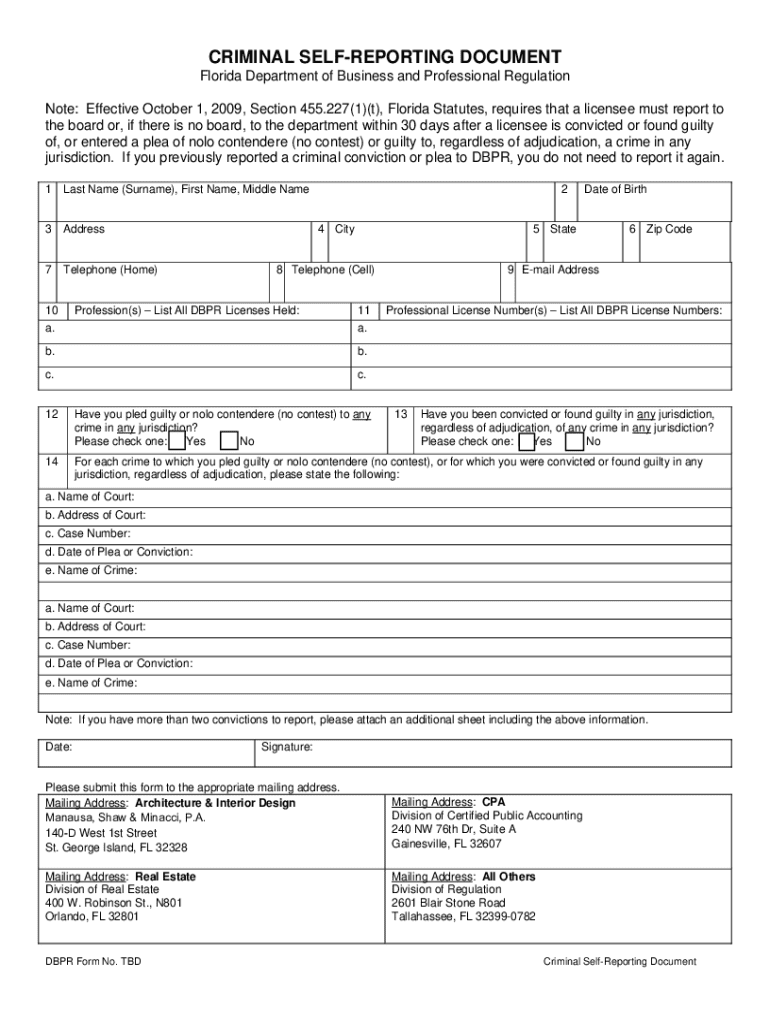
The Certified Public Accounting Criminal Self-Reporting is a mandatory document issued by the Florida Department of Business and Professional Regulation. It requires licensed Certified Public Accountants (CPAs) to disclose any criminal convictions or pleas that occur within 30 days of the judgment. This form upholds the ethical standards expected of CPA professionals by ensuring transparency and accountability. Timely submission is crucial for maintaining good standing with the licensing board.
How to Use the Certified Public Accounting Criminal Self-Reporting
Using this form involves detailed reporting of any criminal incidents post-conviction. CPAs must complete sections containing personal information, details of the offense, and any court documentation. Accurate data entry is essential as inaccuracies can lead to further scrutiny or penalties. Beyond merely listing offenses, applicants should provide comprehensive information on judgments, sentences, or probation details to present a clear picture of their legal standing.
Steps to Complete the Certified Public Accounting Criminal Self-Reporting
-
Collect Necessary Information: Assemble all pertinent legal documents related to the conviction, including case numbers, jurisdiction details, and official judgment copies.
-
Fill in Personal Details: Input your name, license number, address, and contact details accurately to ensure the form is linked correctly to your professional profile.
-
Detail Criminal Offenses: Clearly state the nature of the crime, conviction date, and corresponding sentence—including probation or imprisonment terms.
-
Attach Required Documentation: Submit supporting documents such as court orders, plea agreements, or sentencing details to validate the information reported.
-
Review and Submit: Double-check all entries for accuracy and completeness before submitting the form to the appropriate division based on your professional classification.
Why You Should Submit the Certified Public Accounting Criminal Self-Reporting
Submitting the form is crucial for compliance with state regulations. It safeguards your professional credibility and keeps your license in good standing. By acknowledging criminal offenses transparently, you mitigate the risk of disciplinary actions that could disrupt your career. Non-compliance can result in severe penalties, including license suspension or revocation, thus highlighting the importance of submission.
Important Terms Related to Certified Public Accounting Criminal Self-Reporting
- Licensee: A certified public accountant licensed in the state of Florida.
- Conviction: A formal declaration that someone is guilty of a criminal offense.
- Plea: The formal statement made by a defendant, declaring whether they admit or deny the charge.
- Self-Reporting: The proactive disclosure of one's legal standing in relation to criminal activities post-conviction.
Legal Use of the Certified Public Accounting Criminal Self-Reporting
The form is legally binding and directly impacts the regulatory oversight of CPAs. Adhering to self-reporting requirements underscores a CPA's commitment to ethical practice. Legal use also involves the timely and truthful reporting of all pertinent information regarding any offenses, as misrepresentation can lead to additional legal consequences and damage to one's professional standing.
State-Specific Rules for Certified Public Accounting Criminal Self-Reporting
Florida enforces strict self-reporting rules for CPAs to ensure that the professional conduct of its licensees meets the state's ethical standards. Unlike other states, Florida mandates a 30-day window for reporting any criminal activities, emphasizing swift accountability. These rules may vary in terms of response time and reporting formats across different states, highlighting the need for familiarity with specific state requirements.
Penalties for Non-Compliance
Failure to submit the Certified Public Accounting Criminal Self-Reporting form within the stipulated time frame may result in various penalties, including:
-
Fines and Fees: Monetary penalties assessed by the governing board.
-
License Suspension: Temporary suspension of CPA licensure until compliance is achieved.
-
License Revocation: Permanent loss of CPA licensure, prohibiting practice within the state.
-
Additional Disciplinary Actions: Such as public reprimand or mandatory ethics courses, which aim to reinforce compliance and ethical practices.


