




01. Edit your oregon boat title registration online
Type text, add images, blackout confidential details, add comments, highlights and more.

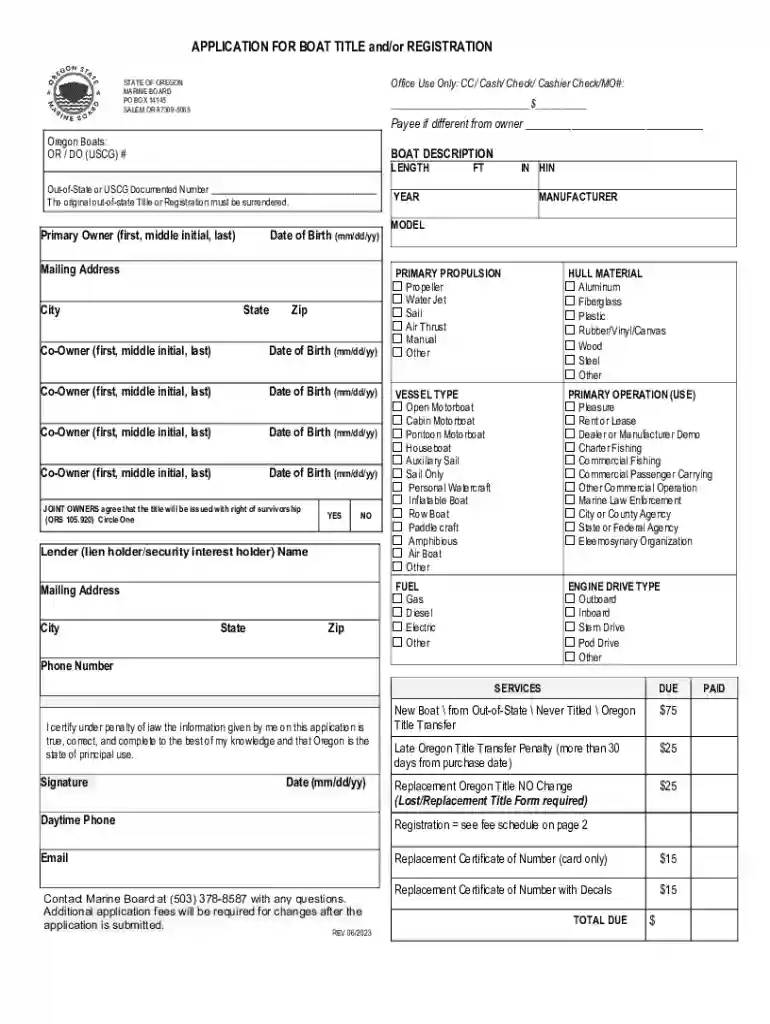
Type text, add images, blackout confidential details, add comments, highlights and more.

Draw your signature, type it, upload its image, or use your mobile device as a signature pad.

Send application boat title via email, link, or fax. You can also download it, export it or print it out.
The Certificate of Number, often referred to as the Registration Card, is an official document required for the legal registration of a vessel or boat in the United States. This form is mandated by state governments to ensure that vessels operating in public waters are properly documented. The Certificate of Number contains crucial details about the vessel, including its unique registration number, owner information, and vessel specifics like size and type. It provides proof of registration, which is essential not only for legal compliance but also for safety and regulatory purposes. Owning this certificate allows authorities to track vessel ownership and monitor compliance with maritime laws.
Once obtained, the Certificate of Number must be carried on board whenever the vessel is in operation. This allows for presentation to authorities upon request. It is also advisable to provide a copy of the registration card to anyone who might operate the vessel, ensuring that they are also aware of its registration details. The registration number displayed on the Certificate of Number must be affixed to the vessel, usually on both sides of the bow. This makes it easy for authorities to identify the vessel visually from a distance. Compliance with these requirements not only ensures legal operation but also contributes to safety and accountability on the water.
Obtaining this certificate typically involves submitting an application to the state's maritime authority or department of motor vehicles. The process often includes completing a specific form, providing proof of ownership, such as a bill of sale, and paying a registration fee. Some states may require a hull identification number inspection or proof of sales tax payment. Applications can often be submitted online, via mail, or in person, depending on the state's procedures. Once the application is approved, the authority will issue the Certificate of Number, allowing the vessel to be legally operated on public waters.
The Certificate of Number comprises several critical elements that provide pertinent information about the vessel and its ownership. These elements may include:
While there is a generally standard format for the Certificate of Number, each state in the U.S. may have specific rules and requirements regarding its issuance and renewal. For example, states may differ in their registration renewal cycles—some mandate annual renewals, while others require biennial updates. Certain states might have additional requirements for boat inspections or safety courses that must be fulfilled before issuance. It's essential to refer to your specific state's guidelines to ensure compliance with all local maritime laws.
Failing to register your vessel or not adhering to the documentation requirements can result in significant penalties. These penalties may include fines, the vessel being barred from operating in state waters, and even possible legal action. It's vital to keep the Certificate of Number current and adhere to state-specific guidelines to avoid these penalties. This underscores the importance of renewing the registration before expiration and ensuring that all procedural requirements are continually met.
In practical terms, the Certificate of Number is used to legitimize vessels operating on U.S. waters. For instance, if a vessel is moored in a marina, the Certificate of Number must be provided to the marina operator as part of the mooring agreement. Similarly, if the boat is sold, the Certificate of Number must be transferred to the new owner to continue its legal use. Moreover, the registered details on the certificate are crucial in situations involving law enforcement checks or in the unfortunate event of theft or disaster, allowing for swift investigation and recovery efforts.
The legal use of the Certificate of Number involves adhering to all the registration and display requirements stipulated by law. Vessel owners should ensure that the registration is valid, and the correct number is visibly marked on the vessel as dictated by state laws. Engaging in the operation of a vessel without carrying the valid certificate, having incorrect or obscured registration numbers, or using an expired certificate may lead to legal consequences. Consequently, maintaining compliance with the registration requirements is essential for lawful and safe boating activities.
We've got more versions of the oregon boat title registration form. Select the right oregon boat title registration version from the list and start editing it straight away!
At DocHub, your data security is our priority. We follow HIPAA, SOC2, GDPR, and other standards, so you can work on your documents with confidence.
Certificate of Number Required (Registration Card). less than 26 feet in length and
A Certificate of Number ID Card is issued at the time of registration (with decals). A sample certificate of number ID card can be viewed online.Read more


