California dual capacity disclosure - REMN Wholesale 2026

Get Form
capacity disclosure Preview on Page 1

Here's how it works

01. Edit your capacity disclosure online
Type text, add images, blackout confidential details, add comments, highlights and more.

02. Sign it in a few clicks
Draw your signature, type it, upload its image, or use your mobile device as a signature pad.

03. Share your form with others
Send capacity disclosure form via email, link, or fax. You can also download it, export it or print it out.

How to use or fill out California Dual Capacity Disclosure - REMN Wholesale with our platform

Form edit decoration
9.5
Ease of Setup
DocHub User Ratings on G2
9.0
Ease of Use
DocHub User Ratings on G2
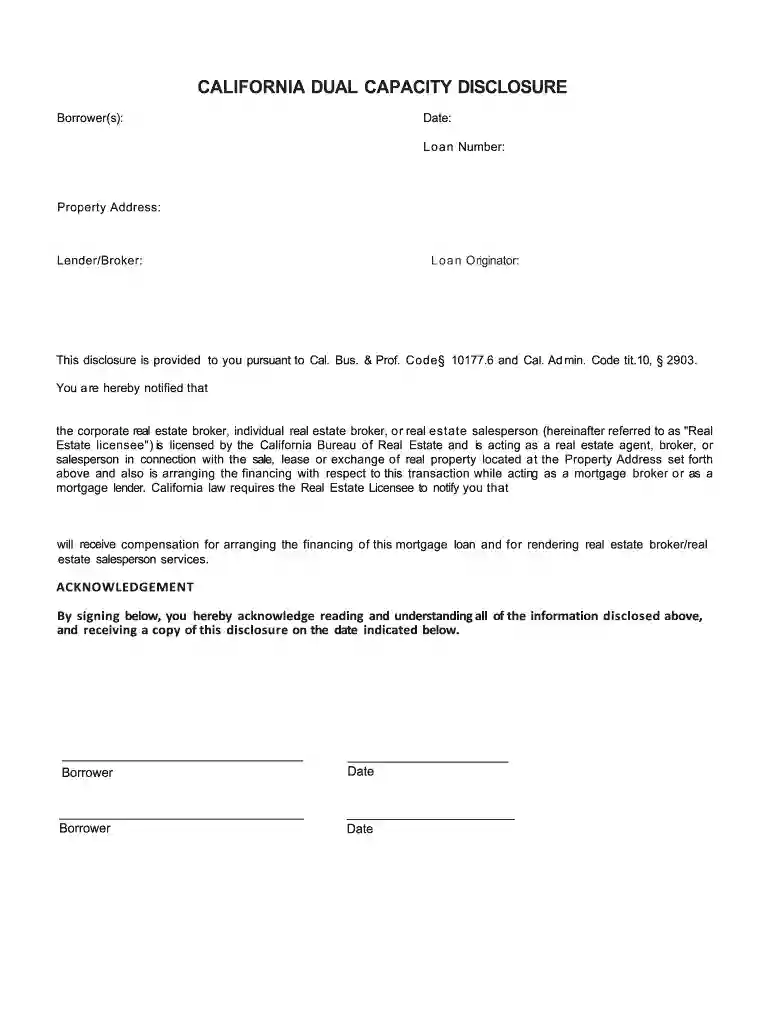
  1. Click ‘Get Form’ to open the California Dual Capacity Disclosure in the editor.
  2. Begin by entering the names of all Borrower(s) in the designated field at the top of the form.
  3. Next, input the Date and Loan Number in their respective fields to ensure accurate record-keeping.
  4. Fill in the Property Address where the transaction is taking place, ensuring it matches official documents.
  5. Provide details for Lender/Broker and Loan Originator, as these are crucial for identifying parties involved in the transaction.
  6. Review the disclosure statement carefully. This informs you about the dual role of your real estate licensee and their compensation structure.
  7. Finally, both Borrowers must sign and date in the Acknowledgment section to confirm understanding of this disclosure.

Start using our platform today to complete your California Dual Capacity Disclosure easily and for free!

See more california dual capacity disclosure - REMN Wholesale versions

We've got more versions of the california dual capacity disclosure - REMN Wholesale form. Select the right california dual capacity disclosure - REMN Wholesale version from the list and start editing it straight away!
Versions Form popularity Fillable & printable
2017 4.5 Satisfied (22 Votes)
2013 4.3 Satisfied (35 Votes)
be ready to get more

Complete this form in 5 minutes or less

Get form

Got questions?

We have answers to the most popular questions from our customers. If you can't find an answer to your question, please contact us.
Contact us
Legally speaking, a dual agent is a real estate broker, or agents working for the same broker, who act on behalf of both the seller and the buyer in a transaction. A broker is permitted to act as a dual agent in California only if the buyer and seller are both aware of and consent to the dual agency.
The agency disclosure form is required for any sale or exchange of one-to-four dwelling units, any lease on one-to-four dwelling units for more than 1 year, commercial real property, and any mobile home if sold by a real estate licensee.
Per the Lending Letter, a mortgage loan originator, or an associate of a mortgage loan originator, may act as both a mortgage loan originator and a real estate broker or agent in connection with the sale of property if the mortgage loan originator provides the buyer a dual capacity disclosure informing the borrower
The TDS is required in the sale of one to four residential units as well as transfers by exchange, installment land sale contract, lease with an option to purchase, option to purchase, or ground lease coupled with improvements.
What types of transactions in California may require agency disclosure? B - Agency disclosure is required for listings for sale or lease involving one- to four-unit residential properties and non-residential (commercial) properties.

Security and compliance

At DocHub, your data security is our priority. We follow HIPAA, SOC2, GDPR, and other standards, so you can work on your documents with confidence.

Learn more
ccpa2
pci-dss
gdpr-compliance
hipaa
soc-compliance
be ready to get more

Complete this form in 5 minutes or less

Get form

People also ask

California, like many states, requires most sellers of residential property containing one to four units to disclose, in writing, details about the property they being offered. These disclosure obligations apply whether its a standalone home, a high-rise condo unit, or a manufactured or mobile home.
Examples of material facts that must be disclosed include structural problems with the house, soil problems, a leaking roof, unpermitted construction, neighborhood noise problems, and anything else that a buyer would deem to be important.

ca capacity disclosure