15 ILCS 510 State Treasurer Employment Code - Illinois 2026

Get Form
15 ILCS 510 State Treasurer Employment Code - Illinois Preview on Page 1

Here's how it works

01. Edit your form online
Type text, add images, blackout confidential details, add comments, highlights and more.

02. Sign it in a few clicks
Draw your signature, type it, upload its image, or use your mobile device as a signature pad.

03. Share your form with others
Send it via email, link, or fax. You can also download it, export it or print it out.

How to use or fill out 15 ILCS 510 State Treasurer Employment Code - Illinois with DocHub

Form edit decoration
9.5
Ease of Setup
DocHub User Ratings on G2
9.0
Ease of Use
DocHub User Ratings on G2
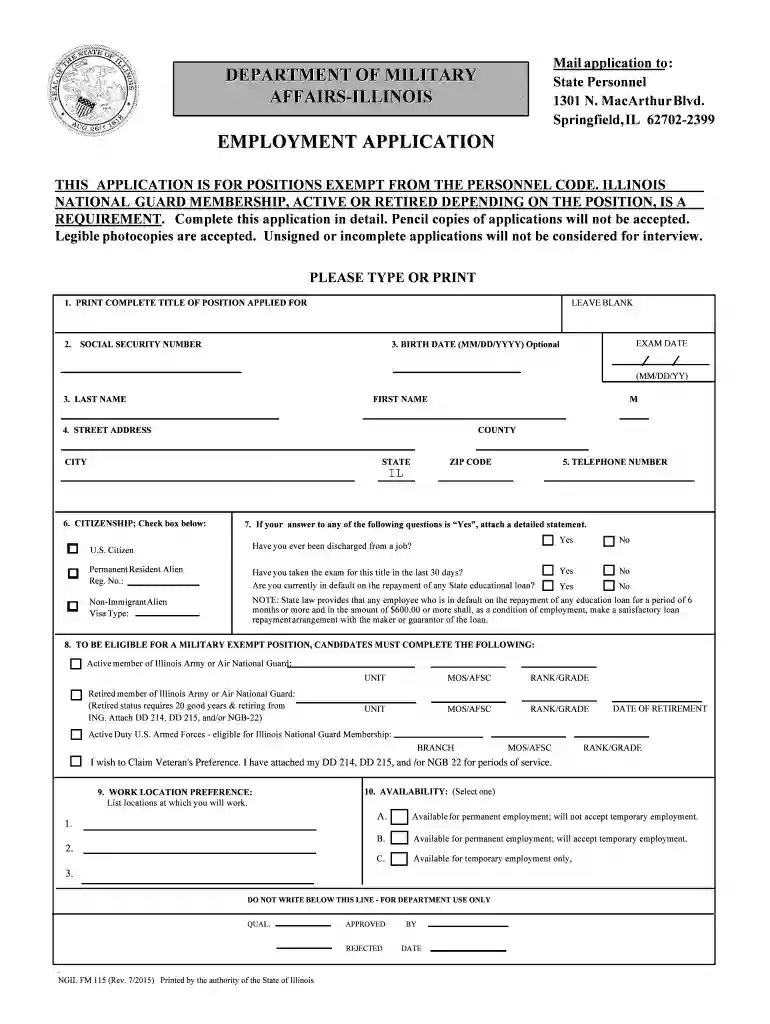
  1. Click ‘Get Form’ to open the 15 ILCS 510 State Treasurer Employment Code - Illinois application in our editor.
  2. Begin by entering the complete title of the position you are applying for in the designated field.
  3. Fill in your personal information, including your last name, first name, and address. Ensure all details are legible and accurate.
  4. Indicate your citizenship status by checking the appropriate box. If applicable, provide additional information regarding any previous job discharges or educational loan defaults.
  5. Complete the military eligibility section if relevant, detailing your service status and attaching necessary documentation like DD 214.
  6. List your education history accurately, including high school graduation status and any college degrees earned. Attach proof of education as required.
  7. Detail your employment history starting from the most recent position. Include employer names, dates of employment, and responsibilities.
  8. Review all sections for completeness before submitting. Ensure that you have signed and dated the application as required.

Start using our platform today to streamline your application process for free!

be ready to get more

Complete this form in 5 minutes or less

Get form

Got questions?

We have answers to the most popular questions from our customers. If you can't find an answer to your question, please contact us.
Contact us
The employer must respond to the claim by taking one of the following actions: The employer can resolve the matter without further costs by submitting a check to the Department for the amount claimed in accordance with the instructions contained in the Departments letter.
Whenever there is a period of excessive unemployment in Illinois, every person who is charged with the duty, either by law or contract, of constructing or building any public works project or improvement or for the clean‑up and on‑site disposal of hazardous waste for the State of Illinois or any political subdivision,
Exemptions at a Glance The law applies to everyone with at least one employee in the state of Illinois, with a few exceptions: Organizations governed by municipalities or counties with a PTO policy. Anyone with a minimally compliant pre-existing policy for leave (including those with unionized workers).
Every employer shall be required, at least semi-monthly, to pay every employee all wages earned during the semi-monthly pay period. Wages of executive, administrative and professional employees, as defined in the Federal Fair Labor Standards Act of 1939, may be paid once a month. Commissions may be paid once a month.
Every employer shall pay to each of his or her employees who is under 18 years of age that has not worked more than 650 hours for the employer during any calendar year: (1) $8 per hour from January 1, 2020 through December 31, 2020; (2) $8.50 per hour from January 1, 2021 through December 31, 2021; (3) $9.25 per hour

Security and compliance

At DocHub, your data security is our priority. We follow HIPAA, SOC2, GDPR, and other standards, so you can work on your documents with confidence.

Learn more
ccpa2
pci-dss
gdpr-compliance
hipaa
soc-compliance
be ready to get more

Complete this form in 5 minutes or less

Get form

People also ask

820 ILCS 115/5. Sec. 5. Every employer shall pay the final compensation of separated employees in full, at the time of separation, if possible, but in no case later than the next regularly scheduled payday for such employee.

Related links