




01. Edit your carmax power of attorney form online
Type text, add images, blackout confidential details, add comments, highlights and more.

Type text, add images, blackout confidential details, add comments, highlights and more.

Draw your signature, type it, upload its image, or use your mobile device as a signature pad.

Send carmax power of attorney form pdf via email, link, or fax. You can also download it, export it or print it out.
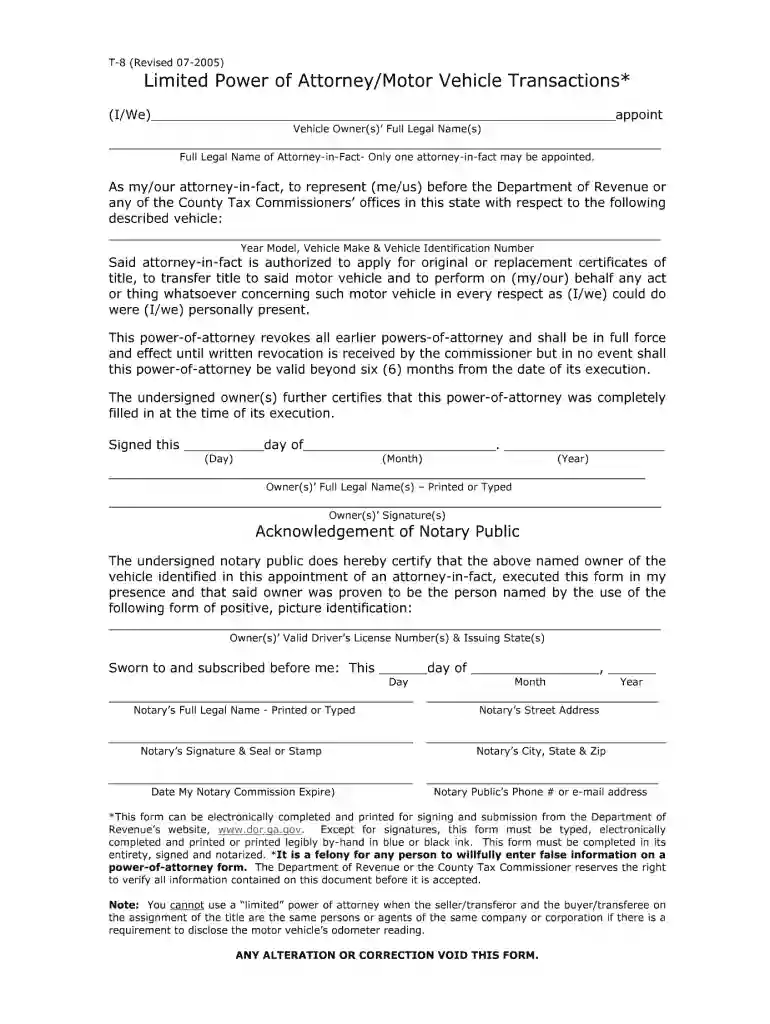
A limited power of attorney for motor vehicle transactions in Maryland, specifically the 2005 form, is a legal document that grants an individual, referred to as the attorney-in-fact, the authority to act on behalf of the vehicle owner in specific situations related to vehicle transactions. This typically includes buying, selling, registering, or transferring the title of a vehicle. The primary goal is to facilitate transactions when the vehicle owner is unable to be present, ensuring that all necessary actions can be taken without delay.
Authority Granted: The attorney-in-fact may only perform actions specified within the document, such as signing title transfer documents or representing the owner at the Maryland Motor Vehicle Administration (MVA).
Duration of Power: The authorization can be time-bound (effective for a certain period) or event-specific (valid until a transaction is completed).
Legal Binding: The form must be executed in accordance with Maryland law to be legally binding, typically requiring notarization.
To effectively utilize the limited power of attorney for motor vehicle transactions, follow these steps:
Identify the Need: Determine the reason for granting the power, such as selling a vehicle while residing in another state or managing documentation during a temporary absence.
Select the Attorney-in-Fact: Choose a trusted person who will act in your best interests. This could be a family member, friend, or a professional.
Complete the Form: Fill out the 2005 Limited Power of Attorney form, detailing the specific powers granted and including the names of both the principal (vehicle owner) and the attorney-in-fact.
Notarization: Sign the form in the presence of a notary public to ensure its legal validity. This step helps protect against fraud and ensures the signature is genuine.
Distribute Copies: Provide copies of the signed and notarized form to the attorney-in-fact and any relevant parties, such as the MVA, to facilitate transactions.
Completing the limited power of attorney form accurately is crucial for its acceptance:
Obtain the Correct Form: Download or request the Maryland 2005 Limited Power of Attorney for Motor Vehicle Transactions from the Maryland MVA or a reliable source.
Fill in Principal’s Information: Enter the full name and address of the vehicle owner granting power.
Designate the Attorney-in-Fact: Clearly write the name and address of the person being appointed as the attorney-in-fact.
Define the Scope of Authority: Specify what actions the attorney-in-fact is authorized to perform. This may include signing titles, submitting registration applications, and handling MVA transactions.
Sign and Notarize: Both the vehicle owner and the notary must sign the form. The notary will verify identities and witness the signing.
File with Relevant Authorities: Depending on the transaction, submit the form to the MVA or keep it with the vehicle title for reference.
Several parties may find themselves needing a limited power of attorney for motor vehicle transactions in Maryland:
Individuals Relocating: Owners moving to a different state may need someone local to manage the sale or registration of their vehicle.
Elderly Owners: Seniors who cannot attend the MVA due to health issues may require assistance in completing necessary vehicle transactions.
Business Owners: Companies that manage multiple vehicle fleets might designate an employee to handle title transfers and registrations on their behalf.
Military Personnel: Members of the armed forces unable to attend to their vehicle dealings due to deployment often use this form.


Understanding key terminology associated with the limited power of attorney for motor vehicle transactions is essential:
Principal: The person granting authority, typically the vehicle owner.
Attorney-in-Fact: The individual authorized to act on behalf of the principal in specific vehicle transactions.
Notary Public: An official authorized to witness signatures on legal documents and ensure their authenticity.
Motor Vehicle Administration (MVA): The state agency responsible for vehicle registration and licensing in Maryland.
Title Transfer: The legal process of changing the vehicle's ownership from one person to another.
When using the limited power of attorney for motor vehicle transactions in Maryland, certain state-specific regulations must be adhered to:
Notarization Requirement: Maryland law requires that the form be notarized to ensure its validity during transactions.
Accepted Powers: The attorney-in-fact may only execute the powers expressly granted within the document, preventing unauthorized actions.
Submission of Documentation: The MVA specifies that the form must be presented as part of the title transfer or registration process, thus following the state guidelines for vehicle transactions.
Revocation of Power: The principal has the right to revoke the power of attorney at any time, provided it is communicated to the attorney-in-fact and relevant parties.
By deeply understanding and properly utilizing the limited power of attorney for motor vehicle transactions, vehicle owners in Maryland can ensure their interests are effectively represented, even when they are unable to personally manage their vehicle affairs.
We've got more versions of the carmax power of attorney form form. Select the right carmax power of attorney form version from the list and start editing it straight away!
At DocHub, your data security is our priority. We follow HIPAA, SOC2, GDPR, and other standards, so you can work on your documents with confidence.
Jan 31, 2012 Power of Attorney. Internal Revenue Service. A foreign country or Alternative motor vehicle credit (Form. Form 1120S. and MedicareRead more
Feb 10, 2006 Maryland An advance directive is a written or oral instruction, such as a living will or durable power of attorney, concerning health careRead more
A party must make the initial disclosures at or within 14 days after the parties Rule 26(f) conference unless a different time is set by stipulation or courtRead more


