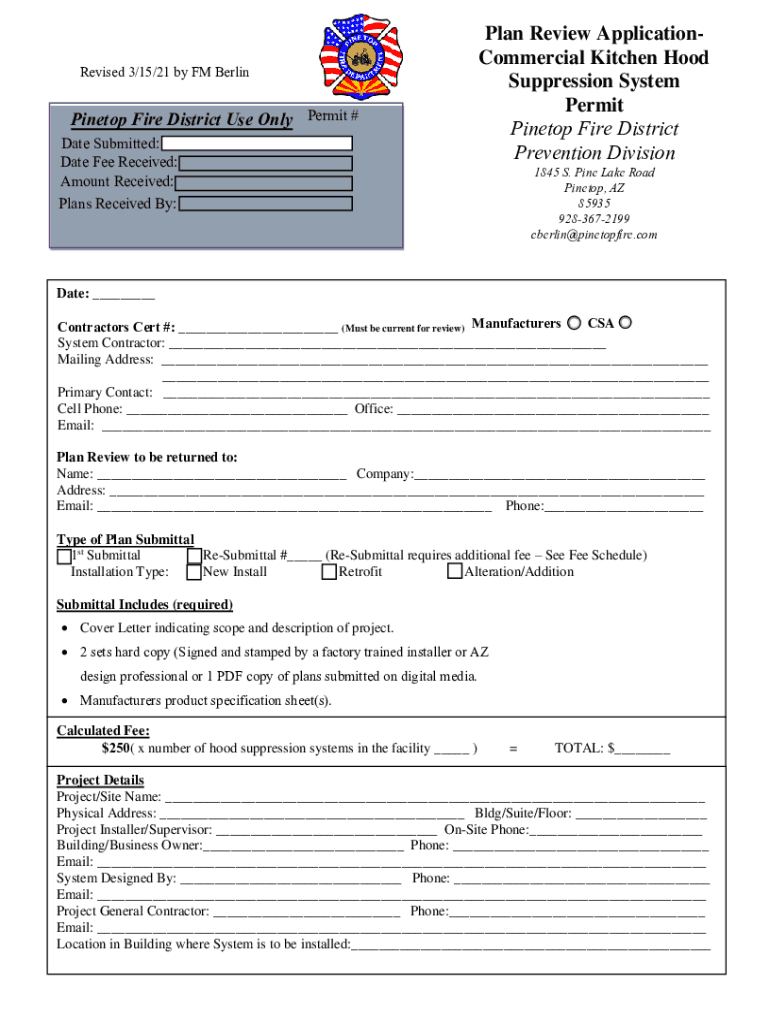
Plan Review Application- Commercial Kitchen Hood Revised 3 2026

Get Form
Plan Review Application- Commercial Kitchen Hood Revised 3 Preview on Page 1

Here's how it works

01. Edit your form online
Type text, add images, blackout confidential details, add comments, highlights and more.
02. Sign it in a few clicks
Draw your signature, type it, upload its image, or use your mobile device as a signature pad.
03. Share your form with others
Send it via email, link, or fax. You can also download it, export it or print it out.

How to use or fill out Plan Review Application- Commercial Kitchen Hood Revised 3 with our platform

Form edit decoration
9.5
Ease of Setup
DocHub User Ratings on G2
9.0
Ease of Use
DocHub User Ratings on G2
  1. Click ‘Get Form’ to open the Plan Review Application in the editor.
  2. Begin by entering the date and permit number at the top of the form. Ensure that you have your contractor's certification number ready, as it is required for review.
  3. Fill in the details of the system contractor, including their mailing address and primary contact information. This section is crucial for communication regarding your application.
  4. Indicate whether this is a first submittal or a re-submittal, and specify the installation type (New Install, Retrofit, Alteration/Addition).
  5. Attach all required documents such as a cover letter, hard copies of plans, and product specification sheets. You can easily upload these documents directly through our platform.
  6. Complete the project details section with accurate information about the project/site name, physical address, and contact details for all involved parties.
  7. Finally, review all entries for accuracy before submitting your application to ensure a smooth review process.

Start using our platform today to streamline your Plan Review Application process for free!

See more Plan Review Application- Commercial Kitchen Hood Revised 3 versions

We've got more versions of the Plan Review Application- Commercial Kitchen Hood Revised 3 form. Select the right Plan Review Application- Commercial Kitchen Hood Revised 3 version from the list and start editing it straight away!
Versions Form popularity Fillable & printable
2021 4.7 Satisfied (46 Votes)
be ready to get more

Complete this form in 5 minutes or less

Get form

Got questions?

We have answers to the most popular questions from our customers. If you can't find an answer to your question, please contact us.
Contact us
In pharmacy settings, these hoods are referred to as chemo hoods. Class II BSCs are designed with an open front with inward airflow (personnel protection), downward HEPA-filtered laminar airflow (product protection) and HEPA-filtered exhaust air (environmental protection).
Type I Hood Requirements Avoid combustibles: your hood at least 18 inches away from combustibles. Use approved materials: Any hood in the kitchen should be made of steel with a minimum thickness of 0.0466 inches of stainless steel with a minimum thickness of 0.0335 inches.
Type 1 hoods are called grease hoods or ducts. They are designed to remove heat smoke and grease build-up from your kitchen. These vent hoods work in a commercial kitchen to remove grease and prevent fire. The type 2 hoods are designed to remove condensation from the kitchen atmosphere.
Type 1 hoods contain fire-extinguishing equipment. These hoods are required over appliances that produce grease-laden vapors or smoke. They must contain both automatic and manual methods of activation. The most common types are wet chemical extinguishing systems (UL 300) and carbon dioxide extinguishing systems.
On average, a range hood fan must move at a minimum of 100 CFM of air for about every 12 inches of the stove width. This actually determines that in case you have a stove that is 30 inches wide then you will need a range hood with a fan that rotates for at least 250 CFM of air.
be ready to get more

Complete this form in 5 minutes or less

Get form

People also ask

Type I hoods are required for equipment that produce smoke or grease-laden fumes. This includes equipment such as fryers, ranges, griddles, convection ovens, tilt skillets and broilers. Type II hoods are used where grease isnt present to remove steam, vapor and odors.
Type 2 hoods, or condensate hoods, are designed to collect and remove steam, vapor, heat, and odor wherever grease is not present.
0:24 0:59 What Is The Difference Between Type I Type II Hoods? - YouTube YouTube Start of suggested clip End of suggested clip Youre going to be doing a dishwasher or just baking. You can actually use a type 2 hood. Which isMoreYoure going to be doing a dishwasher or just baking. You can actually use a type 2 hood. Which is used just for heat and steam. Only. So a type 1 hood is going to be used for grease producing cooking

Related links