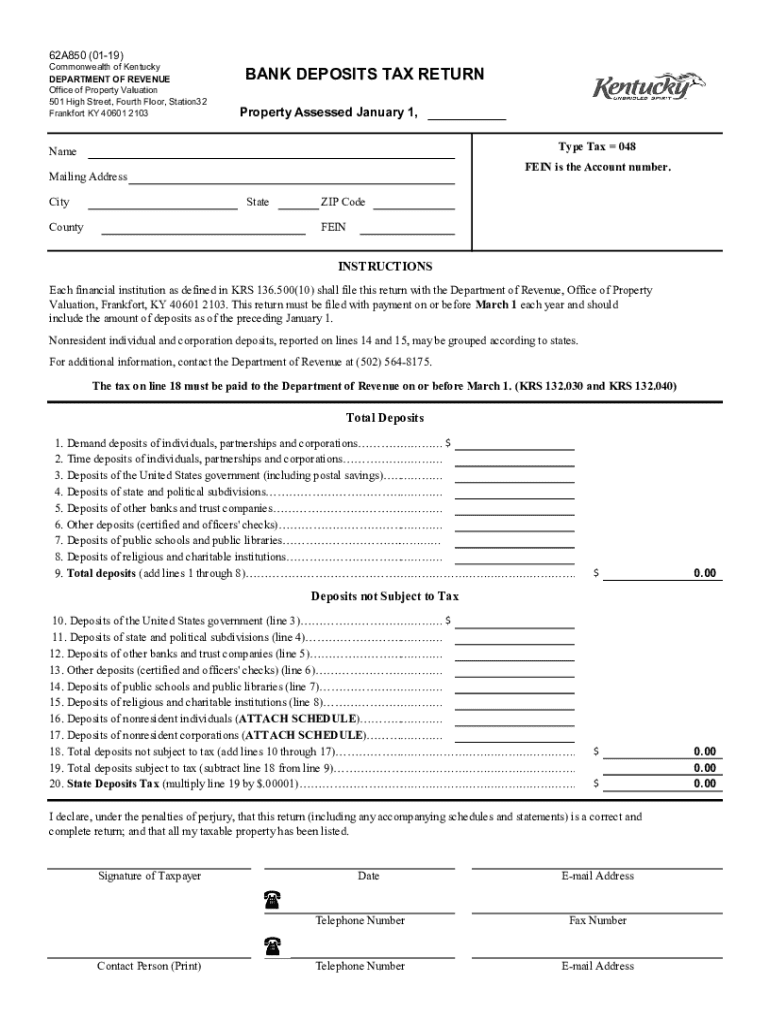
Bank Deposits Tax Return 2025

Get Form
Bank Deposits Tax Return Preview on Page 1

Here's how it works

01. Edit your form online
Type text, add images, blackout confidential details, add comments, highlights and more.
02. Sign it in a few clicks
Draw your signature, type it, upload its image, or use your mobile device as a signature pad.
03. Share your form with others
Send it via email, link, or fax. You can also download it, export it or print it out.

How to use or fill out Bank Deposits Tax Return with our platform

Form edit decoration
9.5
Ease of Setup
DocHub User Ratings on G2
9.0
Ease of Use
DocHub User Ratings on G2
  1. Click ‘Get Form’ to open the Bank Deposits Tax Return in the editor.
  2. Begin by entering your name and FEIN (Account number) in the designated fields at the top of the form.
  3. Fill in your mailing address, including city, state, county, and ZIP code.
  4. In the 'Total Deposits' section, accurately report each type of deposit as of January 1. Ensure you complete lines 1 through 8 for a comprehensive total.
  5. Next, move to the 'Deposits not Subject to Tax' section. Fill out lines 10 through 17 based on your institution's deposits that are exempt from tax.
  6. Calculate the total deposits subject to tax by subtracting line 18 from line 9. Enter this amount on line 19.
  7. Finally, compute the State Deposits Tax by multiplying line 19 by $.00001 and enter it on line 20.
  8. Sign and date the form at the bottom, ensuring all information is accurate before submission.

Start using our platform today for free to streamline your Bank Deposits Tax Return process!

See more Bank Deposits Tax Return versions

We've got more versions of the Bank Deposits Tax Return form. Select the right Bank Deposits Tax Return version from the list and start editing it straight away!
Versions Form popularity Fillable & printable
2019 4.8 Satisfied (27 Votes)
2016 4.6 Satisfied (60 Votes)
2011 4 Satisfied (56 Votes)
be ready to get more

Complete this form in 5 minutes or less

Get form

Got questions?

We have answers to the most popular questions from our customers. If you can't find an answer to your question, please contact us.
Contact us
Bank Deposits Method Generally Bank deposits are one of the primary methods the government uses to calculate taxable income. As an indirect method, circumstantial means are utilized to approximate unreported taxable income. This method focuses on deposits made to a bank, or similar, account in a tax year.
Banks Must Report Large Deposits According to the Bank Secrecy Act, banks are required to file Currency Transaction Reports (CTR) for any cash deposits over $10,000, said Lyle Solomon, principal attorney at Oak View Law Group.
The IRS reporting threshold: The $10,000 rule This applies to cash deposits, wire transfers, and other large financial movements. But this rule isnt about taxing you its part of anti-money laundering laws designed to flag suspicious activity.
You can deposit $50,000 cash in your bank as long as you report it to the IRS. Your individual banking institutions may also have limits on cash deposit amounts, so check with your bank before making large cash deposits.
Banks typically do not impose deposit limits. You can deposit up to $10,000 cash before reporting it to the IRS. Lump sum or incremental deposits of more than $10,000 must be reported. Banks must report cash deposits of more than $10,000.
be ready to get more

Complete this form in 5 minutes or less

Get form

People also ask

A Currency Transaction Report must be filled out and sent to the IRS and FinCEN. The Bank Secrecy Act of 1970 and the Patriot Act of 2001 dictate that banks keep records of deposits over $10,000 to help prevent financial crime.
Depositing $2,000 in cash is generally not suspicious, as it doesnt docHub the $10,000 threshold. However, it could still raise red flags with the IRS, especially if you have a series of somewhat large deposits like this without explanation.
Receiving your refund after approval: Once the IRS approves your refund, how long does it take for it to show in your bank account? The good news is, not long. Financial institutions typically process direct deposit refunds within a few days, though timing can vary depending on bank processing times and volumes.

Related links