How to Accept Credit and Debit Card Payments - Mastercard 2026

Get Form
How to Accept Credit and Debit Card Payments - Mastercard Preview on Page 1

Here's how it works

01. Edit your form online
Type text, add images, blackout confidential details, add comments, highlights and more.

02. Sign it in a few clicks
Draw your signature, type it, upload its image, or use your mobile device as a signature pad.

03. Share your form with others
Send it via email, link, or fax. You can also download it, export it or print it out.

How to use or fill out How to Accept Credit and Debit Card Payments - Mastercard with our platform

Form edit decoration
9.5
Ease of Setup
DocHub User Ratings on G2
9.0
Ease of Use
DocHub User Ratings on G2
  1. Click ‘Get Form’ to open it in the editor.
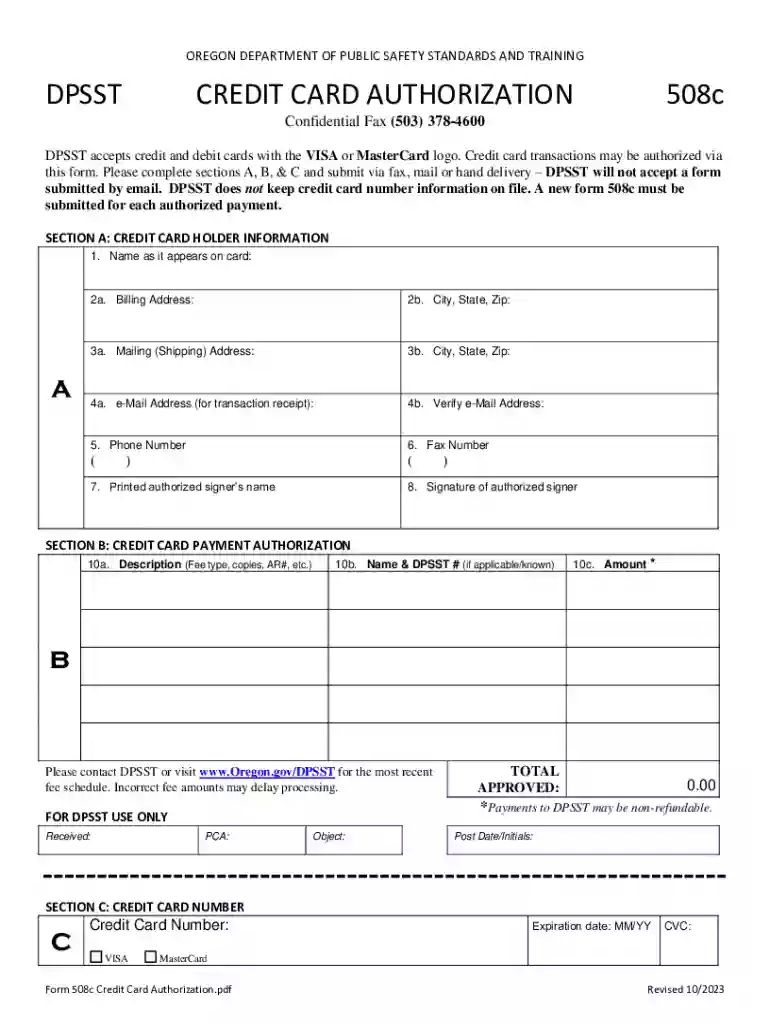
  2. Begin with Section A: Credit Card Holder Information. Fill in your name as it appears on the card, followed by your billing address, including city, state, and zip code.
  3. Next, provide your mailing (shipping) address if different from the billing address. Ensure you include the city, state, and zip code for accuracy.
  4. Enter your email address twice to verify it for transaction receipts. Include a phone number and fax number if available.
  5. In Section B: Credit Card Payment Authorization, describe the payment type and include any relevant details such as fee type or DPSST number.
  6. Specify the amount you wish to authorize for payment. Be sure to check the latest fee schedule on the DPSST website to avoid delays.
  7. Finally, complete Section C by entering your credit card number, selecting either VISA or MasterCard, and providing the expiration date and CVC.

Start using our platform today for free to streamline your document editing and payment authorization process!

See more How to Accept Credit and Debit Card Payments - Mastercard versions

We've got more versions of the How to Accept Credit and Debit Card Payments - Mastercard form. Select the right How to Accept Credit and Debit Card Payments - Mastercard version from the list and start editing it straight away!
Versions Form popularity Fillable & printable
2023 4.6 Satisfied (56 Votes)
2018 4.4 Satisfied (57 Votes)
2018 4.2 Satisfied (40 Votes)
2014 4 Satisfied (27 Votes)
be ready to get more

Complete this form in 5 minutes or less

Get form

Got questions?

We have answers to the most popular questions from our customers. If you can't find an answer to your question, please contact us.
Contact us
Common ways to accept credit card payments In person: Use a point-of-sale (POS) system, so customers can tap to pay with their card or phone. Online: Accept payments through an online store, invoice, or payment link. Over the phone: Key in card details using POS software or a virtual terminal.
How to accept credit cards as a small business Choose a payment services provider (PSP) Set up a merchant account. Integrate a payment gateway. Acquire hardware and software for in-person transactions. Compliance and security considerations.
Anyone can set up an account with a payment service provider like PayPal or Stripe; you dont have to be a legal business entity. Those accounts let you accept credit card payments from anyone, including friends, family, customers and clients.
Yes, you can have both, and you can have several of each. Debit cards are normally associated with bank accounts: youll normally get one to act as your cash card and a payment card, and some banks offer rewards such as cashback or points.
Regardless of your merchant services needs, you must have three things to accept credit card payments online: Digital storefront. Your digital storefront is your businesss home base online. Payment gateway. A payment gateway is an interface for customers to input their payment information. Payment processor.

Security and compliance

At DocHub, your data security is our priority. We follow HIPAA, SOC2, GDPR, and other standards, so you can work on your documents with confidence.

Learn more
ccpa2
pci-dss
gdpr-compliance
hipaa
soc-compliance

People also ask

The 2/3/4 rule generally refers to application limits for certain issuers, like Chase, meaning no more than 2 cards in 30 days, 3 in 90 days, and 4 in 120 days. This helps prevent excessive applications in a short time frame.

Related links