




01. Edit your pain scale form online
Type text, add images, blackout confidential details, add comments, highlights and more.

Type text, add images, blackout confidential details, add comments, highlights and more.

Draw your signature, type it, upload its image, or use your mobile device as a signature pad.

Send chiropractic drawing via email, link, or fax. You can also download it, export it or print it out.
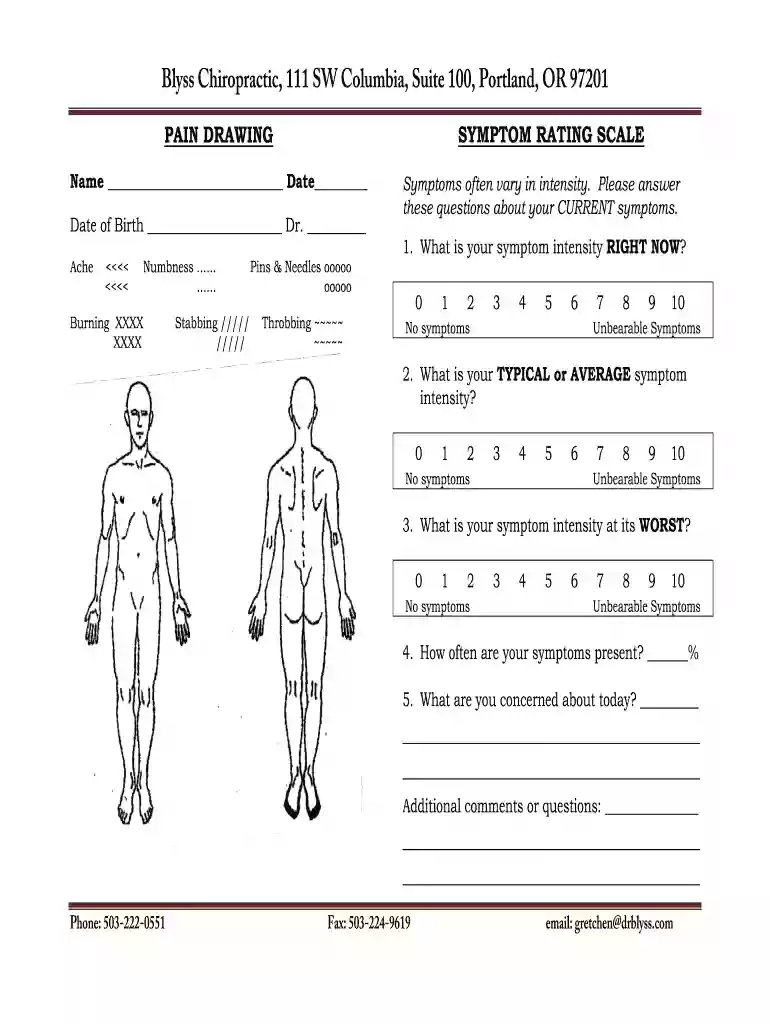
The Pain Drawing Symptom Rating Scale used by Blyss Chiropractic is a specialized tool that allows patients to communicate their pain and discomfort clearly. This form is designed to assist healthcare professionals in visualizing the patient's pain experience. Patients use specific body diagrams to pinpoint areas of pain, which helps their chiropractors develop a tailored treatment plan.
The scale enables patients to rate their pain on a continuum, from mild discomfort to severe pain. By combining visual elements with descriptive pain levels, the form seeks to provide comprehensive insights into each patient's unique experience. This empowers both patients and healthcare providers to engage in informed discussions about treatment options.
Pain is subjective, making effective communication essential. The pain drawing component serves as a visual descriptor, which can enhance understanding and diagnostic accuracy. This scale not only aids in immediate care but also helps track changes in the patient's condition over time.
Using the Pain Drawing Symptom Rating Scale involves a straightforward process that prioritizes patient engagement.
Patients are encouraged to complete this form as accurately as possible, as it will inform their treatment plan.
Completing the Pain Drawing Symptom Rating Scale is organized into distinct steps to ensure clarity and comprehensiveness.
These steps are designed to promote an effective dialogue between the patient and the chiropractor, fostering better treatment outcomes.
The Pain Drawing Symptom Rating Scale offers numerous advantages for both patients and practitioners.
Utilizing this scale can significantly impact the effectiveness of chiropractic care, leading to better health outcomes for patients.
The Pain Drawing Symptom Rating Scale encompasses several critical components essential for thorough assessment.
Integrating these elements within the pain rating scale ensures a comprehensive overview of the patient's condition, fostering informed treatment decisions.
Understanding terminology surrounding the Pain Drawing Symptom Rating Scale can enhance communication and improve outcomes.
Chairing knowledge of these terms can help patients engage more effectively with healthcare providers, leading to improved therapeutic relationships and outcomes.
We've got more versions of the pain scale form form. Select the right pain scale form version from the list and start editing it straight away!
| Versions | Form popularity | Fillable & printable |
|---|---|---|
| 2010 | 4 Satisfied (36 Votes) |
If you regularly work with documents stored in your Google Drive, DocHub is a perfect option for you to easily and quickly fill out, edit, and sign them. This editor integrates well with Google apps, so you can export your pain chart from your Google Drive to the editor without the need of downloading and re-uploading it. Right-click on your file, choose Open With → DocHub PDF Sign and Edit. In our editor, add and assign Signature Fields for all people involved, then click on the Menu button above → Send → decide on how you want to share your form.
In case your go-to electronic mail service is Gmail, it is simple to incorporate your DocHub editor in your work. Edit your PAIN DRAWING SYMPTOM RATING SCALE - Blyss Chiropractic with DocHub instruments and connect it to your drafts in Gmail. See how easy it is to exchange documents and collaborate having a swift PDF editing solution at hand.
At DocHub, your data security is our priority. We follow HIPAA, SOC2, GDPR, and other standards, so you can work on your documents with confidence.
by D Hohenschurz-Schmidt 2024 Cited by 11 Comparison of a pain tolerability question with the numeric rating scale for assessment of self-reported chronic pain. JAMA Netw Open 2020;3Read more
by V Misailidou 2010 Cited by 383 The numeric rating scale (NRS) is a verbal or written determination of a pain level on a scale from 0 to 10, in which 0 represents no pain and 10 representsRead more


