
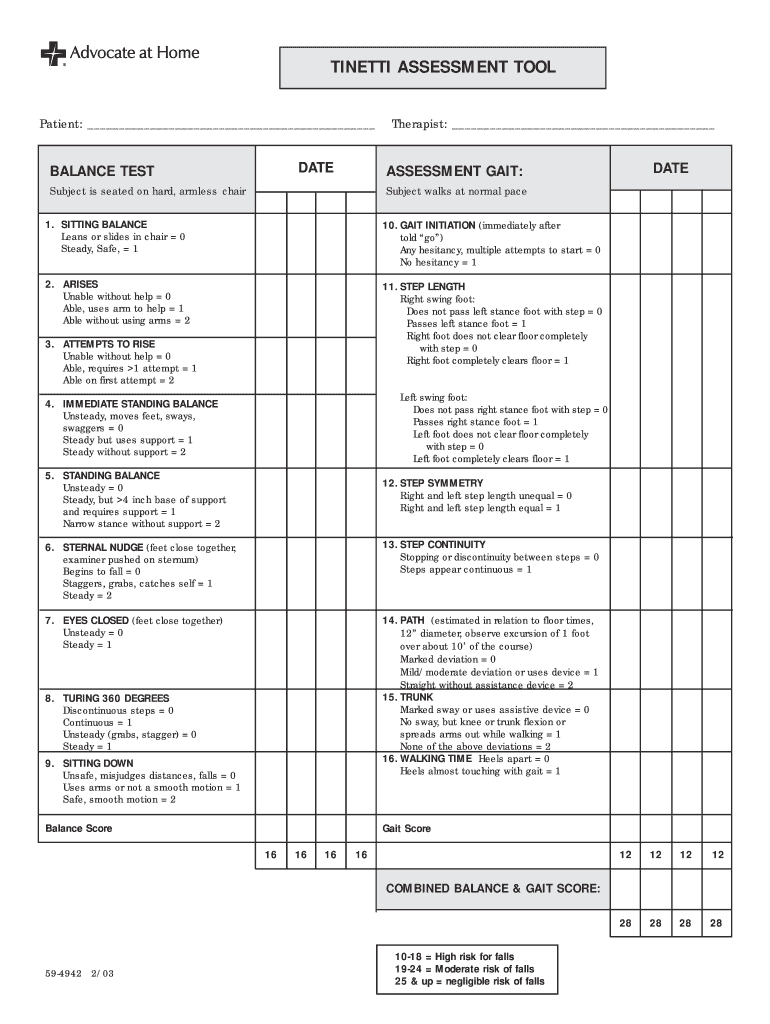







Overview of the Tinetti Test
The Tinetti test is a widely recognized assessment tool that evaluates an individual's balance and gait. Primarily utilized in healthcare settings, it helps in identifying those at risk for falls, thereby enabling appropriate interventions to prevent such incidents. This assessment is particularly useful for older adults and those with mobility issues.
Components of the Tinetti Assessment
The Tinetti assessment consists of two main sections: the Balance section and the Gait section. Each part evaluates different aspects of mobility.
Balance Assessment
The balance portion examines stability in various positions. Key tests include:
- Sitting Balance: Evaluates the ability to maintain a seated position with minimal support.
- Standing Balance: Assesses stability when standing, including the ability to regain balance after being nudged.
- Transitions: Observes the ability to move from sitting to standing and vice versa, which is critical for overall mobility.
Gait Assessment
The gait section assesses walking efficiency and safety. Critical components include:
- Gait initiation: Measures the ability to start walking from a standing position.
- Step length and symmetry: Evaluates the distance and uniformity of steps taken.
- Continuity: Determines whether walking has smoothness and consistency.
Scoring the Tinetti Test
Scoring for the Tinetti test is broken down by the components assessed. Each section has specific criteria that correspond to points:
- Balance is scored out of 16 points.
- Gait is scored out of 12 points.
The total possible score is 28, which corresponds to fall risk levels. Higher scores indicate better balance and gait stability, whereas lower scores highlight a higher risk of falls.
Risk Interpretation
- High risk: Scores of 18 or lower.
- Moderate risk: Scores between 19 and 24.
- Low risk: Scores of 25 and above.
These classifications help healthcare professionals in developing tailored interventions for patients.
Application of the Tinetti Test in Clinical Practice
The Tinetti test is utilized across various clinical settings, including:
- Rehabilitation centers: To monitor progress and adjust therapeutic approaches.
- Nursing homes: For routine assessments to ensure resident safety.
- Home healthcare: To guide caregivers in assisting clients effectively.
Its structured format provides valuable insights that inform individual care plans and enable targeted strategies to enhance mobility.
Benefits of Using the Tinetti Test
Utilizing the Tinetti assessment tool offers numerous benefits:
- Standardization: Provides a reliable method for evaluating balance and gait across diverse populations.
- Early Intervention: Identifies individuals at risk, allowing preventative measures to be implemented.
- Comprehensive Insights: Assists healthcare providers in understanding specific mobility challenges faced by patients.
The inclusion of this assessment in routine evaluations fosters a proactive approach to patient care.
Limitations of the Tinetti Test
While the Tinetti test is an effective assessment tool, there are certain limitations:
- Cultural variations: Different populations may exhibit distinct walking patterns or balance abilities that are not accurately captured.
- Environmental factors: The test is usually conducted indoors, which may not reflect the challenges faced in various settings.
- Physical conditions: Temporary ailments or injuries may skew results and do not represent a person's typical balance capabilities.
Understanding these limitations helps practitioners interpret results with appropriate context.
Future Directions for the Tinetti Test
Continued research is necessary to enhance the efficacy of the Tinetti assessment. Potential areas of development include:
- Digital adaptations: Creating mobile applications for more accessible scoring methods.
- Tailoring for specific populations: Developing modified assessments for specific age groups or conditions.
- Integration with technology: Utilizing wearable devices to gather real-time balance and gait data.
These advancements could significantly improve the assessment’s utility in preventative healthcare and fall risk reduction strategies.




