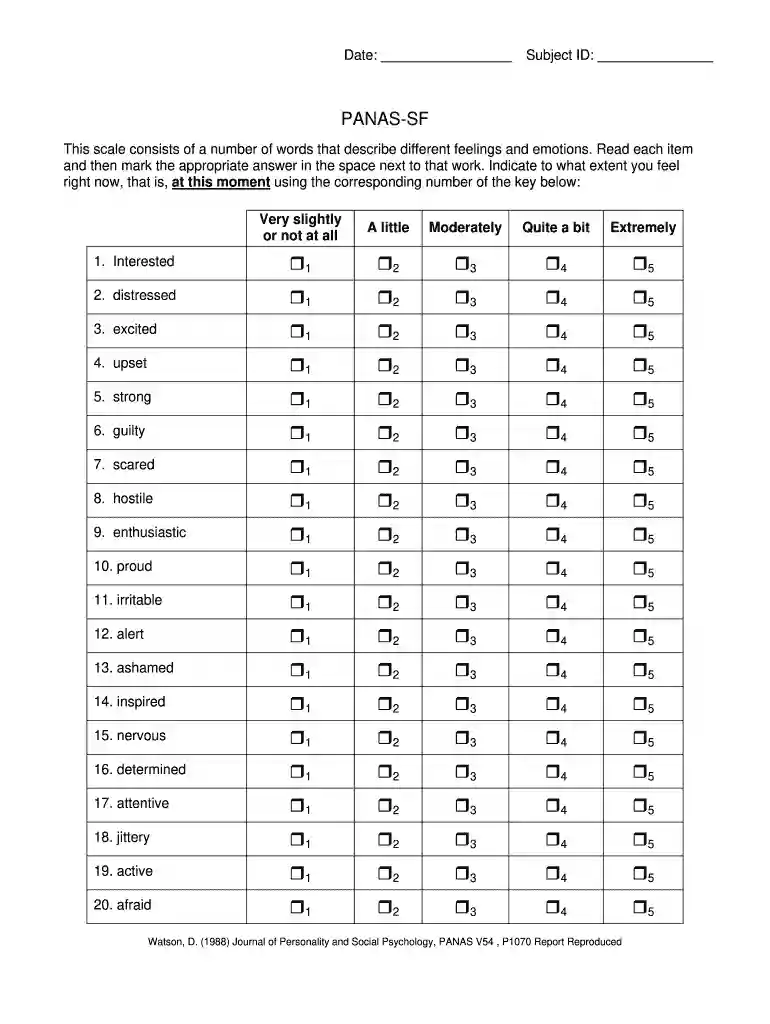
Panas 2026

Get Form
panas Preview on Page 1

Here's how it works

01. Edit your panas online
Type text, add images, blackout confidential details, add comments, highlights and more.

02. Sign it in a few clicks
Draw your signature, type it, upload its image, or use your mobile device as a signature pad.

03. Share your form with others
Send panas test via email, link, or fax. You can also download it, export it or print it out.

Definition and Meaning of PANAS

The PANAS, or Positive and Negative Affect Schedule, is a widely-used psychological assessment tool designed to measure positive and negative emotions. It consists of a list of adjectives that describe various feelings and states of mind, such as "excited," "irritable," or "enthusiastic." Respondents express the extent to which they have felt each emotion over a specified timeframe, typically using a Likert scale ranging from "very slightly or not at all" to "extremely." This instrument is valuable in both clinical and research settings to assess emotional responses and psychological well-being.

Importance of the PANAS

Understanding emotions through the PANAS is critical for several reasons:

  • Monitoring Mental Health: Regularly assessing emotional states can help identify mood disorders, anxiety, or depression.
  • Research Applications: Researchers utilize the PANAS in studies examining the relationship between emotions and various psychological or physiological conditions.
  • Therapeutic Use: Therapists and counselors may use it to track a client’s emotional changes over time, helping guide treatment.

How to Use the PANAS

Using the PANAS involves a straightforward process, typically administered through paper forms or digital platforms. The user first completes the questionnaire by indicating their feelings in relation to the adjectives provided. Here’s a step-by-step guide:

  1. Choose a Time Frame: Respondents typically reflect on their feelings over the past week or month.
  2. Rate Emotions: For each adjective, indicate the level of feeling experienced using the specified scale.
  3. Summarize Results: Total the scores for positive and negative emotions, which can then be analyzed for broader emotional trends.

Practical Considerations

  • Setting: To ensure accurate results, use the PANAS in a comfortable setting where respondents feel at ease to reflect on their emotions.
  • Confidentiality: Ensure all responses are kept confidential, especially when used in therapeutic settings.

Important Terms Related to PANAS

Several terms are essential to understanding and effectively using the PANAS:

  • Affect: The experience of feeling or emotion, divided into positive (pleasant) and negative (unpleasant) categories.
  • Likert Scale: A common rating scale that measures attitudes by asking how much respondents agree or disagree with a particular statement.
  • Psychometrics: The field of study concerned with the theory and technique of psychological measurement.

Steps to Complete the PANAS

To accurately complete the PANAS, follow these steps:

  1. Preparation: Find a quiet space where you can concentrate on your feelings without interruption.
  2. Review the Adjectives: Familiarize yourself with the list of adjectives provided in the PANAS.
  3. Reflect: Think about your emotional states over the specified time frame.
  4. Rate Each Emotion: Use the scale to assign a value that reflects your feelings for each adjective.
  5. Review Your Responses: Double-check your ratings for consistency and completeness.

Example of Completion

For instance, if you felt "energetic" or "happy" frequently, you might rate these items close to the higher end of the scale, reflecting strong positive emotions. Conversely, if you experienced stress or sadness occasionally, these might receive lower ratings.

Who Typically Uses the PANAS

The PANAS is employed by a diverse array of individuals and professionals, including:

  • Psychologists and Counselors: Used in therapy sessions to evaluate emotional well-being.
  • Researchers: Applied in studies to understand the interplay between emotions and behavior.
  • Healthcare Providers: Used to assess patient mood pre- and post-treatment for various health conditions.
  • Educational Institutions: Administered in schools to gauge student well-being and develop intervention strategies.
decoration image ratings of Dochub

Legal Use of the PANAS

The PANAS serves a legitimate purpose in psychological evaluations and research, as it is a validated tool recognized by the psychological community. However, its use must adhere to ethical standards, including:

  • Informed Consent: Participants must be informed about the use of their data.
  • Confidentiality: Results should be handled in compliance with data protection laws to protect participant identities.

Ethical Considerations

Employing the PANAS requires respect for individuals' privacy and the thoughtful interpretation of results. Practitioners should aim to debrief participants if applicable, explaining how to interpret their scores and any potential next steps in their emotional journey.

Versions or Alternatives to the PANAS

While the PANAS is highly regarded, several other scales measure similar emotional constructs, including:

  • ARI (Affect Regulation Inventory): Focuses on individuals' ability to regulate emotions.
  • Rosenberg Self-Esteem Scale: Assesses self-esteem but indirectly relates to emotional states.
  • Profile of Mood States (POMS): Measures transient mood states across various dimensions.

Comparison with PANAS

Each of these alternatives varies in focus and depth compared to the PANAS, with the latter emphasizing a dichotomy of positive and negative affects. Depending on the specific requirements of a study or therapeutic process, one might be more suitable than the other.

Key Elements of the PANAS

A comprehensive understanding of the PANAS involves its essential components, which include:

  • Adjective List: The core part of the PANAS that allows participants to rate their feelings.
  • Affective Dimensions: The differentiation between positive and negative affects provides a broad overview of emotional health.
  • Scoring System: Detailed methods for accurate scoring ensure reliable interpretation of results.

The PANAS represents a valuable tool in the exploration of emotional landscapes, bridging psychological theory with practical applications in various settings.

be ready to get more

Complete this form in 5 minutes or less

Get form

Got questions?

We have answers to the most popular questions from our customers. If you can't find an answer to your question, please contact us.
Contact us
Pana can be very friendly as in mi pana meaning good friend.
(= compaero) pal (informal) ⧫ buddy (esp US) Collins Spanish-English Dictionary by HarperCollins Publishers.
Definition. The Positive and Negative Affect Schedule (PANAS) (Watson, Clark, Tellegen, 1988) is one of the most widely used scales to measure mood or emotion.
Friend / Buddy (pana is also a name for breadfruit in Puerto Rico) From partner.
The Positive and Negative Affect Schedule or (PANAS) is a scale that consists of different words that describe feelings and emotions.
be ready to get more

Complete this form in 5 minutes or less

Get form