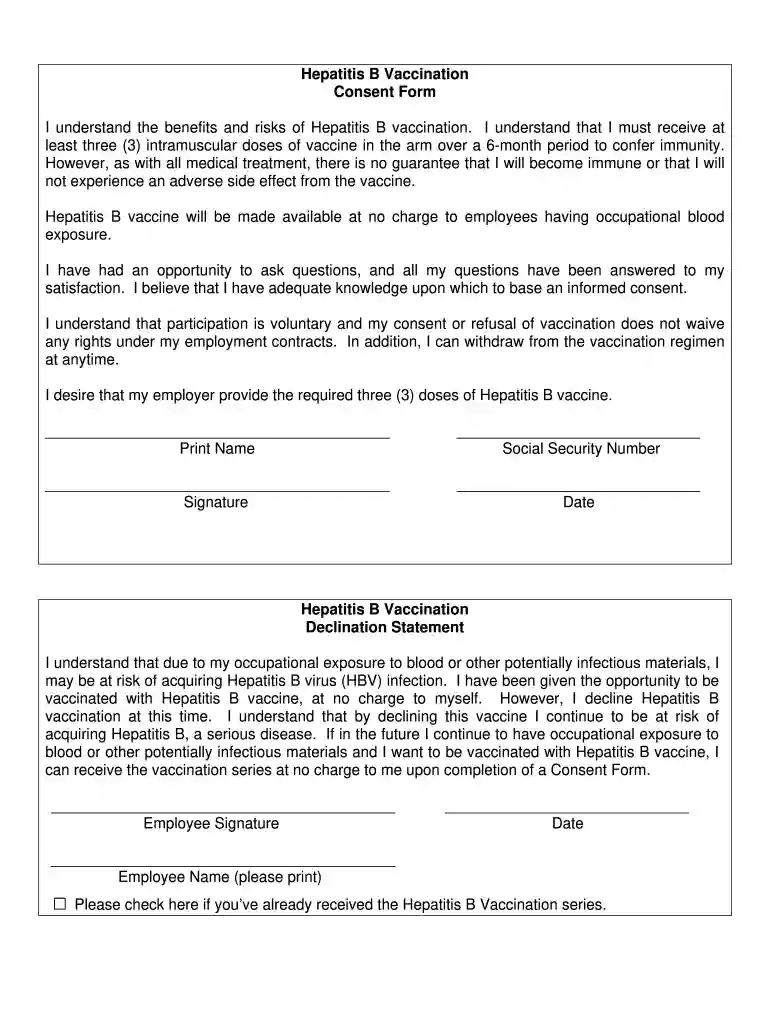
Hepatitis b vaccine documentation form 2026

Get Form
hepatitis b form for employees Preview on Page 1

Here's how it works

01. Edit your hepatitis b form for employees online
Type text, add images, blackout confidential details, add comments, highlights and more.

02. Sign it in a few clicks
Draw your signature, type it, upload its image, or use your mobile device as a signature pad.

03. Share your form with others
Send hepatitis b form via email, link, or fax. You can also download it, export it or print it out.

Understanding the Hepatitis B Vaccine Documentation Form

The hepatitis B vaccine documentation form is pivotal for ensuring that employees receive the necessary vaccinations to protect against hepatitis B, particularly for those at risk due to occupational blood exposure. This form not only serves as a record of vaccination but also outlines important information regarding consent and the rights of employees concerning the vaccine.

Purpose and Importance of the Document

The primary purpose of the hepatitis B vaccine documentation form is to facilitate informed consent for individuals receiving the vaccine. Key components of the form typically include:

  • Benefits and Risks: The document details potential advantages of vaccination, such as reduced risk of hepatitis B infection, and may also mention potential side effects, fostering informed decision-making.
  • Employee Eligibility: It specifies who is eligible for the vaccine at no cost, commonly targeting employees in healthcare or similar fields where exposure to blood is a risk.
  • Informed Consent: The form underscores that participation is voluntary. Employees must acknowledge understanding their right to refuse the vaccine without penalties.

This ensures that all parties involved understand their involvement and the implications tied to vaccination.

Components of the Hepatitis B Vaccine Form

A well-structured hepatitis B vaccine documentation form generally includes several critical sections. Each component plays a vital role in ensuring clarity and compliance with health regulations.

  • Patient Information: Basic details such as name, contact information, and job title help identify the individual receiving the vaccine.
  • Vaccine Administration Details: This section notes when and where the vaccine was administered, creating a reliable record for future reference.
  • Signature and Acknowledgment: Space for the signature of both the recipient and the administering healthcare professional validates that the process has taken place and confirms understanding of the vaccine’s purpose.

How to Complete the Hepatitis B Vaccine Documentation Form

Completing the hepatitis B vaccine documentation form requires careful attention to detail. The process typically involves the following steps:

  1. Fill Out Employee Information: Provide all necessary identifying information accurately.
  2. Record Vaccine Administration: Enter specific dates for each of the three doses, if applicable, and the name of the healthcare provider administering the vaccine.
  3. Sign and Acknowledge: Both the employee and the administering party should sign the form, confirming that the vaccine has been received and that the implications and benefits have been discussed.

Keeping this documentation accurate is critical for compliance with workplace health regulations.

Declination and Rights of Employees

The hepatitis B vaccine documentation form also contains a declination option for employees who choose not to receive the vaccine. Important aspects of this section include:

  • Acknowledgment of Risk: Employees who decline the vaccine must acknowledge that they understand the risks associated with hepatitis B exposure.
  • Voluntary Participation: The form clearly states that opting out is voluntary, ensuring that employees do not face repercussions for their decision.
  • Right to Revoke: Employees have the right to change their minds about vaccination in the future, which should also be communicated clearly.

This section protects both the employer and the employee by ensuring informed choices are made.

Compliance and Record Keeping

Finally, maintaining accurate records of hepatitis B vaccinations is vital for workplace safety and compliance with OSHA regulations. An employer must keep the following:

  • Vaccination Records: All completed documentation must be stored securely to prove compliance with health and safety laws.
  • Audit Trails: In the event of an inspection, having documented evidence can substantiate that proper procedures were followed regarding employee vaccinations.

Employers should regularly review and update their records to reflect any new vaccinations or declinations among staff.

Conclusion

The hepatitis B vaccine documentation form is essential for managing employee health in workplaces that may expose staff to bloodborne pathogens. By understanding its components, ensuring accurate completion, and maintaining thorough records, employers can support both compliance with regulatory requirements and the overall health of their workforce.

See more hepatitis b vaccine documentation form versions

We've got more versions of the hepatitis b vaccine documentation form form. Select the right hepatitis b vaccine documentation form version from the list and start editing it straight away!
Versions Form popularity Fillable & printable
2007 4.9 Satisfied (62 Votes)
be ready to get more

Complete this form in 5 minutes or less

Get form

Got questions?

We have answers to the most popular questions from our customers. If you can't find an answer to your question, please contact us.
Contact us
The National Childhood Vaccine Injury Act requires that a VIS must be given to parents, legal representatives, or adult patients before administering the vaccine. A VIS must be provided prior to each dose, not just the first dose. Providers should be sure they are using the most current version of each VIS.
Immunization against hepatitis B disease is recommended for all newborn babies, infants, children, and adolescents up to 19 years of age. It is also recommended for adults who live in areas that have a high rate of hepatitis B disease or who may be at increased risk of infection from hepatitis B virus.
A record from a healthcare providers medical record system (including a patient portal) that is either a: Vaccine Administration Record from the facility where the vaccine was administered that includes the: Vaccine administered. Vaccination date.
Testing for evidence of immunity after vaccination is not routinely recommended, except those in certain groups. In those at risk of occupational exposure, particularly healthcare and laboratory workers, antibody levels should be checked one to two months after the completion of the full vaccination course.
Immunization providers are required by law to record what vaccine was given, the date the vaccine was given (month, day, year), the name of the manufacturer of the vaccine, the lot number, the signature and title of the person who gave the vaccine, and the address where the vaccine was given.

Security and compliance

At DocHub, your data security is our priority. We follow HIPAA, SOC2, GDPR, and other standards, so you can work on your documents with confidence.

Learn more
ccpa2
pci-dss
gdpr-compliance
hipaa
soc-compliance

People also ask

By law, the following information must be documented on the patients paper or electronic medical record (or on a permanent office log): The vaccine manufacturer. The lot number of the vaccine. The date the vaccine is administered.
What information does federal law require us to document when we immunize a patient? The vaccine manufacturer. The lot number of the vaccine. The date the vaccine is administered. The name, office address, and title of the healthcare provider administering the vaccine.
For example, documentation should list all vaccine components along with a notation such as counseling for all components completed. The documentation format (eg, checkbox, handwritten, electronic template) for this service should be the same as for other services.

hep b vaccine form