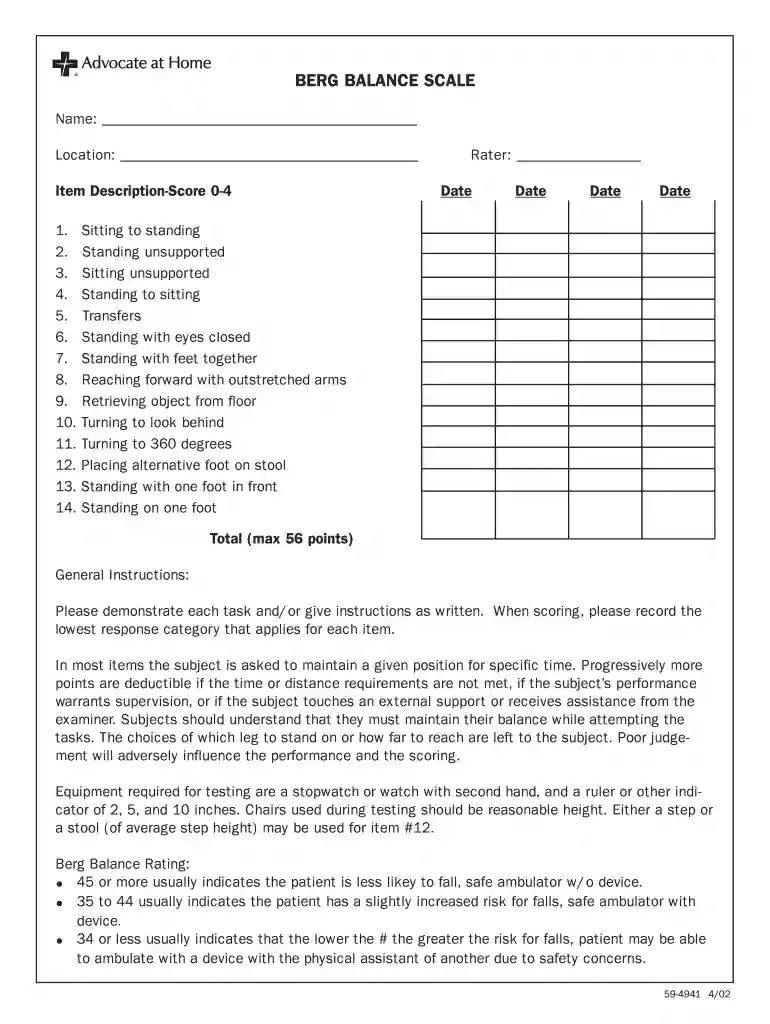
Berg balance test pdf 2026

Get Form
berg balance test pdf Preview on Page 1

Here's how it works

01. Edit your berg balance test pdf online
Type text, add images, blackout confidential details, add comments, highlights and more.

02. Sign it in a few clicks
Draw your signature, type it, upload its image, or use your mobile device as a signature pad.

03. Share your form with others
Send berg balance scale pdf via email, link, or fax. You can also download it, export it or print it out.

Definition & Meaning of the Berg Balance Test PDF

The Berg Balance Test is a widely recognized assessment tool used to measure an individual's balance and risk of falling. It consists of 14 specific tasks that evaluate various aspects of balance through functional movements. Each task is scored on a range from 0 to 4, culminating in a maximum score of 56 points. The scoring system categorizes individuals based on their performance, indicating the likelihood of falls and the need for assistance.

This tool is particularly relevant in rehabilitation settings, geriatric care, and physical therapy practices, where understanding a patient's balance abilities is essential for creating effective treatment plans. The Berg Balance Test PDF allows practitioners to easily share, record, and analyze patients' scores while providing vital data for tracking progress over time.

Steps to Complete the Berg Balance Test PDF

Performing the Berg Balance Test involves a series of well-defined steps to ensure accuracy and reliability in the assessment.

  1. Gather Required Equipment: Ensure you have the necessary materials, including a stopwatch, a ruler, a chair, and weights to create a standardized testing environment.
  2. Prepare the Test Environment: Select a quiet space with sufficient area for movement. Ensure there are no obstacles that might interfere with the test.
  3. Familiarize the Participant: Explain the purpose of the test to the participant and ensure they understand the tasks they will be performing.
  4. Perform Each Task: Administer each of the 14 tasks sequentially. Tasks include activities like standing up from a seated position, reaching forward while standing, and sidestepping. For each task, observe and score the individual based on their performance.
  5. Record Scores: Document the scores immediately after each task to maintain accuracy. Total the scores at the conclusion of the assessment to determine the participant's overall balance ability.

Each task is critical, as it evaluates different balance skills that contribute to fall risk. Adhering to these steps ensures that the evaluation is consistent and meaningful.

Important Terms Related to the Berg Balance Test PDF

Understanding the terminology associated with the Berg Balance Test is crucial for effective implementation and interpretation of results. Key terms include:

  • Functional Mobility: The ability to move safely from one position to another, crucial for daily activities.
  • Scoring Rubric: The framework used to interpret the scores for each task, guiding the assessment of balance capabilities and fall risk.
  • Assistive Devices: Tools like walkers, canes, or crutches that may be used by individuals to enhance their stability and mobility.
  • Fall Risk Assessment: A comprehensive evaluation that determines an individual’s likelihood of experiencing falls, factoring in balance, strength, and mobility considerations.

These definitions provide foundational knowledge for practitioners and assist in the effective use of the Berg Balance Test PDF.

Who Typically Uses the Berg Balance Test PDF

The Berg Balance Test is frequently employed by a diverse group of professionals, largely in health care and rehabilitation. Key users include:

  • Physical Therapists: They often use this test to develop individualized treatment plans and track progress for patients recovering from injury or surgery.
  • Occupational Therapists: These professionals utilize the assessment to determine the impact of balance on daily living activities and to facilitate adaptations as needed.
  • Geriatric Specialists: The test aids in identifying balance issues in older adults, helping to reduce the risk of falls that could lead to serious injuries.
  • Rehabilitation Centers: Facilities that focus on recovery for patients with neurological conditions frequently implement the Berg Balance Test to evaluate and monitor patients' balance.

Understanding the user demographics is essential for applying the Berg Balance Test PDF effectively in various clinical settings.


decoration image ratings of Dochub

Examples of Using the Berg Balance Test PDF

Practical applications of the Berg Balance Test PDF illustrate its significance in real-world scenarios. Some examples include:

  • Geriatric Assessments: Conducting the test in senior living facilities to identify residents at risk for falls, enabling targeted interventions.
  • Post-Stroke Rehabilitation: Utilizing the test to establish baseline balance capabilities after a stroke, guiding rehabilitation efforts aimed at improving mobility.
  • Sports Injury Recovery: Athletes returning from injuries can undergo the assessment periodically to monitor balance improvements and readiness to resume full activity.

These examples demonstrate the versatility of the Berg Balance Test PDF and its critical role in various rehabilitation environments.

See more berg balance test pdf versions

We've got more versions of the berg balance test pdf form. Select the right berg balance test pdf version from the list and start editing it straight away!
Versions Form popularity Fillable & printable
2002 4.8 Satisfied (142 Votes)
be ready to get more

Complete this form in 5 minutes or less

Get form

Got questions?

We have answers to the most popular questions from our customers. If you can't find an answer to your question, please contact us.
Contact us

Yes, a typed name is recognized as a valid electronic signature when you create it on your form utilizing a compliant solution like DocHub. Simply add your berg balance calculator to our editor, click Sign in the top tool pane → Create your signature → Type your name in the proper tab, and choose how it will appear on your document.

If you choose analog methods of completing your berg balance test calculator, you can easily download your file for printing. Search DocHub’s Forms & Templates catalog to find the exact file template you need and open it for editing or download it on your device in the format of your liking. It is easy to complete your form electronically and put your handwritten signature on it after printing or eSign your file with DocHub.

1:21 4:12 Berg Balance Test - YouTube YouTube Start of suggested clip End of suggested clip Place your feet together. And stand without holding measure eight reaching forward with outstretchedMorePlace your feet together. And stand without holding measure eight reaching forward with outstretched arm. While standing lift arm to 90 degrees stretch. Out your fingers.
The 14 tasks each come with specific instructions on how to perform. For example, when testing the standing unsupported with eyes close, the instructions are to \u201cto close your eyes and stand still for 10 seconds".
Purpose. The Berg Balance Scale (BBS) is a 14-item objective measure that assesses static balance and fall risk in adults.

Security and compliance

At DocHub, your data security is our priority. We follow HIPAA, SOC2, GDPR, and other standards, so you can work on your documents with confidence.

Learn more
ccpa2
pci-dss
gdpr-compliance
hipaa
soc-compliance

People also ask

A score of 0 represents an inability to complete the item, and a score of 56 represents the ability to independently complete the item. 0-20 on the BBS represents balance impairment; 21-40 on the BBS represents acceptable balance; 41-56 on the BBS represents good balance.
A score of 56 indicates functional balance. A score of < 45 indicates individuals may be at greater risk of falling.
The Berg Balance Scale (BBS) is a valid, efficient measure of postural balance in the geriatric population. A study assessed functional independence, motor performance, and balance regularly over a 9-month period in 113 elderly residents.
It is a 14 item list with each item consisting of a five-point ordinal scale ranging from 0 to 4, with 0 indicating the lowest level of function and 4 the highest level of function and takes approximately 20 minutes to complete.
Test Your Balance With Balance Tests Have you ever taken a step on a slippery patch of ice or uneven snow and almost lost your balance? Stand with your feet touching side by side and close your eyes: You should be able to stand for > 30 seconds without swaying or losing your balance.

berg pdf