Lead Consumer Notice CWS TCEQ Form 20680a - tceq texas 2026

Get Form
cws form Preview on Page 1

Here's how it works

01. Edit your cws form online
Type text, add images, blackout confidential details, add comments, highlights and more.

02. Sign it in a few clicks
Draw your signature, type it, upload its image, or use your mobile device as a signature pad.

03. Share your form with others
Send tceq 290 via email, link, or fax. You can also download it, export it or print it out.

How to use or fill out Lead Consumer Notice CWS TCEQ Form 20680a - tceq texas with our platform

Form edit decoration
9.5
Ease of Setup
DocHub User Ratings on G2
9.0
Ease of Use
DocHub User Ratings on G2
  1. Click ‘Get Form’ to open the Lead Consumer Notice CWS TCEQ Form 20680a in the editor.
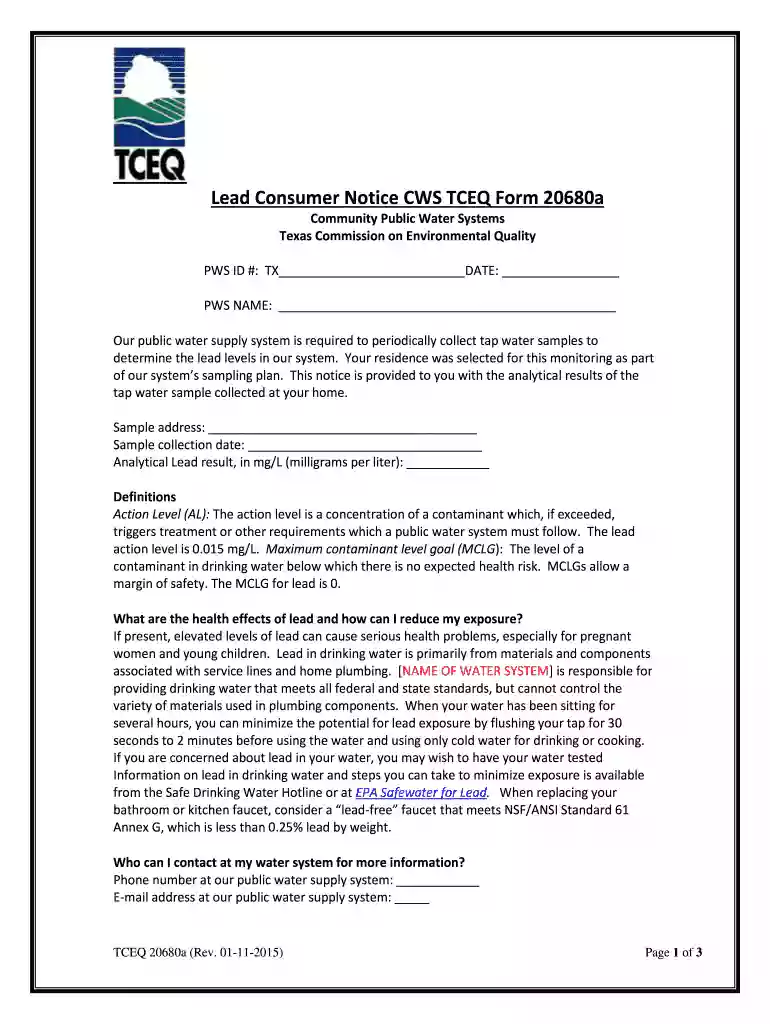
  2. Begin by entering your PWS ID number and the date at the top of the form. This information is crucial for identifying your public water system.
  3. Fill in the PWS name and sample address where the tap water was tested. Ensure accuracy as this information is vital for compliance.
  4. Record the sample collection date and analytical lead result in mg/L. This data reflects the lead levels detected during testing.
  5. Provide contact information for your water system, including a phone number and email address, ensuring residents can reach out for further inquiries.
  6. Complete the certification section by filling in monitoring period details, dates results were received, and when they were provided to customers.
  7. Review all entries for accuracy before saving or exporting your completed form. Utilize our platform’s features to sign and distribute it efficiently.

Start using our platform today to easily complete and manage your Lead Consumer Notice!

See more Lead Consumer Notice CWS TCEQ Form 20680a - tceq texas versions

We've got more versions of the Lead Consumer Notice CWS TCEQ Form 20680a - tceq texas form. Select the right Lead Consumer Notice CWS TCEQ Form 20680a - tceq texas version from the list and start editing it straight away!
Versions Form popularity Fillable & printable
2017 4.8 Satisfied (210 Votes)
2015 4.1 Satisfied (31 Votes)
be ready to get more

Complete this form in 5 minutes or less

Get form

Got questions?

We have answers to the most popular questions from our customers. If you can't find an answer to your question, please contact us.
Contact us
Multiply the number of samples taken by 0.9; the resultant number correlates to the lead or copper value that represents the 90th percentile (EX: if you collect 60 samples, the value of lead or copper of the 54th sample is the 90th percentile. 60 x 0.9 = 54).
The action level is exceeded if the 90th percentile lead level exceeds 0.015 mg/L in any monitoring period. The 90th percentile lead level is exceeded when more than 10% of tap water samples have a concentration over the action level. (B) Copper action level. The copper action level is 1.3 mg/L.
The Lead and Copper Rule (LCR) protects public health by minimizing lead and copper levels in drinking water, primarily by reducing corrosion of plumbing materials. This rule applies to all community water systems (CWSs) and non-transient non-community water systems (NTNCs).
CCT can come in many forms: Ⅰ Modification of drinking water chemistry (such as pH and hardness) to prevent the potential for corrosion. Ⅰ Addition of chemicals (such as orthophosphates) to form a barrier between the pipes and the drinking water to prevent leaching of lead and copper.
The Texas Commission on Environmental Quality is the environmental agency for the state.

Security and compliance

At DocHub, your data security is our priority. We follow HIPAA, SOC2, GDPR, and other standards, so you can work on your documents with confidence.

Learn more
ccpa2
pci-dss
gdpr-compliance
hipaa
soc-compliance
be ready to get more

Complete this form in 5 minutes or less

Get form

People also ask

The EPA Lead and Copper Rule has set drinking water standards with two levels of protection [EPA 1991; EPA 2000b]. Action levels for lead of 15 ppb and copper of 1.3 ppm in more than 10% of customer taps sampled. An action level is the level for enforcement. The maximum contaminant level goal (MCLG) is zero.
The purpose of the federal Lead and Copper Rule (LCR), Revisions (LCRR), and Improvements (LCRI) is to protect public health by reducing lead and copper levels in drinking water. Lead and copper can enter drinking water through disturbance or corrosion of lead and copper plumbing materials.
Below is a listing of reports the TCEQ is required to submit to the Texas Legislature and other officials in state government.

tceq form 20683