Type text, add images, blackout confidential details, add comments, highlights and more.
02. Sign it in a few clicks
Draw your signature, type it, upload its image, or use your mobile device as a signature pad.
03. Share your form with others
Send it via email, link, or fax. You can also download it, export it or print it out.
How to use or fill out QUESTIONNAIRE (IFQ) with our platform
Ease of Setup
DocHub User Ratings on G2
Ease of Use
DocHub User Ratings on G2
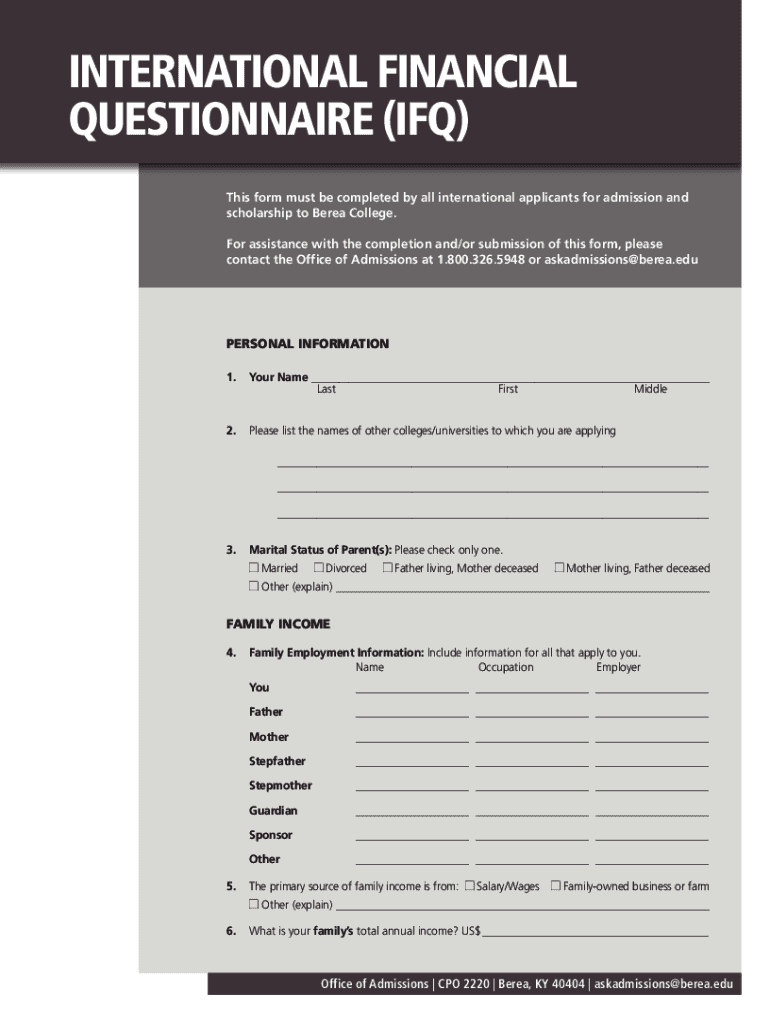
Click ‘Get Form’ to open the QUESTIONNAIRE (IFQ) in the editor.
Begin by filling out your personal information. Enter your full name, including last, first, and middle names. Then, list any other colleges or universities you are applying to.
Indicate the marital status of your parents by checking the appropriate box. This section helps provide context for your family background.
In the Family Income section, provide details about family employment. Fill in the names, occupations, and employers for each family member applicable.
Complete the Family Assets section by answering whether your family owns a house and providing relevant financial details if applicable.
List all persons living in your home and their relationships to you in the Family Expenses section. This information is crucial for understanding household dynamics.
Finally, review all entries for accuracy before signing at the end of the form. Ensure that all signatures are provided where required.
Start filling out your QUESTIONNAIRE (IFQ) today on our platform for free!
We've got more versions of the QUESTIONNAIRE (IFQ) form. Select the right QUESTIONNAIRE (IFQ) version from the list and start editing it straight away!
NHANES 2019-2020 Infant Formula Questionnaire (IFQ)
INFANT FORMULA QUESTIONNAIRE IFQ. Target Group: SPs Birth to 24 Months. BOX 1. IF SP 24 MONTHS, GO TO THE END OF THE SECTION. IF DBQ050 = MISSING, GO TORead more
Cookie consent notice
This site uses cookies to enhance site navigation and personalize your experience.
By using this site you agree to our use of cookies as described in our Privacy Notice.
You can modify your selections by visiting our Cookie and Advertising Notice.